
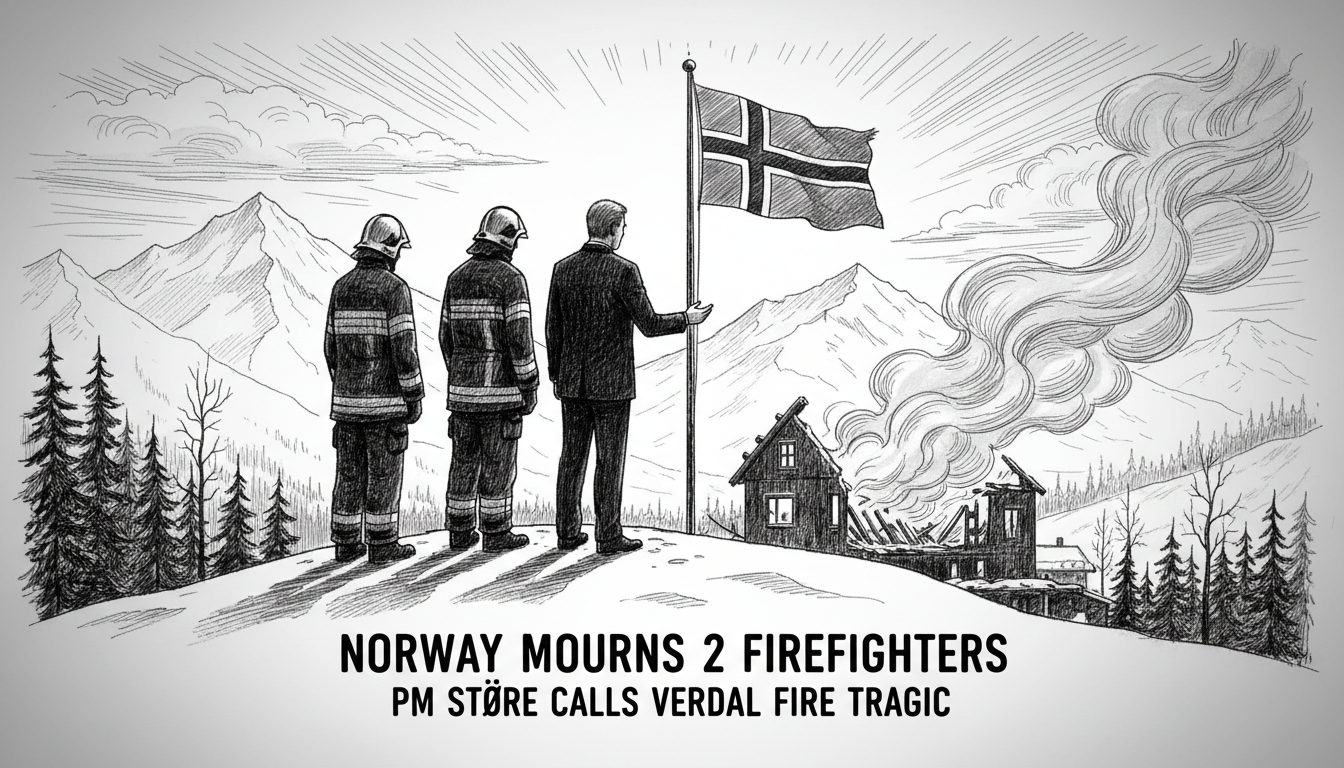
Norway is mourning two firefighters missing and presumed dead after a house fire in Verdal. Prime Minister Jonas Gahr Støre called the news tragic, highlighting the inherent dangers faced by first responders who work for public safety. The incident occurred overnight in the Trøndelag county municipality, casting a pall over the nation's emergency services community.
"This is tragic news, and it reminds us that there are people out there going to work that is dangerous, for your and my safety," Støre told reporters. The Prime Minister, who leads the Labour Party (Ap) coalition government, directly addressed the profound impact on those closest to the responders. "This affects family and colleagues deeply, people who are committed to saving us when there is danger," he said.
A Community and a Nation in Mourning
The loss strikes at the heart of Norway's closely-knit professional and volunteer fire services. Verdal, a municipality of approximately 15,000 people located along the Trondheimsfjord, represents the kind of community where first responders are often neighbors and friends. The specific circumstances leading to the firefighters becoming missing during the firefighting operation are under investigation by local police and fire authorities. Such line-of-duty deaths are relatively rare in Norway, which invests heavily in training and equipment, making each incident a profound national event.
Støre's immediate and empathetic response is a required function of his office, but it also reflects the social democratic values of his Labour Party. The party has long championed robust public services and the welfare of workers, including those in high-risk professions. "We must give thanks that we have these people," Støre stated. "They are well-trained, but it is dangerous to enter a house in full flame." His comments serve both as a tribute and a stark reminder that no amount of preparation can eliminate all risk.
The Inherent Risks Behind the Safety
Norway consistently ranks as one of the world's safest countries, with a high level of public trust in its institutions. This safety is underpinned by the work of personnel who routinely face hazardous situations. Firefighters in Norway, whether full-time professionals or dedicated volunteers, undergo rigorous training. Their tasks range from battling structure fires in wooden homes to handling complex industrial blazes at oil and gas facilities, and responding to vehicle accidents on treacherous winter roads.
Experts in emergency response note that structure fires, particularly in residential buildings, present unpredictable dangers. "Flashovers, backdrafts, and sudden structural collapse are constant threats," explains Lars Holt, a former fire chief and now a safety consultant. "The environment changes in seconds. Training mitigates the risk, but the bravery lies in entering that unpredictable space when others are fleeing." The psychological toll on crews involved in such incidents, and the need for immediate and long-term critical incident stress support, becomes a paramount concern for departments in the aftermath.
Political Leadership in Moments of Crisis
For Prime Minister Støre, responding to national tragedies is a critical aspect of the premiership. His statement from the government quarter in Oslo frames the loss within the broader context of societal duty and collective gratitude. It is a moment of non-political leadership, aiming to unify the country in recognition of service and sacrifice. Political analysts observe that such responses are closely watched for their tone and substance.
"In Norway, there is a deep-seated expectation that the Prime Minister acts as a unifying figure during a crisis, especially one involving public servants," says political scientist Anette Flem. "Støre's background in foreign affairs and crisis management shapes his response—it is measured, acknowledges the human cost, and directs thanks to the broader services. It reinforces the social contract between the state and those who protect it." The government's attention will now also turn to ensuring that investigation processes are supported and that families receive the full backing of the state's welfare apparatus.
The Road Ahead for Verdal and the Services
The immediate focus in Verdal remains on supporting the families of the missing firefighters and their colleagues. The local fire station will be a center of grief and solidarity, a scene repeated in communities across Norway whenever a first responder falls. Memorials of flowers and candles are likely to appear, spontaneous gestures from a public acutely aware of the debt owed.
In the coming weeks, official investigations will seek to determine the precise sequence of events. The goal will be to understand what occurred to improve future safety protocols. This process is standard but takes on immense weight following a fatal outcome. The findings may influence training procedures or equipment standards nationwide, as the fire services continuously adapt to new knowledge.
For the Støre government, the tragedy reinforces ongoing discussions about resource allocation for emergency services, particularly in rural and semi-rural areas like Trøndelag. While not directly linked to this event, debates about staffing levels, equipment modernization, and the balance between professional and volunteer forces are perennial in municipal and national politics. This incident will likely bring renewed gravity to those conversations.
A Reminder of the Human Foundation
The ultimate toll of the Verdal fire is measured in two lives lost, families shattered, and a community scarred. Norway's reputation for safety and order can sometimes obscure the simple, human bravery that maintains it. Individuals go to work in dangerous conditions, relying on skill, teamwork, and courage to manage the unmanageable.
Prime Minister Støre's somber remarks ultimately point to this fundamental truth. The tragedy is not just a statistical rarity or a procedural failure; it is a human story of sacrifice. It prompts a national moment of reflection on who bears risk for the common good. As the people of Verdal and the Norwegian fire services begin to process their grief, the rest of the nation is reminded that safety is not an abstract concept—it is provided by people, with all the vulnerability that entails. How does a society truly honor that debt beyond words of gratitude?