
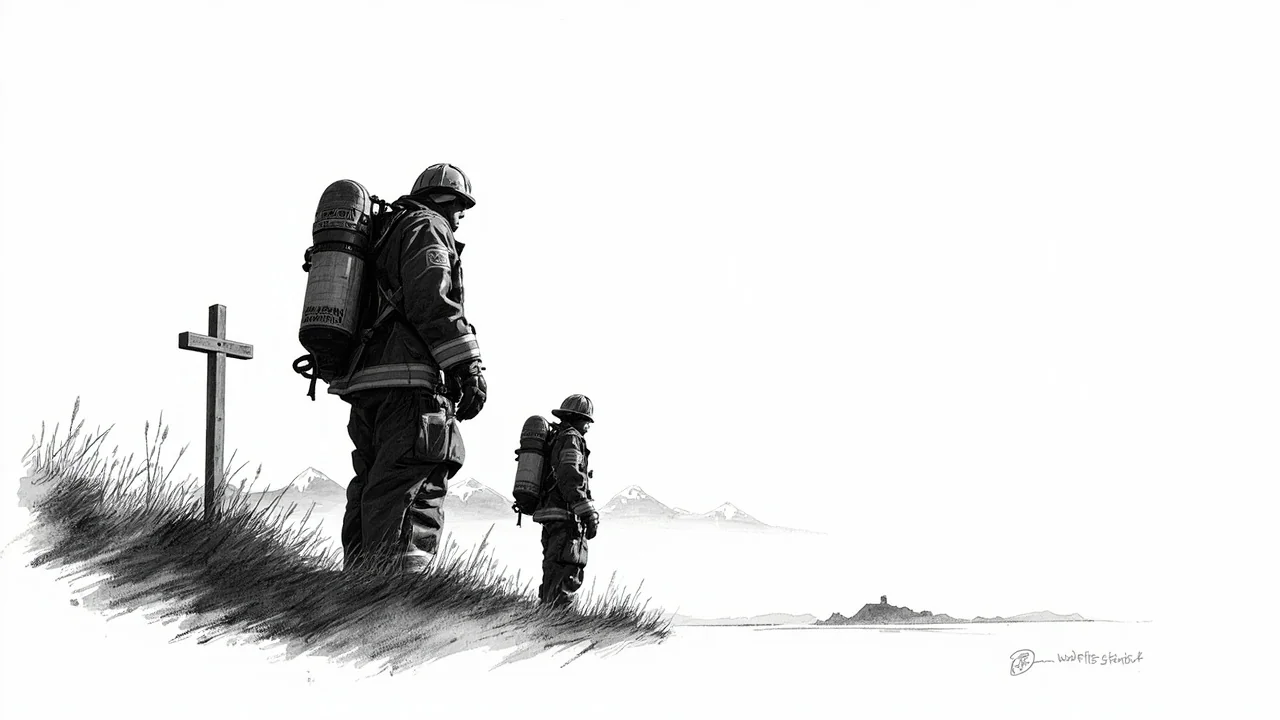
Norway's tight-knit emergency service community is grieving the loss of two firefighters. Geir Otto Lein Johnson, 58, and Roger Kvello Hansen, 51, died responding to a house fire in Verdal in early January.
A Craftsman's Calling
Atle Aune remembers his longtime friend and business partner with a mixture of pride and profound sadness. The two men opened "Snekkeriet" (The Carpenter's Shop) together in 2001. They built the company from the ground up. Johnson was a third-generation staircase carpenter. His grandfather's axe still hangs above the staircase in their workshop. "He was a funny guy, but also very serious in his work," Aune recalled. "A real model soldier. Conscientious, so there was never an email that wasn't answered the same day."
Their working days were long but filled with camaraderie. They joked that they spent more time together than with their own families. For years, Johnson balanced his meticulous craft with another calling. He trained to become a firefighter and smoke diver. He juggled building staircases with responding to emergencies. Aune believes this dual path was no accident. "He really loved to understand things and be in control," Aune said. "All the pumps and machines, the big truck and all the equipment. I think it was a little boy's dream."
A Cruel Irony
In 2010, Johnson experienced the danger of his volunteer work from the other side. He was on fire watch when the alarm sounded. He rushed to the fire truck as he had done countless times before. He initially thought the fire was in a neighboring building. He arrived to find his own workplace, the Snekkeriet he helped build, engulfed in flames. The business burned completely to the ground that October day. The experience of losing his own workshop to a fire did not deter him. He continued serving as a firefighter, demonstrating a deep commitment to his community.
Johnson had stepped back from daily operations at the carpentry shop a few years ago. He remained a co-owner until last year. On the morning of the fatal fire, rumors began swirling in the small community about the identities of the two missing firefighters. By lunchtime, the devastating truth reached his old friend and partner. The man he built a business with was gone.
The Burden on Small Communities
This tragedy highlights the unique pressures on Norway's rural and semi-rural emergency services. In smaller towns like Verdal, firefighters are often volunteers or part-time professionals. They are neighbors protecting neighbors. Their deaths resonate through every layer of the community. They are not anonymous responders; they are local tradespeople, parents, and friends.
Professor Arvid Haugen, a sociologist who studies Scandinavian emergency services, explains the impact. "In a major city, a firefighter's death is a profound tragedy for the corps and the city," Haugen said. "In a small community, it is a familial loss. The firefighter who dies is also the person who fixed your stairs last month. Their children go to school with your children. The psychological and social aftermath is compounded."
Haugen points to the dual roles many hold. "These individuals often have full-time jobs as carpenters, teachers, or mechanics. They carry pagers and are expected to drop everything—their work, their family dinner—to run toward danger. Society relies on their extraordinary willingness to serve, often with less institutional support than their urban counterparts."
A Legacy of Service
The aftermath of such a loss involves both formal and informal support networks. The national firefighter's union immediately provides crisis support to the affected station and the families. Local communities, however, often create their own sustained networks of care. Meals are prepared. Childcare is organized. The mundane tasks of life are covered for the grieving families.
This community response is a testament to the deep bonds formed in small-town Norway. It also underscores the weight carried by the survivors. The remaining firefighters in Verdal must process their grief while knowing they must be ready for the next alarm. They have lost colleagues, but the duty to protect their town remains.
For Atle Aune, the loss is deeply personal and professional. He is left with memories of a dedicated craftsman and a selfless public servant. He remembers the man who loved mastering complex machinery and building beautiful, functional staircases. He remembers the partner who was always the first to arrive in the morning.
The axe of Geir Otto Lein Johnson's grandfather still hangs in the workshop. It is now a silent reminder of a legacy interrupted. It represents generations of skilled work and a life of service that ended in the line of duty. The tragedy asks a difficult question of every community that depends on volunteer responders: how do we properly honor and safeguard those who are always willing to answer the call?
The investigation into the fatal fire continues. The focus for the community, however, is on remembrance and support. The story of Geir Johnson is not just one of tragedy. It is a story of a lifelong craftsman who chose to serve. He built structures for living and repeatedly risked his life to save them.