
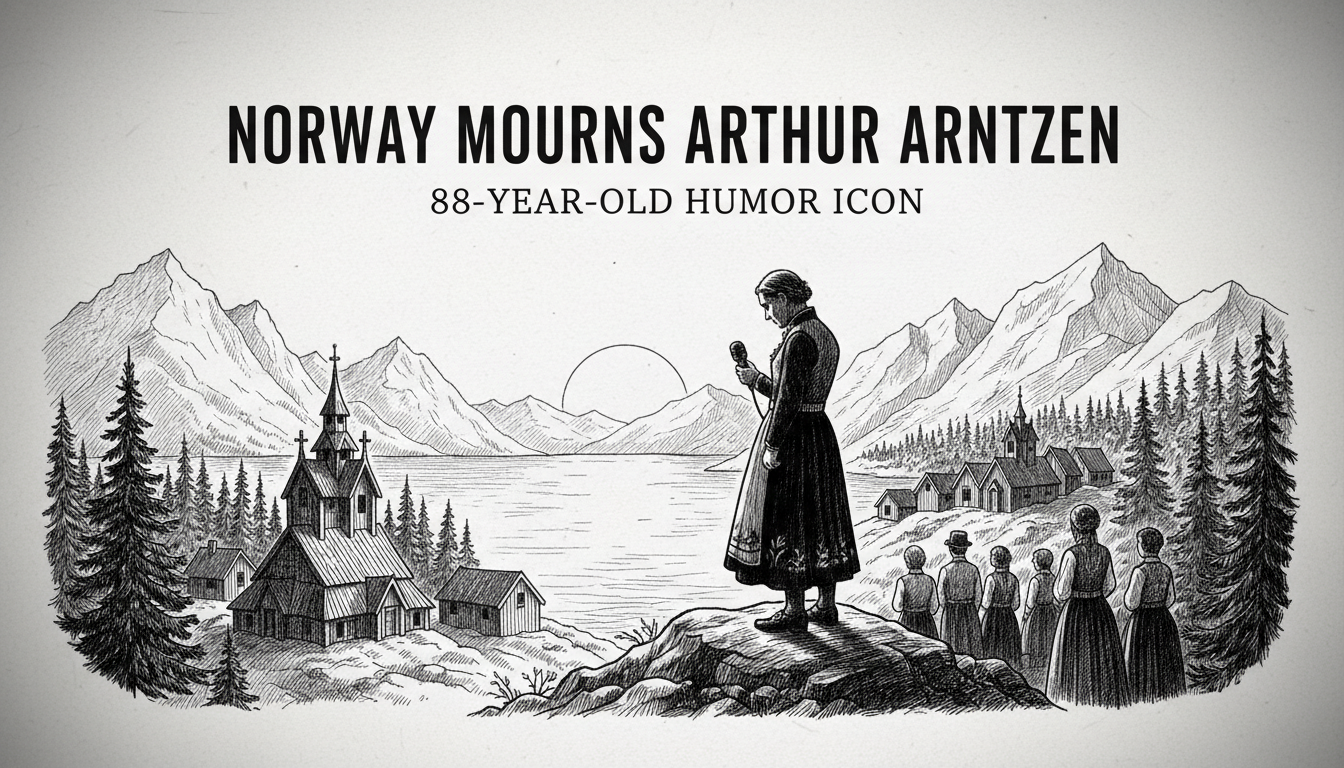
Norway's beloved humorist Arthur Arntzen, who brought the character of "Oluf" to national fame, has died at age 88. Arntzen passed away Friday morning at the Otium nursing home in Tromsø, surrounded by family, according to local reports. His death marks the end of an era for Norwegian cultural history, particularly for the distinct comedic traditions of Northern Norway.
Arntzen was a multi-talented journalist, revue artist, and author. He achieved his greatest fame through his rustic character "Oluf," instantly recognizable by his traditional fur hat, or skinnlue. For decades, Arntzen used this persona to translate the unique humor, dialect, and worldview of Norway's northern regions for a national audience. His work spanned books, records, theater stages, and television screens, making him a household name.
The Voice of the North
Arthur Arntzen's career was built on celebrating and amplifying the cultural identity of Northern Norway. This vast region, stretching from Trøndelag to the Russian border, possesses a strong sense of self shaped by Arctic landscapes, a harsh climate, and a history distinct from southern Norway. The humor here is often characterized by dry wit, understatement, and a philosophical acceptance of life's challenges—qualities Arntzen masterfully channeled through Oluf.
"He didn't just tell jokes; he gave a voice and a face to an entire region," said Professor Kari Jensen, a cultural historian at the University of Tromsø. "Before national television became ubiquitous, Norway's cultural landscape could feel very Oslo-centric. Arntzen, through Oluf, insisted that the north had something vital to contribute to the national conversation. He made it both respectable and hilarious to speak in a strong northern dialect on a national platform."
Arntzen's work served as a crucial counterbalance during Norway's rapid modernization in the post-war period. As society became more homogenized, his comedy preserved and celebrated local dialects and rural perspectives. He demonstrated that Norwegian identity was not monolithic but a collection of vibrant regional voices.
From Journalist to National Treasure
Arntzen's path to stardom was rooted in his profession as a journalist. This background informed his comedy, which often contained sharp observations about society, politics, and everyday life. He understood narrative and timing, skills he transferred seamlessly to the stage and recording studio. His revue shows were immensely popular, often selling out venues across the country as southern Norwegians flocked to experience his northern charm.
His success paved the way for other northern Norwegian artists and comedians. By proving there was a massive appetite for regionally-specific humor, he helped break down cultural barriers within Norway. Figures like the musician and comedian Halvdan Sivertsen, among others, followed in the trail he blazed.
"Arntzen was a pioneer in the truest sense," said Lars Moen, director of the Norwegian Comedy Archive. "He took a very local product—north Norwegian dialect humor—and turned it into a national export. His records sold hundreds of thousands of copies. He showed that you could be deeply local and universally relatable at the same time. That is a rare gift."
The Legacy of Oluf
The character of Oluf was more than a simple comic disguise; it was a carefully crafted vessel for Arntzen's insights. Oluf was the wise, slightly bewildered, yet eternally optimistic everyman from the north. He would comment on everything from newfangled technology to political scandals in Oslo, always from his grounded, pragmatic viewpoint. The humor was never mean-spirited but arose from the gentle clash between traditional values and a changing world.
This character resonated because it contained a kernel of truth recognizable to all Norwegians, regardless of origin. It tapped into a nostalgia for a simpler, perhaps more authentic, connection to the land and community. In a nation experiencing the immense wealth and social change brought by offshore oil, Oluf remained a constant, a reminder of roots.
Arntzen's passing coincides with ongoing national debates about centralization, the depopulation of rural districts, and the preservation of dialects. His life's work stands as a monumental argument for the value of regional diversity. He didn't just entertain; he fostered a greater understanding between different parts of the country.
A Cultural Bridge Now Gone
The Otium bo- og velferdssenter, where Arntzen spent his final days, is located in Tromsø, the unofficial capital of Northern Norway. It is fitting that he remained in the region he loved and championed throughout his life. His death was peaceful, with his family present, closing a long and impactful chapter.
Tributes have begun flowing from across the political and cultural spectrum. Politicians, fellow artists, and cultural institutions have all acknowledged his unique contribution. The flag at Tromsø's city hall was flown at half-mast, a rare honor for a civilian artist, underscoring his status as a regional icon.
His extensive body of work—the books, the audio recordings, the television clips—ensures that Oluf will not be forgotten. These artifacts will continue to serve as primary sources for understanding 20th-century Norwegian popular culture and the dynamics of regional identity. For future generations, Arntzen's material will be both comedy and historical document.
What Norway Has Lost
Arthur Arntzen's death removes a foundational pillar of modern Norwegian humor. He operated in a space between local folk tradition and mass media, a space that is increasingly difficult to navigate in the globalized digital age. While new comedians emerge, few carry the same cultural weight as a figure who literally introduced one part of a nation to another.
His success challenged the notion that culture must flow from the capital to the provinces. He reversed that flow, sending northern Norwegian culture southward with immense success. This legacy is perhaps his most enduring. He empowered a region to speak for itself, loudly and funnily, on the national stage.
Norway today is a different country from the one Arntzen first entertained—more urban, more diverse, more connected to global trends. Yet the questions he explored in his comedy remain urgent: How do we maintain local identity? How do we speak in our own voice? How do we laugh at ourselves? Arthur Arntzen, through Oluf, provided answers that delighted a nation for generations. The sound of that distinctive northern laugh, now silent, leaves a profound echo across all of Norway.