
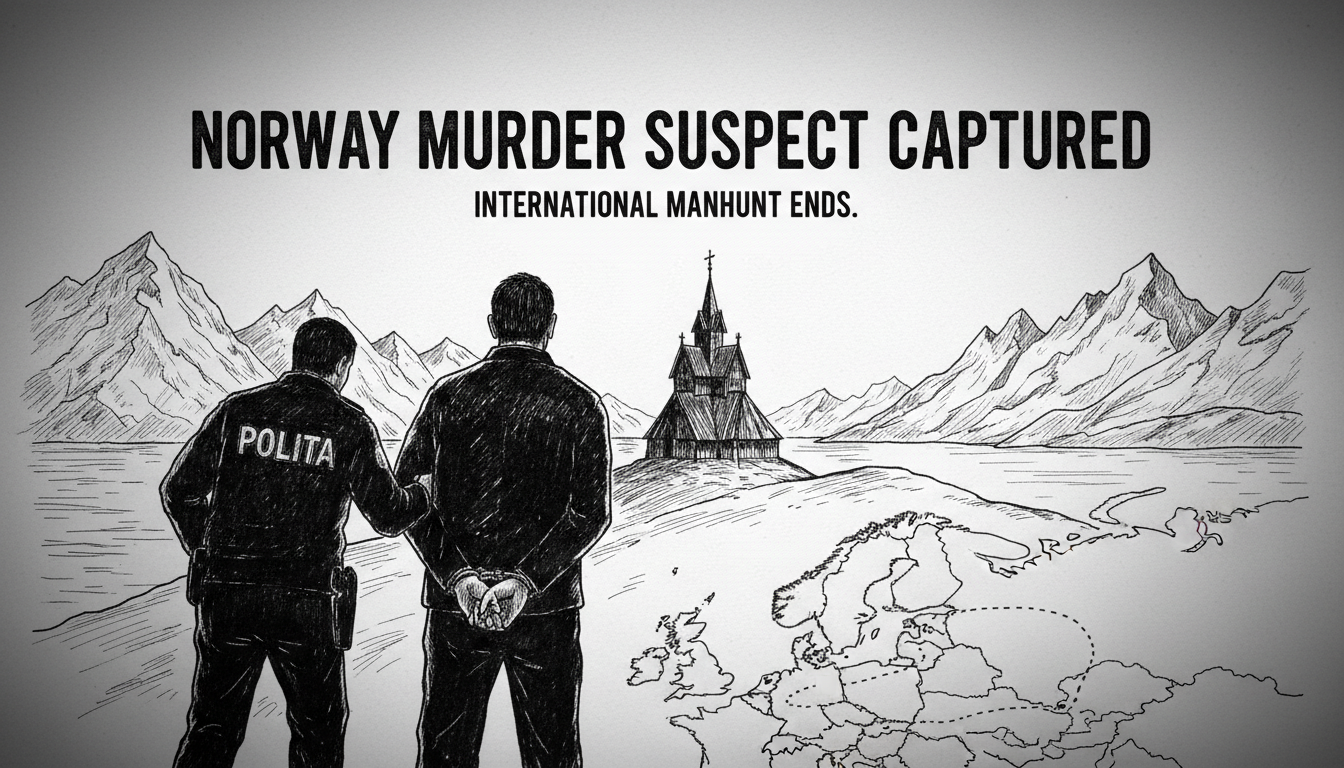
Norway police have arrested a man in his sixties for the murder of 48-year-old May Torill Eriksen in Kirkenær. The Innlandet Police District, assisted by officers from Oslo, apprehended the suspect who had been the subject of an international arrest warrant since Sunday. He will be transported to a custody facility in Hamar for questioning, marking a swift conclusion to a cross-border search that gripped the small eastern Norwegian community.
A Community in Shock
The arrest brings a measure of closure to Kirkenær, a quiet town of approximately 3,500 residents in Innlandet county. Violent crimes of this nature are statistical anomalies in Norway, a country with one of the world's lowest homicide rates. In 2022, the entire nation recorded 31 homicides, translating to a rate of about 0.5 per 100,000 inhabitants. Each case, therefore, resonates deeply, particularly in close-knit communities where such events are profoundly disruptive. The death of May Torill Eriksen is not just a police statistic; it is a devastating event that has shattered the normal peace of a rural Norwegian town.
Local police have released few details about the circumstances surrounding Eriksen's death, citing the ongoing investigation. The focus now shifts to the judicial process. The suspect's rapid transition from internationally wanted fugitive to custody in Hamar demonstrates the efficiency of modern police cooperation. He will be given the opportunity to provide his explanation to investigators, a right fundamental to the Norwegian legal system.
The Mechanics of a Cross-Border Search
The successful arrest highlights the operational capabilities of the Norwegian Police Service. The collaboration between the Innlandet and Oslo police districts is a standard procedure for major cases, leveraging broader metropolitan resources when needed. The issuance of an international warrant, however, signifies the police assessed a significant flight risk. This tool, often referenced in dramatic crime fiction, is a practical instrument in Europe's interconnected landscape, triggering alerts across the Schengen Information System and other international law enforcement networks.
Criminologists point to such cooperation as a critical factor in solving crimes that cross jurisdictions. "The first 48 hours are often decisive, but when a suspect flees the country, the game changes," explains a professor of criminology at the University of Oslo, who requested anonymity due to the active case. "It becomes a test of administrative coordination and international agreements. The swift action here suggests police had strong indications of where to look and moved decisively with their European partners."
This network is crucial for a country like Norway, with extensive land borders with Sweden, Finland, and Russia, and easy air connections to the rest of Europe. The arrest prevents a potentially prolonged international legal saga, ensuring the case will be adjudicated in Norwegian courts.
The Rarity of Violence in a Peaceful Society
To understand the impact of this crime, one must consider Norway's context. The nation's consistently low homicide rate is a point of national pride and a reflection of its social stability. Most murders in Norway are not random acts by strangers but occur between people who know each other, often within domestic or social circles. This pattern, while tragic, contributes to a general public feeling of safety from arbitrary violence.
A single homicide in a small town like Kirkenær therefore consumes disproportionate attention in local and national media. It disrupts the perceived social contract. Residents are forced to confront a reality that feels both alien and frightening. The community's grief for May Torill Eriksen is compounded by a collective anxiety about the violation of their safe environment.
"The psychological impact on a small community cannot be overstated," says the criminology professor. "There is the immediate trauma for the victim's network, but also a secondary, diffuse fear that spreads. Trust is temporarily eroded. The rapid apprehension of a suspect is the first and most important step in the long process of restoring that sense of security."
Justice Ahead in Hamar
The suspect's journey to the arrest cell in Hamar is the start of a meticulous legal process. Hamar, the administrative capital of Innlandet county, will serve as the central hub for the investigation's next phase. Norwegian law mandates strict protocols for the treatment of individuals in custody, including access to legal counsel. The police will now work to build a prosecutable case, likely combining forensic evidence, witness statements, and the suspect's own testimony.
The path forward will be slow and methodical, characteristic of the Norwegian justice system which emphasizes thoroughness over speed. The police will not publicly speculate on a motive or the relationship between the suspect and the victim while their work continues. This restraint, though sometimes frustrating for a public seeking answers, is designed to protect the integrity of the investigation and the rights of all involved.
For the residents of Kirkenær, life will gradually return to a new normal, but one marked by this tragedy. The national news cycle will move on, but the local community will continue to feel the absence of May Torill Eriksen. The efficient police work leading to an arrest provides a foundation for healing, offering a clear signal that the rule of law remains robust even when confronted with profound violence.
A Test of Systems and Society
This case, while a deeply personal tragedy, serves as a small-scale test of Norway's institutional frameworks. It tested police coordination between districts and across borders. It will test the judicial system's capacity for fair and transparent proceedings. And it tests the social cohesion of a small community faced with an almost unthinkable event.
The low crime statistics are a comfort at the national level, but they are cold consolation to a town in mourning. The numbers represent a successful societal model, but they can also mask the intense, localized pain that a single violent death causes. The arrest closes one chapter—the urgent hunt for a suspect. It opens another, longer chapter of legal process and communal grief. The true measure of justice will be felt in Kirkenær not just in a courtroom verdict, but in the slow restoration of peace and trust in the streets surrounding the Glomma river.