
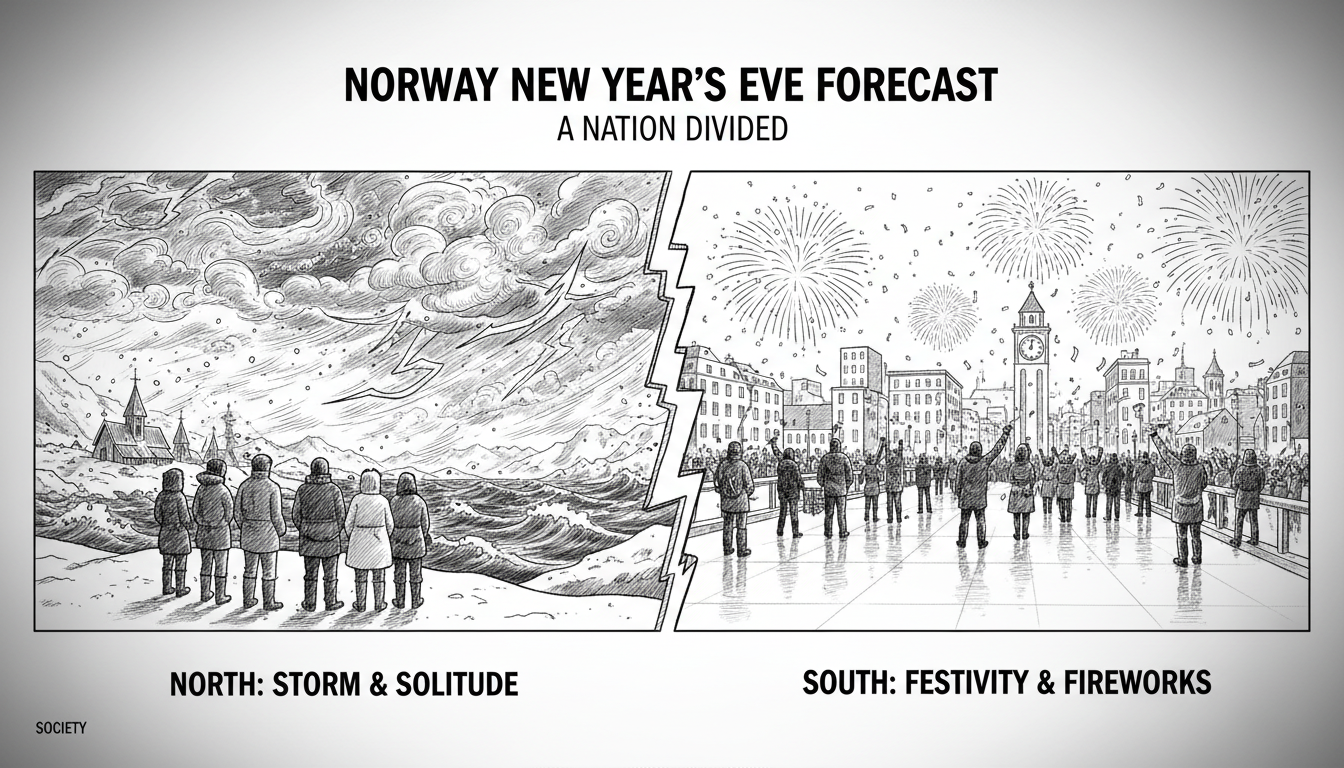
Norway's New Year's Eve weather is shaping up to be a tale of two halves of the long, mountainous nation, with forecasts pointing to a sharp divide between north and south. The Norwegian Meteorological Institute reports a high-pressure system dominating Southern Norway, while northern regions brace for active winter weather, illustrating the profound climatic diversity that defines the country. While meteorologists stress the inherent uncertainty of forecasts made days in advance, current models paint a picture of a calm, cold celebration for many in the south and a snowier, more dynamic night for those in the north.
A Meteorological Balancing Act
The weather patterns setting up for the final days of the year are classic for a Norwegian winter. A stable high-pressure area is expected to settle over Southern Norway. This typically brings cold, settled conditions, particularly to inland valleys and areas away from the moderating influence of the sea. 'We have a high pressure over Southern Norway, which makes it cold in inland areas,' said Meteorologist Magnus Ovhed. He noted that along the coast, temperatures could creep above freezing in the period between Christmas and New Year's. This split between bitter inland cold and milder coastal fringe is a recurring feature, driven by Norway's complex topography and the warming effects of the Gulf Stream.
Meanwhile, the forecast for Northern Norway is governed by a different force. 'There is a fairly cold air stream over Northern Norway,' Ovhed explained. This colder air mass interacting with moisture is likely to produce periodic snow showers across Trøndelag, Nordland, Troms, and Finnmark during the festive period. The precise southern extent of this wintry precipitation remains one of the key uncertainties in the forecast. How far south these snow showers will reach is still too early to say with confidence.
Regional Forecasts and Inherent Uncertainty
Detailed location-specific forecasts provided by national services offer a snapshot of potential conditions, but meteorologists are quick to remind the public of their provisional nature. For major cities, the outlook varies significantly. Oslo could see partly cloudy skies with temperatures hovering around freezing, between -1 and 1 degree Celsius. Bergen, on the west coast, may experience milder temperatures of 2 to 4 degrees with a mix of cloud, sun, and possible rain.
The north-south contrast is stark. In the far northern town of Kautokeino, in Finnmark, temperatures could plunge to a biting -16 to -13 degrees Celsius under overcast skies. Conversely, the coastal city of Ålesund might see 3 to 4 degrees with rain. Central regions like Trondheim and Lillehammer occupy a middle ground, with Trondheim facing a mix of snow and rain at 0 to 2 degrees, and Lillehammer experiencing clearer but colder conditions at -5 to -3 degrees.
Ovhed highlighted the particular uncertainty for counties like Møre og Romsdal, describing the forecast there as a bit of a 'gamble.' Residents could see the tail end of the southern high pressure, bringing cool temperatures and light cloud, or they could find themselves on the receiving end of sleet or snow showers moving in from the north. This unpredictability for central coastal areas underscores the challenge of forecasting in a zone where competing weather systems meet.
Why Norway's Weather Defies Simple Forecasts
The significant variation in forecasts across such short distances is not unusual for Norway. The country's extreme length, stretching from 58°N to 81°N, means it spans multiple climate zones. Its rugged terrain, featuring deep fjords and steep mountains, creates countless microclimates. A valley could be shrouded in freezing fog while a nearby coastal village enjoys mild, damp air. The North Atlantic Oscillation, a large-scale atmospheric pressure pattern, also plays a major role in determining whether a winter will be stormy and mild or cold and calm across Northern Europe.
These factors make long-range forecasting particularly challenging. Meteorologists rely on complex computer models that simulate the atmosphere, but small errors can grow over time, leading to different outcomes. 'It is still a little early to say for sure,' Ovhed cautioned regarding the New Year's Eve specifics. This professional hedging is standard practice. Forecasts are updated frequently as the event draws closer and the signal becomes clearer. The public is advised to check daily updates from official sources as the holiday approaches.
Implications for Celebrations and Travel
This divided forecast has practical implications for millions of Norwegians planning their celebrations. In the south and inland, the predicted calm wind conditions are good news for outdoor gatherings and fireworks displays. The cold, however, demands appropriate clothing for those spending time outside. In the north and potentially parts of the central coast, the prospect of snow showers and stronger winds, particularly in Nordland and Troms as noted in the forecast, requires more caution. Travel plans, especially on roads that are vulnerable to winter conditions, should be made with flexibility and awareness of the latest weather warnings.
The uncertainty in central regions serves as a reminder to have contingency plans. An outdoor celebration in Ålesund or Trondheim might need a sheltered alternative if precipitation moves in. The Norwegian tradition of celebrating with fireworks also depends heavily on conditions; low cloud or falling snow can obscure displays, and wind directions must be considered for safety.
As the country counts down to the new year, the evolving weather picture perfectly encapsulates living in Norway: a constant negotiation with a powerful and varied natural environment. Whether under a clear, starry, freezing sky in the mountains of the south or amidst the swirling snow of a northern coastal town, the weather will once again be a central character in Norway's national celebration. The final word, as always, will belong to the atmosphere itself, with meteorologists working to interpret its intentions until the final hour.