
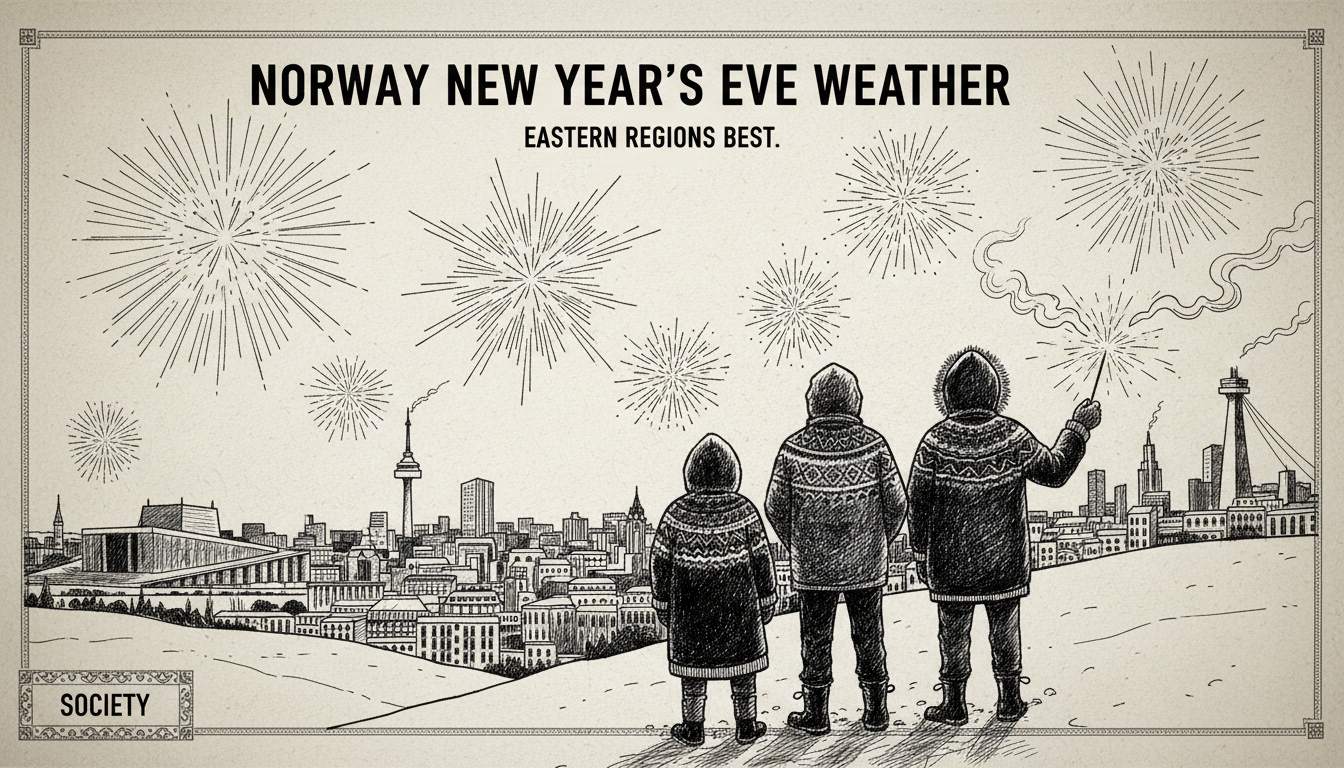
Norway New Year's Eve weather forecasts for December 31, 2025, reveal a stark regional divide, with clear skies promising ideal conditions for fireworks in the east while a low-pressure system threatens western celebrations. Meteorologists confirm that Eastern Norway, particularly the Oslo area and Østfold, will be largely shielded from incoming rain until after midnight, setting the stage for a dry and visible display. This contrast underscores how geography and climate patterns directly impact one of Norway's most cherished annual traditions.
A Clear Skies Celebration for the East
Residents across Østlandet, Norway's eastern region encompassing Oslo, Viken, and Innlandet, can anticipate near-perfect conditions for outdoor New Year's Eve festivities. The southeastern areas, including Østfold county along the Swedish border, are predicted to have the clearest skies. Meteorologist Per Egil Haga explained the timing in a statement: 'Precipitation from the west likely won't reach Eastern Norway until after midnight on New Year's Eve, so this region will have the finest weather for rockets and fireworks.' This forecast allows for uninterrupted gatherings in gardens, public squares, and along fjords like the Oslofjord, where thousands typically congregate.
New Year's Eve, or nyttårsaften, holds significant cultural weight in Norway. It is marked by a festive dinner often featuring pinnekjøtt (cured lamb ribs) or lutefisk, followed by the broadcast of the national 'New Year's Eve Show' on television. The climax is the communal lighting of fireworks at midnight, a tradition that depends heavily on dry, calm weather. Clear conditions not only enhance safety but also ensure that the colorful explosions reflect brilliantly off snow-covered landscapes or dark waters.
Western Norway Braces for Inclement Weather
In sharp contrast, Vestlandet and the western parts of Sørlandet face a disruptive low-pressure system expected to make landfall on Tuesday, December 30. This weather front will bring precipitation and likely stronger winds to cities like Bergen, Stavanger, and Trondheim throughout New Year's Eve. The system is forecast to spread across all of Southern Norway by the early hours of January 1, 2026. Such conditions could dampen outdoor celebrations, forcing many to shift festivities indoors or under shelter, and may lead to cancellations of public fireworks displays in coastal areas.
The geographical divide is classic for Norwegian weather patterns. The Scandinavian Mountains, running along the country's spine, act as a barrier that often blocks Atlantic low-pressure systems from penetrating inland. This phenomenon, known as the rain shadow effect, leaves Østlandet drier while western slopes bear the brunt of moisture-laden winds from the North Sea. For this specific forecast, the mountains are effectively shielding the east during the critical evening hours.
Meteorological Insights: Why the Divide?
Senior meteorologists emphasize that this east-west split is a common but nuanced feature of Norway's winter climate. 'Low-pressure systems from the Atlantic typically approach from the southwest,' explained Haga. 'Their path and intensity determine how far inland the precipitation travels. For this New Year's Eve, the trajectory means the eastern valleys and the Oslo region will lie in the lee of the weather, remaining dry until the system fully envelops the south overnight.' The precision of modern forecasting allows authorities and the public to plan with greater confidence, reducing risks associated with fireworks in wet or windy conditions.
Weather models indicate that the low-pressure system will move across the country relatively quickly, potentially clearing by January 2. However, New Year's Day itself may see lingering rain or snow in many regions. Temperature-wise, forecasts suggest seasonal norms for late December, with coastal areas hovering around 0 to 5°C and inland areas, especially in the east, possibly dipping below freezing. This could create icy conditions on roads for those traveling after celebrations, a point stressed by the Norwegian Public Roads Administration in their seasonal advisories.
Cultural and Economic Ripples of the Forecast
The weather forecast has tangible implications beyond personal plans. For municipalities, clear skies in the east mean likely higher attendance at public events, requiring adequate safety and security resources. In western towns, event organizers must consider contingencies for rain. The retail sector also feels the impact; sales of fireworks and outdoor celebration supplies are often stronger in regions with favorable forecasts. Historically, poor weather on New Year's Eve can lead to a surge in unused fireworks, which poses storage and safety challenges.
Tourism is another factor. While international tourism is lower in winter, domestic travel between regions is common during the holiday period. A clear forecast for Østlandet might encourage more last-minute trips to cabin destinations in the eastern mountains or along the Oslofjord. Conversely, travelers to the western fjords, such as those near Geiranger or Nærøyfjord, may need to prepare for wetter conditions. The Norwegian Meteorological Institute provides detailed regional updates that are closely followed by the hospitality industry.
Planning a Safe and Enjoyable Celebration
Given the forecast, authorities across Norway reiterate standard safety advice for New Year's Eve. The Norwegian Fire Protection Association advises keeping fireworks a safe distance from buildings and forests, a caution particularly pertinent in dry eastern areas where fire risk, though low in winter, still exists. In western regions, the advice shifts to ensuring fireworks are only used during lulls in rain and never in strong winds. Many communities offer organized public displays as a safer alternative, with some in the west potentially moving indoors or to covered venues.
For families, the weather may influence menu choices and gathering locations. An indoor feast becomes a focal point in rainy regions, while eastern households might plan outdoor bonfires or waterfront gatherings. The tradition of making New Year's resolutions often includes reflections on nature and climate, especially as extreme weather events become more frequent. This year's divide serves as a reminder of Norway's diverse microclimates, shaped by its complex topography and maritime influences.
Looking Beyond the Holiday
This New Year's Eve weather pattern fits within broader climatic trends observed in Scandinavia. Research indicates that North Atlantic low-pressure systems may be intensifying due to climate change, potentially leading to wetter winters on the coast. However, the shielding effect of the mountains on eastern regions remains a consistent feature. As Norwegians celebrate the transition to 2026, the weather underscores a deeper connection to the environment—a nation where life and tradition are perpetually intertwined with the elements.
Will future generations experience similarly divided New Year's Eves, or will warming temperatures blur these regional lines? For now, as midnight approaches on December 31, the skies over Oslo and Østfold are set to ignite with celebration, while the west watches and waits for a break in the clouds. This annual meteorological lottery continues to define the Norwegian holiday experience, proving that even in the age of advanced technology, nature still writes the final script for our festivities.