
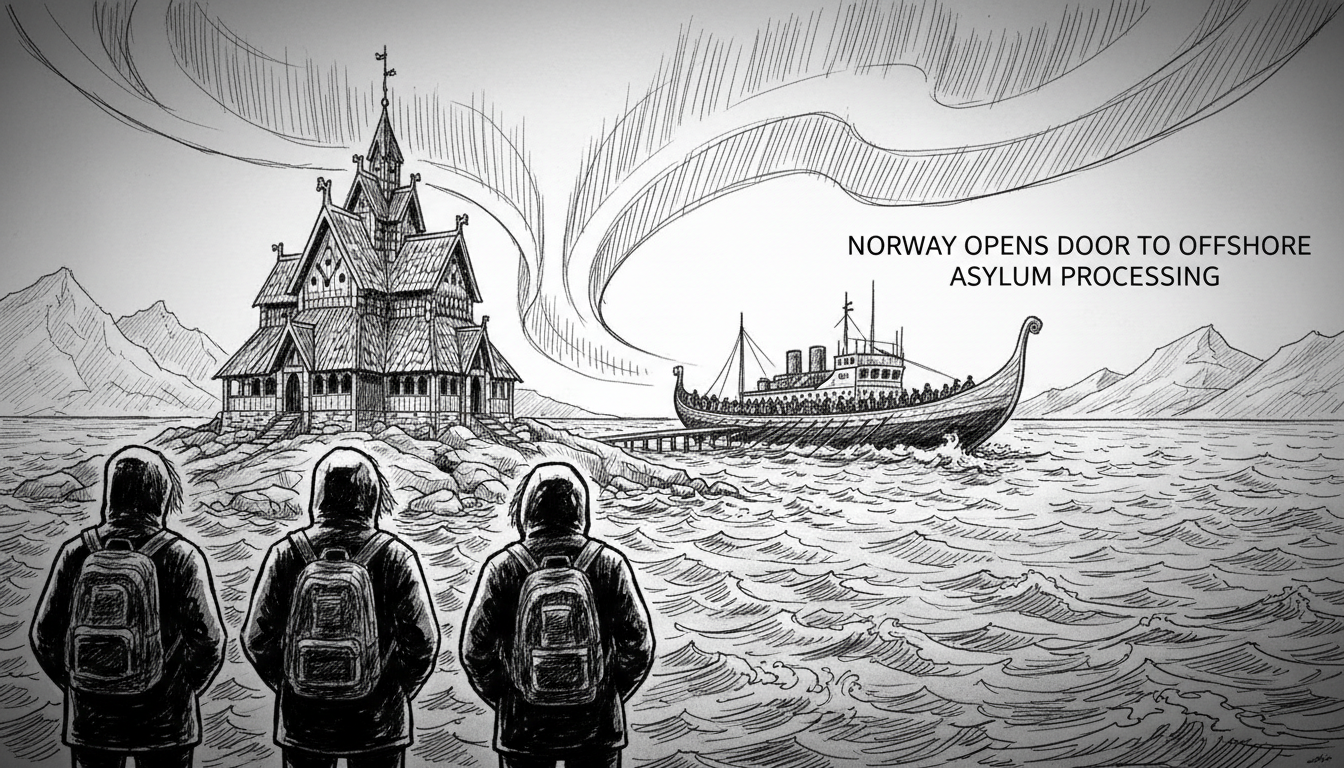
Norway's government is proposing a significant tightening of its immigration policy, opening the door to processing asylum applications and establishing return centers in third countries. Justice Minister Astri Aas-Hansen announced the move, which aligns with a broader Nordic push to challenge the legal boundaries set by the European Court of Human Rights. The policy shift signals a new, more restrictive chapter for a nation grappling with the balance between sovereignty and international human rights obligations.
"Norway is opening up to consider asylum reception abroad," Aas-Hansen stated. "This applies to both applications for residence and return centers." The minister also confirmed Norway's support for a Danish-led initiative aimed at sending a political signal to the Strasbourg-based court. "Together with the rest of the Nordics, the government believes that too many criminal foreigners are being protected," she added.
This marks a decisive turn for Norway's center-left coalition, led by the Labour Party (Ap). Historically, Norway has maintained a controlled immigration system, but the debate has intensified in recent years. The 2023 figure of approximately 3,500 asylum applications, while down from the 2015 crisis peak, continues to fuel political discussions on integration and resource allocation. The government's new stance directly addresses growing public and political concerns over foreign nationals who commit crimes. As of 2022, foreign citizens constituted about 15% of Norway's prison population.
A Nordic Front on Migration
The policy is not developed in isolation. It forms part of a coordinated Nordic response, with Denmark acting as the primary architect of the external processing model. Denmark has actively pursued agreements with countries like Rwanda to host asylum centers outside Europe, a model Norway is now seriously considering. By joining this Danish initiative, Norway seeks collective weight to influence the European Court of Human Rights, which member states often cite when blocking deportations.
This Nordic alignment represents a strategic calculation. Individually, each country possesses limited influence over the court's jurisprudence. Together, they represent a significant bloc capable of applying political pressure. The core argument, as articulated by Aas-Hansen, is that current interpretations of human rights law excessively protect individuals who pose a threat to public safety. The goal is to recalibrate the balance between an individual's right to non-refoulement and a state's right to expel foreign criminals.
Legal and Ethical Quagmires
Legal experts immediately raise red flags about the proposal's compatibility with international law. The cornerstone principle of refugee law is non-refoulement—the prohibition against returning asylum seekers to territories where they face serious threats to life or freedom. Processing claims in third countries, particularly those with questionable human rights records, risks violating this fundamental tenet.
"The legality of such offshore processing is highly dubious under the European Convention on Human Rights," says Professor Henrik Syse, a legal scholar at the University of Oslo. "The convention establishes that a state's responsibility is engaged when it exercises effective control. Sending asylum seekers to a partner country does not necessarily absolve Norway of its duties. The Strasbourg court will scrutinize the conditions and procedures in any third-country center with extreme rigor."
Ethical concerns are equally profound. Critics argue the policy represents an abdication of moral responsibility, effectively outsourcing humanitarian obligations to often less stable nations. They fear it could create a "two-tier" system where the right to seek asylum depends on one's point of entry or nationality, undermining the universal nature of refugee protection.
The Domestic Political Calculus
For the Labour-led government, this move is a delicate political maneuver. It aims to address voters' concerns about immigration and crime, potentially drawing support from the right while risking alienation from its own left flank. The Conservative Party (Høyre) and the Progress Party (FrP) have long advocated for stricter policies, leaving the government vulnerable on the issue.
By adopting a harder line, Aas-Hansen and Prime Minister Jonas Gahr Støre seek to reclaim the narrative. The focus on criminal foreigners is a politically potent angle, designed to frame the policy as one of public security rather than mere border control. However, the coalition's junior partner, the Centre Party (Sp), has traditionally represented rural constituencies with mixed views on immigration, adding another layer of internal complexity to the policy's rollout.
Implications for Asylum Seekers and Integration
If implemented, the policy would fundamentally alter the journey for those seeking safety in Norway. Instead of arriving on Norwegian soil—be it at Oslo Airport Gardermoen or a remote border station in Finnmark—asylum seekers could be diverted to a processing center in a third country. Only those granted protection would then be transferred to Norway.
This model aims to deter what the government views as irregular migration, particularly by individuals who may have traveled through multiple safe countries. Proponents argue it will create a more orderly system and disrupt the business model of human smugglers. Detractors counter that it will penalize the most vulnerable, who often have no safe or legal route to protection and are forced to rely on dangerous journeys.
Furthermore, the policy could impact Norway's integration framework. By pre-selecting individuals offshore, the state could theoretically prioritize applicants based on integration potential or labor market needs, moving further away from a protection system based purely on need.
The Road Ahead and International Repercussions
The announcement is just the first step. Formalizing the policy requires navigating a thicket of legal, diplomatic, and logistical challenges. Norway must identify willing partner countries, negotiate detailed agreements guaranteeing humane conditions and fair procedures, and draft new domestic legislation. This process will face intense scrutiny from opposition parties, civil society, and international bodies.
The move also places Norway in a controversial vanguard of European migration policy. It closely mirrors the UK's stalled Rwanda plan and follows Denmark's lead. Other EU nations, grappling with rising anti-immigration sentiment, will watch closely. A successful Norwegian model could inspire similar policies across the continent, potentially reshaping the European asylum landscape.
However, failure—whether legal, diplomatic, or ethical—could be costly. It could damage Norway's reputation as a nation committed to international law and human rights, a reputation it has carefully cultivated on the global stage, particularly in its UN engagements.
The government's gamble is clear. It is betting that concerns over national sovereignty, public security, and controlled migration now outweigh the risks of challenging established human rights norms. As Justice Minister Aas-Hansen aligns Norway with its Nordic neighbors, the nation steps into a complex and contentious future, where the very meaning of asylum and protection is being renegotiated. The coming debate in the Storting will not just be about policy details, but about the kind of nation Norway chooses to be in an era of global displacement.