
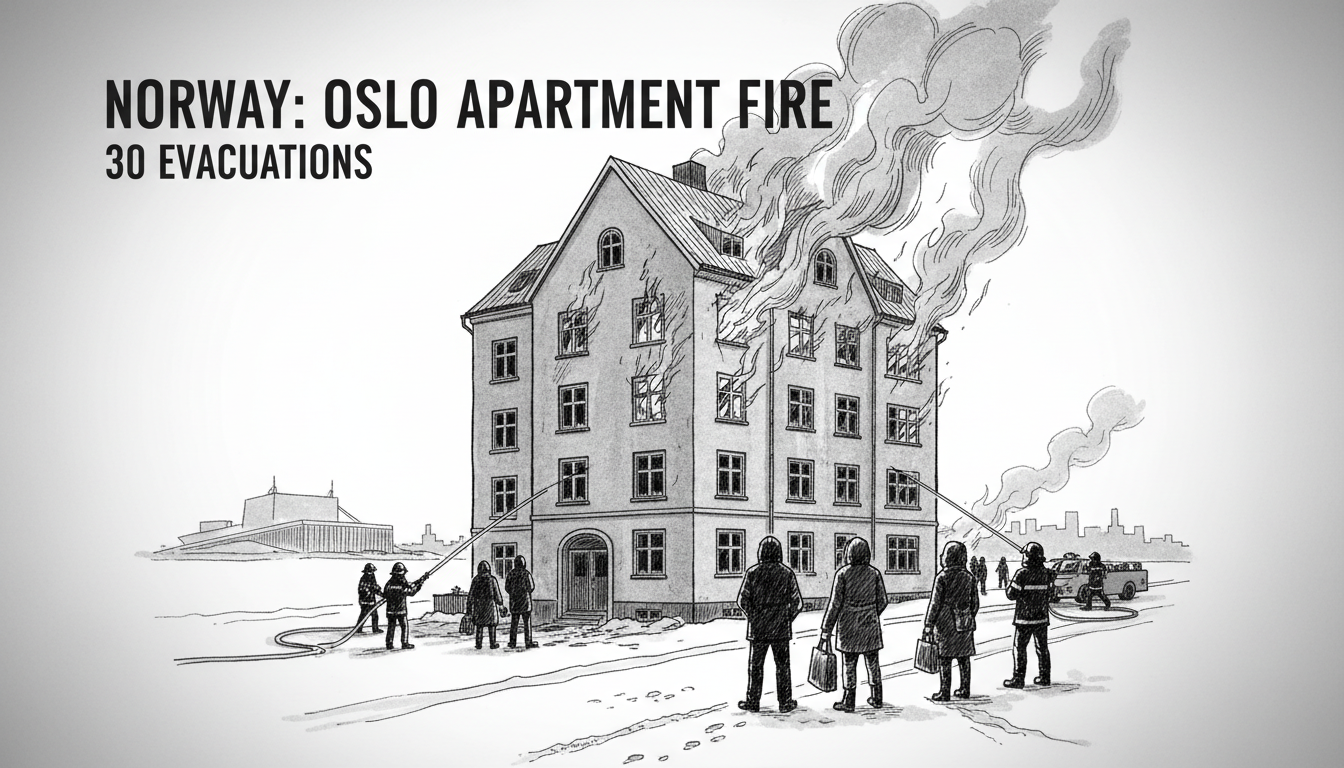
A major apartment fire in Oslo's Skullerud neighborhood forced the evacuation of 30 residents on Tuesday night. Flames engulfed a single unit on an upper floor of a residential block, sending thick smoke through the building's stairwells and triggering a large emergency response.
Fire crews from multiple stations arrived at the scene within minutes. Their priority was containing the blaze to the apartment of origin and ensuring all residents were safely evacuated. Police cordoned off the area around the building as firefighters worked to extinguish the intense fire.
Emergency Response in a Residential Enclave
Residents described a scene of sudden chaos followed by organized evacuation. Many were alerted by the building's centralized fire alarm system. "We heard the alarm, then saw smoke in the hallway," said one resident who wished to remain anonymous. "The instructions were clear, and everyone moved calmly to the assembly point." Emergency services conducted secondary searches to confirm no one was left inside.
The incident occurred in a typical post-war apartment block in Skullerud, a quiet, family-oriented neighborhood in the Østensjø borough. These areas, developed during Oslo's expansion south and east, are known for their proximity to nature and good public transport links. The fire presented specific challenges due to the building's construction and shared ventilation systems.
Scrutiny Turns to Fire Safety Standards
Norwegian building codes mandate stringent fire safety measures, especially in multi-unit dwellings. Requirements typically include fire-resistant materials between units, clearly marked escape routes, and mandatory smoke alarms. Older buildings, however, may not have retrofitted sprinkler systems unless significantly renovated.
"Every fire like this is a test of our preventative systems," said Lars Holen, a fire safety engineer with 20 years of experience in Oslo. He was not directly involved in Tuesday's response. "The goal is compartmentalization—keeping fire and smoke contained to one unit. When that works, it saves lives and limits property damage. The evacuation of 30 people without serious injury suggests the passive safety measures functioned as intended."
Holen emphasized that while regulations are strong, resident awareness is the critical final component. Knowing evacuation plans, not propping open fire doors, and immediate reporting of alarms are essential. The cause of the Skullerud fire remains under investigation by the police fire unit.
The Anatomy of a Suburban Oslo Neighborhood
To understand the incident's context, one must look at Skullerud itself. It is a classic example of Oslo's 20th-century suburban growth. Developed primarily from the 1960s onward, it offers a mix of apartment blocks and terraced houses. The area borders the vast Østmarka forest, a fact that influences both its community character and emergency service planning.
Families are drawn here for the green spaces and quieter pace, while still being connected to the city center via the Metro (T-bane) Line 3. The local hub is Skullerudstua, a shopping center that serves as the neighborhood's commercial and social heart. Incidents like this fire resonate deeply in such close-knit, stable communities where many residents have lived for decades.
The Aftermath and Looking Ahead
In the fire's immediate aftermath, the Red Cross provided temporary assistance to displaced residents. The municipality's crisis team assessed needs for temporary housing, clothing, and essential supplies. While the affected apartment suffered extensive damage, adjacent units primarily faced smoke and water damage.
The insurance process for such events in Norway is generally efficient, covered under standard household policies. However, the disruption and emotional toll on residents can be significant. Community support networks often become active in these situations, offering help with practicalities.
This event will likely prompt local building managers across Oslo to review their own fire safety protocols. It serves as a real-world reminder for residents to check their smoke alarms and familiarize themselves with evacuation routes. For city officials, it adds data points to ongoing evaluations of whether fire safety regulations for older housing stock need further tightening.
A Broader Perspective on Urban Safety
Norway boasts one of the world's lowest rates of fire-related fatalities. This is attributed to a combination of strict building codes, a widespread culture of safety, and a well-funded, professional emergency services sector. Each incident, however, is analyzed meticulously to identify potential systemic improvements.
The Skullerud fire was not a catastrophic failure but a managed emergency. Its successful resolution—no fatalities, no serious injuries—underscores the strength of existing protocols. Yet, it also poses questions. As Oslo's building stock ages, how will fire safety standards evolve? Are residents in all types of housing equally protected? The investigation into the fire's cause will provide answers critical for future prevention.
For now, the residents of the Skullerud block face a period of dislocation and repair. Their quiet neighborhood, known for its access to forest trails and reliable metro line, has endured a jarring night. The community's resilience, supported by Oslo's comprehensive emergency framework, will be what guides its recovery in the coming weeks.