
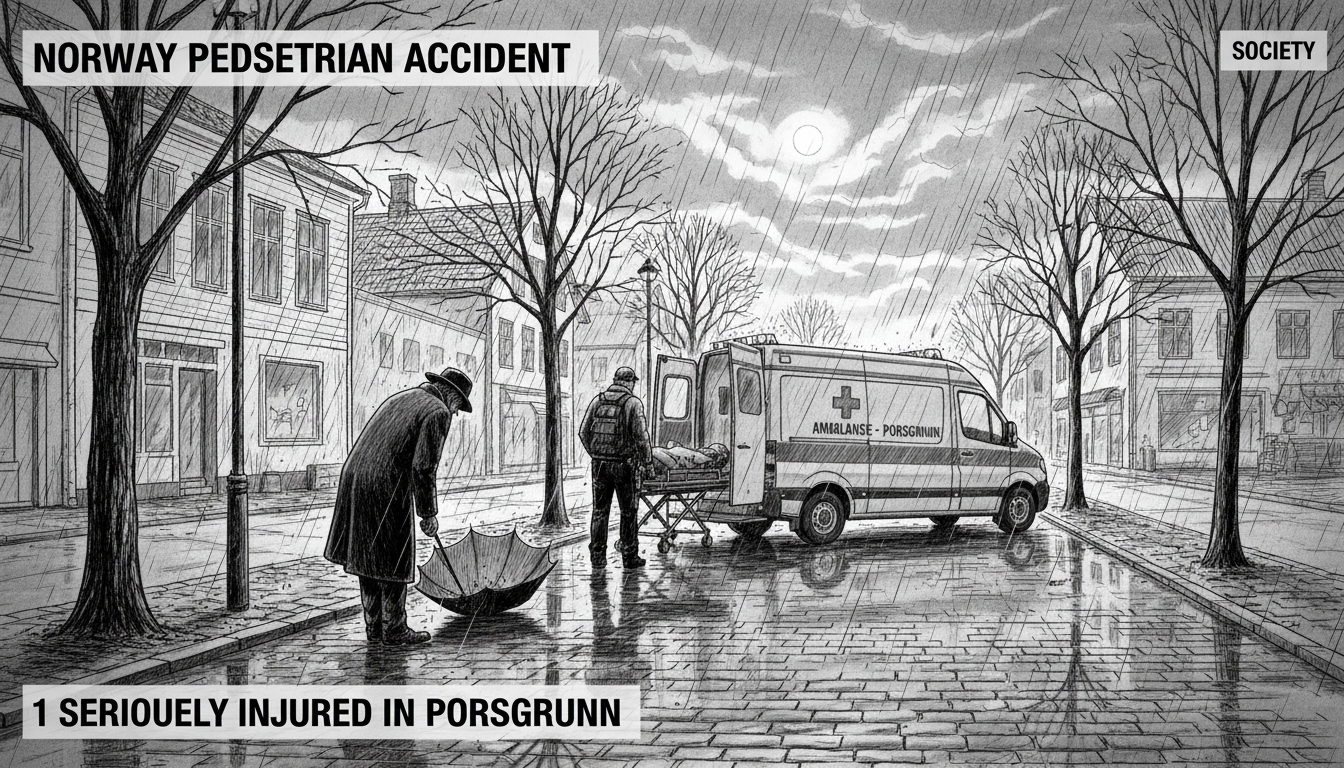
Norway road safety faces renewed scrutiny after a serious pedestrian accident in Porsgrunn's city center left one person severely injured. The victim was struck by a car in a central area, requiring immediate air ambulance evacuation. Emergency services, including police and medical teams, responded to the scene on Tuesday, underscoring the persistent danger on urban Norwegian roads despite the nation's generally strong safety record.
Emergency Response at the Scene
Police confirmed they are in direct contact with the driver of the vehicle involved. The injured pedestrian was initially treated in an ambulance at the location before being transported for further emergency care. The deployment of Norway's air ambulance service, known for its critical role in reaching remote and urgent cases, highlights the severity of the incident. Traffic in Porsgrunn sentrum faced significant disruptions as investigators worked to secure the area and document evidence. The immediate focus of authorities was on medical care and initiating a formal investigation into the cause.
Investigation into Causation Factors
Local police have launched a standard procedure investigation to determine the precise circumstances that led to the collision. Traffic safety experts note that such probes typically examine multiple factors. These include driver attentiveness, vehicle speed relative to the urban zone limit, road conditions, lighting, and potential obstructions to visibility. The accident occurred in a built-up area where the speed limit is likely 50 km/h or lower, a zone designed to prioritize pedestrian safety. "Every such accident is a tragedy and represents a failure in the system," said a veteran traffic police officer not directly involved in the case, speaking on background. "Our job is to piece together whether that failure was human, technical, or related to infrastructure."
Porsgrunn's Traffic Safety Context
Porsgrunn, a municipality of approximately 36,000 inhabitants in Vestfold og Telemark county, is part of the industrial Grenland region. Its city center combines shopping streets with through traffic, a common urban challenge across Norway. The E18 highway runs close to the municipality, feeding considerable traffic into local roads. This incident brings to the forefront ongoing local debates about urban planning and traffic calming measures. City council representatives have previously discussed initiatives to enhance pedestrian zones and improve crossing safety. "This is a terrible reminder of why we must constantly evaluate our city centers," said a local Green Party politician. "We design these spaces for people, but cars and their speed remain a dominant, dangerous factor."
National Statistics and a Safety Paradox
Norway is consistently ranked as one of the world's safest countries for road traffic. Preliminary figures from the Norwegian Public Roads Administration (Statens vegvesen) for 2022 recorded 117 traffic fatalities. In the same year, 623 people were seriously injured in road accidents. While these numbers are low by international standards, each incident sparks introspection. The national trend shows a gradual reduction in fatalities over decades, thanks to strict enforcement of drunk-driving laws, persistent safety campaigns, and vehicle technology improvements. However, the number of serious injuries has proven more stubborn, often linked to accidents in urban environments involving vulnerable road users like cyclists and pedestrians. This creates a paradox: globally safe roads, yet persistent local tragedies that feel preventable.
The Human Cost and Policy Implications
Beyond the statistics lies a profound human impact. A serious traffic injury often leads to long-term physical and psychological trauma for victims and families, alongside significant healthcare and societal costs. This accident in Porsgrunn will likely fuel existing policy discussions. Key topics include lowering default speed limits in city centers from 50 km/h to 30 km/h, an idea tested in parts of Oslo. Other measures involve expanding car-free zones, installing more raised crosswalks, and enhancing lighting and signage. The Norwegian Public Roads Administration's "Vision Zero" policy aims to eliminate all serious traffic injuries and fatalities, but achieving it requires continuous local adaptation. "National policy is implemented on municipal streets," noted a transport researcher at the Institute of Transport Economics (TØI). "The gap between high-level vision and street-level reality is where these accidents happen. Closing it requires political will, funding, and public acceptance of stricter limits on driving."
A Community's Response and Looking Ahead
As the investigation continues, the community in Porsgrunn is left to confront the sudden breach of safety in a familiar space. Such incidents often lead to temporary increases in caution among both drivers and pedestrians, but that effect typically fades. The true test will be whether this event catalyzes concrete changes to local infrastructure or traffic regulations. Local police will submit their findings to the public prosecutor, who will decide if any charges are warranted. For Norway, the incident is a somber data point in the long-term effort to perfect road safety. It asks an uncomfortable question: How does a nation already at the pinnacle of traffic safety push further to prevent the next serious injury on a seemingly ordinary day in a city center? The answer, as Porsgrunn's emergency responders dealt with the human cost on Tuesday, remains as urgent as it is complex.