
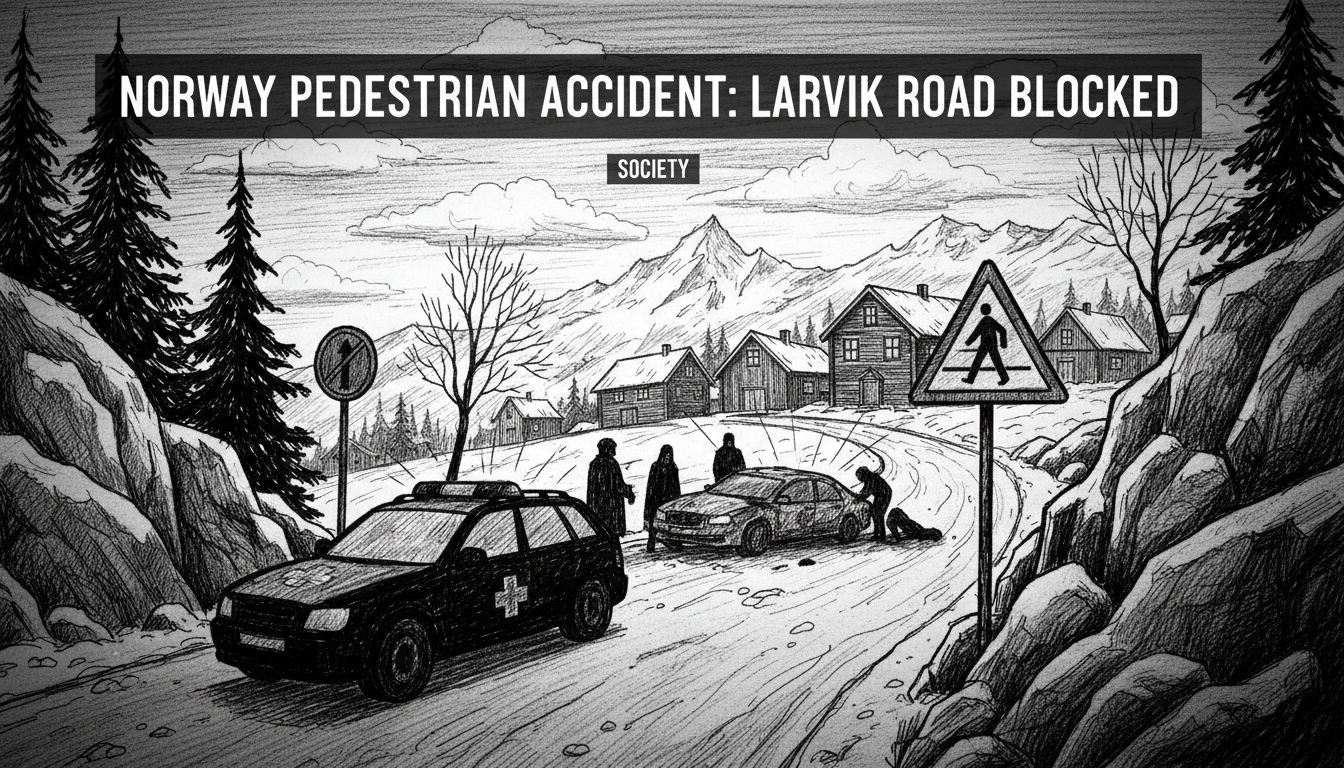
Norway's emergency services responded to a serious traffic accident in Larvik on Thursday, where a pedestrian was struck by a passenger car. A rescue helicopter was dispatched to the scene, and authorities blocked the road in both directions as the investigation began. The incident highlights ongoing road safety challenges in Norwegian communities.
Emergency Response Mobilized
Operational leader Inge Landsrød confirmed that ambulance personnel were on site shortly after the collision was reported. The decision to send a rescue helicopter, or 'redningshelikopter', underscores the potential severity of the incident. Helicopter dispatch in Norway typically occurs when ground transport to a trauma center would take too long, or when the patient's condition requires specialized en-route care. "Ambulance has taken over the patient," Landsrød said in a statement, indicating the initial emergency phase had concluded. The specific location within the Larvik municipality has not been disclosed, but the road closure affected local traffic patterns significantly.
Larvik, a coastal municipality in Vestfold county, is a hub for ferry connections to Denmark. Its roads see a mix of local, regional, and international traffic. Accidents involving pedestrians in such areas often prompt immediate reviews of crosswalk visibility, speed limits, and driver awareness campaigns. The police investigation will now focus on determining the exact sequence of events, examining factors like lighting, weather conditions, and vehicle speed.
A National Safety Context
This accident occurs against a backdrop of national efforts to improve road safety. Preliminary figures from the Norwegian Public Roads Administration (Statens Vegvesen) indicate there were 116 road fatalities in 2022. While this number represents a long-term decline from previous decades, each incident triggers a renewed focus on prevention. Vestfold county has historically mirrored national trends, with fluctuations in accident statistics year to year.
Pedestrian safety remains a particular focus for urban planners and traffic engineers. "The immediate medical response is critical, but so is the subsequent forensic investigation," explains a traffic safety analyst who requested anonymity as the police investigation is active. "We look at everything: the road surface, signage, sightlines, and vehicle data. The goal is never just to assign blame, but to understand the systemic factors that can be corrected." This holistic approach to road safety is a hallmark of Norwegian policy, where engineering, enforcement, and education are seen as interconnected.
The Human and Community Impact
Beyond the statistics and police reports, an accident like this sends shockwaves through a community. Larvik is a town of approximately 48,000 residents, where local news of a serious traffic incident resonates deeply. Road closures disrupt daily life, and the sight of emergency helicopters leaves a lasting impression. For families and witnesses, the event is a traumatic reminder of vulnerability.
Community leaders often respond by advocating for specific safety improvements. Past incidents in other Norwegian municipalities have led to the installation of new pedestrian crossings, enhanced street lighting, and reduced speed zones in residential areas. The Norwegian Public Roads Administration frequently conducts follow-up audits at accident sites to recommend infrastructure upgrades. Whether this accident in Larvik will lead to such changes depends on the investigation's findings.
Norway's Evolving Road Safety Strategy
Norway's approach to achieving 'Vision Zero' – the goal of no fatalities or serious injuries on the roads – involves continuous adaptation. Recent years have seen a stronger emphasis on protecting vulnerable road users: pedestrians, cyclists, and motorcyclists. Measures include stricter penalties for driving violations in urban areas, investment in separated cycle paths, and public awareness campaigns about driver attention.
Technology also plays a growing role. Many new cars in Norway are equipped with advanced driver-assistance systems (ADAS) designed to detect pedestrians and automatically brake. However, the effectiveness of these systems depends on various conditions, and they do not replace attentive driving. The accident in Larvik will inevitably contribute to the data pool that safety researchers and policymakers use to evaluate which strategies are working and where gaps remain.
Looking Ahead: Investigation and Prevention
The police work in Larvik now enters a meticulous phase. Officers will document the scene, collect witness statements, and likely perform technical examinations of the vehicle involved. Their findings will be compiled into a report that could inform broader safety discussions at the municipal and county level. While legal proceedings may follow, the public interest often centers on the preventive lessons that can be learned.
For the residents of Larvik and similar towns, the hope is that tragedy leads to tangible improvement. Will a dangerous intersection be redesigned? Could speed limits on certain stretches be reviewed? The answers depend on a careful analysis of this specific event within the wider context of Norwegian road safety. The dispatch of the rescue helicopter symbolizes a society investing immense resources to save a single life—a principle that extends to preventing the next accident from happening at all. As the road reopens and traffic resumes, the longer-term work to understand and mitigate risk is just beginning.