
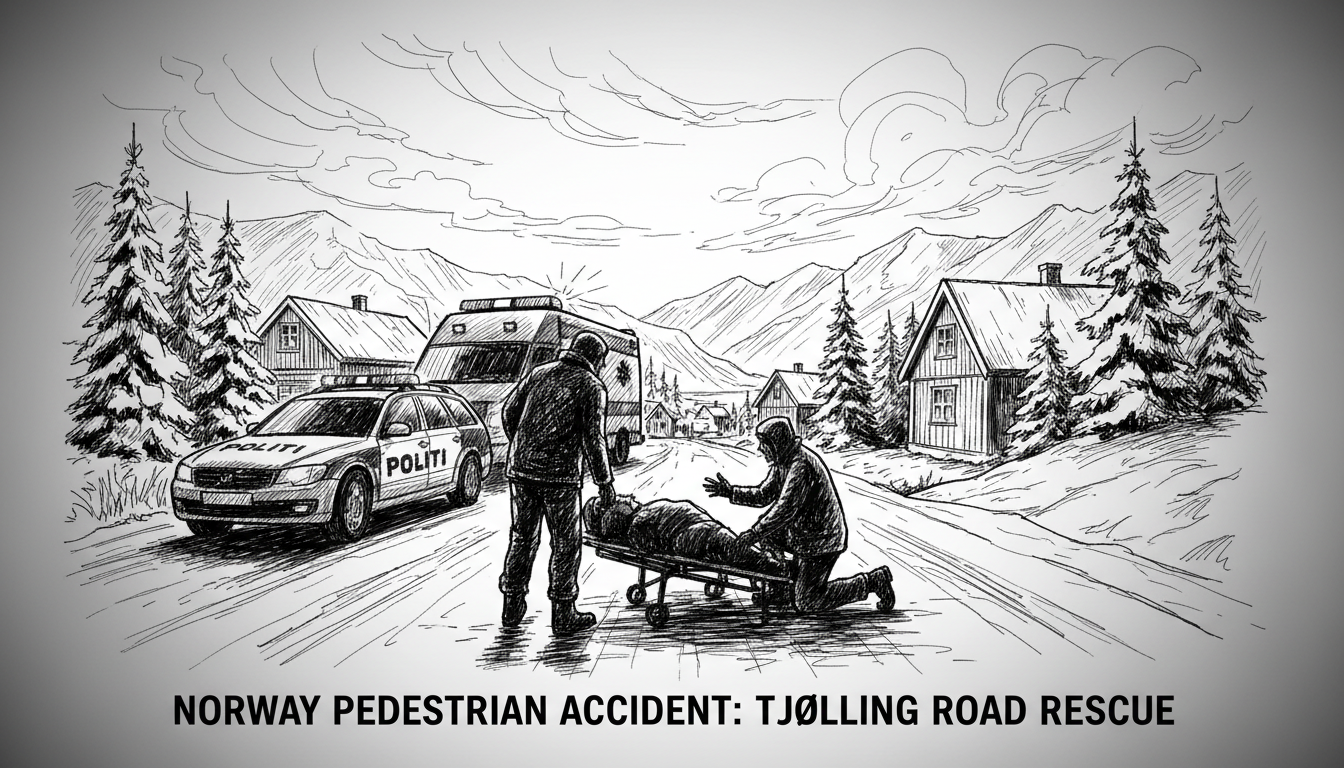
Norway's emergency services launched a major rescue operation in Larvik on Tuesday after a pedestrian was struck by a car on Tjøllingveien. Police confirmed a person was hit by a passenger vehicle, with immediate cardiac and lung resuscitation performed at the scene. A rescue helicopter was dispatched to the area as ambulance personnel worked to stabilize the patient. Authorities have closed traffic in both directions on the key local road while the response continues.
A Critical Response Unfolds
The call to emergency services triggered a standard yet urgent protocol for severe traffic incidents. Police, ambulance crews, and a rescue helicopter team coordinated their response to the Tjølling area. The immediate administration of CPR, or 'hjerte- og lungeredning,' indicates the seriousness of the victim's injuries. Medical experts stress that the first hour after a traumatic incident—often called the golden hour—is critical for patient survival. The decision to deploy a rescue helicopter, likely from the Norwegian Air Ambulance service, suggests road transport to a major trauma center was deemed unsuitable or too slow.
Tjøllingveien, the road where the accident occurred, is now a closed crime scene. Police investigators will work to determine the exact sequence of events. They will examine vehicle marks, interview any witnesses, and assess environmental factors. This forensic process is standard but crucial for understanding causation and potential liability. The road closure will remain in effect until investigators complete their initial evidence collection.
The Human Cost of Road Incidents
While the immediate focus is on medical rescue, such accidents highlight ongoing road safety challenges. Pedestrian-vehicle collisions often result in severe or life-altering injuries for the person on foot. Traffic safety researchers point to a complex mix of contributing factors. Driver inattention, excessive speed for conditions, poor visibility, and pedestrian behavior can all play a role. The design of the road itself, including signage, lighting, and pedestrian crossings, will also come under scrutiny.
Norway generally has some of the world's safest roads, but local roads in residential and semi-rural areas like Tjølling present specific risks. These roads often mix local traffic, pedestrians, and cyclists without the separation found on highways. Speed limits may be 50 or 60 km/h, but the impact at those speeds can be devastating. The accident serves as a stark reminder for all road users to exercise heightened caution, especially in areas where people live and walk.
The Infrastructure and Community Context
Tjølling is a former municipality absorbed into Larvik in Vestfold county. It is a community with a mix of residential areas, farmland, and historical sites. Roads like Tjøllingveien are its lifelines, connecting residents to schools, shops, and the larger urban center of Larvik. An accident causing a prolonged closure disrupts daily life for many. It forces detours, delays deliveries, and creates a tangible sense of community concern that extends beyond the immediate victim.
Local authorities in Larvik municipality regularly review traffic safety data. A serious accident like this will likely prompt a renewed assessment of this specific stretch of road. Municipal engineers may analyze accident history, traffic volume, and pedestrian activity. Potential interventions could range from improved signage and street lighting to physical traffic calming measures like speed bumps or a reduced speed limit. These decisions involve balancing safety with the practical needs of residents and emergency access.
The Path Forward for Investigation and Support
The police investigation will proceed methodically. Officers will seek to establish whether any traffic laws were broken. They will determine if weather, road surface conditions, or vehicle defects contributed. The driver's actions and the pedestrian's location and direction will be central questions. This fact-finding is essential not only for potential legal proceedings but for providing a clear account to the affected families and the public.
Support systems will also engage. The victim and their family will be connected with medical and potentially psychological support services. The driver involved will also likely require support. Such traumatic events can have lasting emotional impacts on all directly involved, including first responders. Norway's well-developed public health and support networks play a vital role in the aftermath that follows the flashing lights of the initial emergency response.
A Sobering Reminder on Road Safety Priorities
This incident in Tjølling is a single, acute event. Yet it reflects a universal and persistent public safety issue. Every nation grapples with reducing traffic fatalities and serious injuries. Norway's Vision Zero policy, which aims to eliminate all traffic fatalities and serious injuries, is tested in real-time by accidents like this. The policy shifts the focus from blaming individual road users to designing a transportation system that accounts for human error.
Today's rescue operation—with its police cars, ambulances, and helicopter—represents the reactive cost of road danger. The greater challenge, and the goal of Vision Zero, is proactive prevention. This means continuous investment in safer road designs, vehicle safety technology, and public education. It requires communities to demand safe streets and drivers to internalize their responsibility for the lethal potential of their vehicles.
As the road reopens and the news cycle moves on, the work for the injured individual and their family is just beginning. The community of Tjølling and Larvik will reflect on this event. For the rest of us, it is a moment to check our own driving habits, to slow down in residential areas, and to remember that the difference between a near miss and a tragedy is often a matter of seconds and attention. The ultimate measure of a society's progress is not just in its emergency response, but in its success at preventing the need for that response in the first place.