
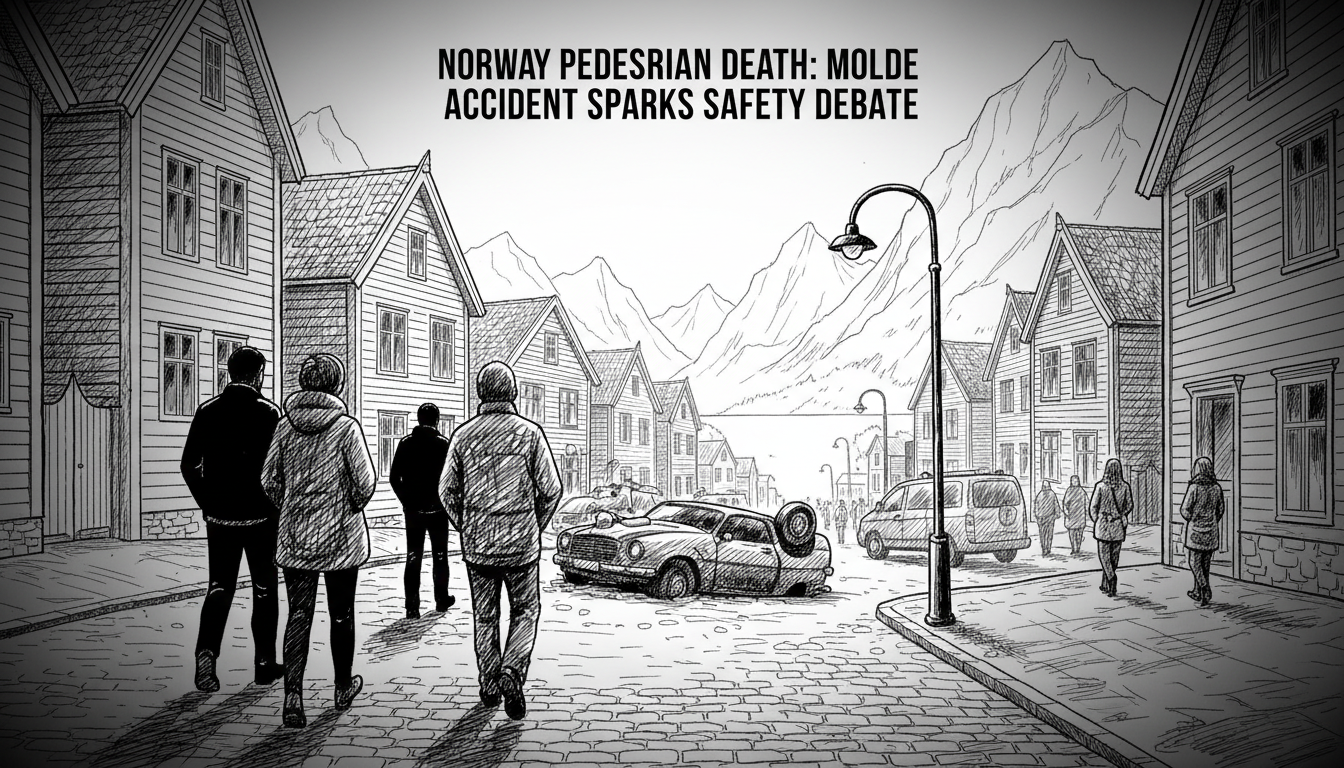
Norway's road safety record faces scrutiny after a woman in her 60s died from injuries sustained in a Molde pedestrian crossing. The fatal collision occurred Monday evening in the city center, with the driver now charged under Section 3 of the Road Traffic Act. Police confirmed the victim succumbed to her injuries after being airlifted to St. Olavs Hospital in Trondheim. Investigators continue working to determine the exact cause of the incident that has shaken the coastal community.
A Community in Mourning
Molde, known for its panoramic views of the Romsdal Alps and its vibrant cultural scene, is grappling with the sudden loss. The accident happened in a marked pedestrian zone, areas specifically designed for safe passage. Local residents have begun placing flowers at the site, a quiet tribute that underscores the profound impact on this tight-knit city of 27,000 people. Such tragedies strike at the heart of Norwegian values, where community safety and accessibility are deeply held principles.
Police have not released the victim's name, respecting the family's privacy during their grief. The driver involved is cooperating with authorities as the formal investigation proceeds. Charging under Section 3 indicates police are examining whether fundamental traffic rules—concerning care, attention, or right of way—were breached. This legal step is standard in serious collisions while the full picture emerges.
Norway's Road Safety Paradox
This death presents a stark contrast to Norway's generally exemplary traffic safety statistics. The country recorded 116 road fatalities in 2022, one of the lowest rates per capita in Europe. This achievement stems from decades of sustained investment in infrastructure, strict law enforcement, and robust vehicle safety standards. From the winding roads of the Western Fjords to the arterial highways near Oslo, engineering and policy have worked to protect all road users.
Yet, each number represents a personal tragedy and a systemic question. Møre og Romsdal county, where Molde is situated, has experienced variable accident rates over the past decade. The Norwegian Public Roads Administration (Statens vegvesen) continuously monitors these trends, using data to guide infrastructure upgrades and targeted safety campaigns. This incident will become another data point in that ongoing analysis, prompting local authorities to re-examine the specific crossing and its surrounding traffic flow.
The Human Factor in Traffic Safety
Experts consistently identify driver behavior as the most critical and challenging variable in road safety. "Technical infrastructure can be perfected, but the human element remains unpredictable," says a senior analyst with the Institute of Transport Economics, who requested anonymity as the police investigation is active. "Even in a country with Norway's resources and safety culture, moments of inattention, misjudgment, or error can have irreversible consequences."
Section 3 of the Road Traffic Act serves as the cornerstone of responsible driving, mandating that every driver must exercise "due care and caution" to avoid endangering life or property. Charges under this section are serious and can lead to significant penalties, including license suspension or imprisonment for grievous outcomes. The law's broad application allows it to cover scenarios from speeding and distraction to failing to yield to pedestrians in a marked crossing.
Infrastructure and the Pursuit of 'Vision Zero'
Norway, alongside its Nordic neighbors, has committed to 'Vision Zero'—the ethical principle that no loss of life on the roads is acceptable. This philosophy has driven innovations like safer pedestrian crossings with raised platforms, improved lighting, and traffic calming measures in urban centers. Many Norwegian cities, including Oslo, have aggressively reduced car access in downtown areas, prioritizing cyclists and pedestrians.
Molde has implemented similar measures in its central planning. The site of Monday's accident will likely undergo a fresh safety audit. Standard procedure after a serious incident involves the municipal road authority and police reviewing the location's design, sightlines, signage, and lighting. Recommendations could range from adding a traffic signal to installing more prominent road markings or even reconfiguring the street layout.
A National Conversation Renewed
While detailed statistics for 2024 are not yet available, every fatality renews a national conversation about road safety priorities. The Storting frequently debates funding allocations for the National Transport Plan, where pedestrian and cyclist safety projects compete for resources against large-scale highway and railway investments. Local politicians in Molde are now fielding questions from concerned constituents about whether enough is being done at the community level.
This incident also touches on broader societal issues, including an aging population. Older pedestrians can be more vulnerable in collisions, and urban design must account for varying mobility levels. Norway's focus on universal design principles, which aim to create environments accessible to all people regardless of age or ability, is directly relevant to how its streets are built and maintained.
The Path Forward for Molde
In the coming weeks, the police investigation will seek to establish a definitive sequence of events. The findings will inform any potential court proceedings and provide answers to the victim's family. Beyond the legal process, the city's transportation department will have to assess if practical changes are warranted to prevent future tragedies.
For now, the community's focus is on mourning. The quiet act of placing flowers on a sidewalk is a powerful reminder that behind the statistics and legal codes are irreplaceable human lives. Norway's overall safety record is a significant achievement, but as Molde demonstrates, the work of protecting every individual on every street corner is never truly finished. The challenge remains translating a world-class safety system into flawless everyday reality, where a simple walk across a city street does not end in tragedy.
This single event in a Norwegian coastal city raises a universal question: in our pursuit of efficient transportation, have we done everything possible to honor the fundamental right to safe passage? The answer, for Norway and every nation, requires constant vigilance, investment, and a collective commitment to valuing life above all else on the road.