
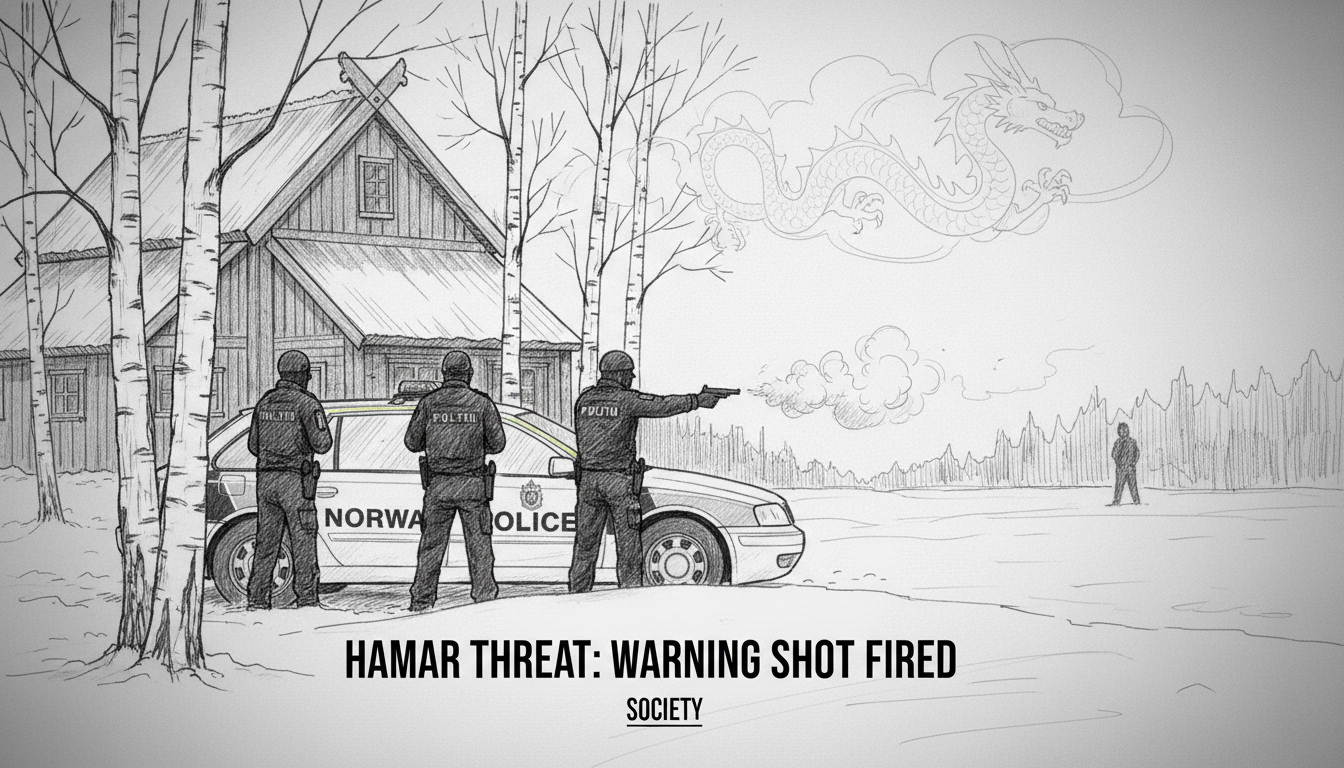
Norway police fired a warning shot in Hamar to control a threat situation Thursday, an uncommon response in a nation with only 44,000 annual penal code offenses. Officers from the Innlandet Police District deployed with multiple resources to a specific address after receiving a report of a threat. Authorities confirmed no injuries resulted and stated there is no danger to third parties following the incident. This event immediately tests the community policing model prevalent across Norway's low-crime society.
The Immediate Response in Hamar
Police action unfolded swiftly in Hamar, a city of approximately 31,000 residents in southeastern Norway's Innlandet county. According to official statements, the situation required officers to discharge a warning shot to establish control. The use of such force is a notable escalation in Norwegian policing, where de-escalation tactics are standard procedure. The Innlandet Police District emphasized that the situation was contained and posed no further risk to the public. Specific details regarding the nature of the threat or the individuals involved remain under investigation and have not been disclosed by authorities.
This incident occurs against the backdrop of Norway's consistently low violent crime rates. The Norwegian Police Service, with its workforce of around 17,000 employees, prioritizes preventive measures and community engagement. A warning shot in a residential area like Hamar represents a significant police action. Local residents reported a heightened but brief police presence, with normalcy returning shortly after the situation was resolved. The quick resolution aligns with police protocols aimed at minimizing public disruption and maintaining safety.
Context of Crime and Policing in Norway
Norway's crime statistics provide critical context for understanding the gravity of the Hamar event. The approximately 44,000 reported offenses against the penal code in 2022 exclude traffic violations, painting a picture of a generally secure society. This figure is low compared to many European and North American counterparts. The Norwegian policing philosophy is deeply rooted in the principles of legitimacy and proximity, where officers are integrated into communities to build trust and prevent crime before it occurs. The Hamar response, while forceful, was ultimately measured and resulted in no physical harm.
Experts point to this incident as a reminder that even peaceful nations face acute public safety challenges. "The use of a warning shot is a tool of last resort in the Norwegian police arsenal," explained a senior analyst from the Norwegian Police University College. "It signifies a perceived immediate threat that required rapid neutralization, but the fact that it ended without injury underscores the training emphasis on controlled responses." This analysis highlights the balance between necessary force and the overarching goal of preservation of life that guides police operations.
The Rarity of Warning Shots and Firearm Use
Firing a warning shot is an exceptionally rare occurrence in Norwegian law enforcement. Norway's strict gun control laws, which require substantive justification for private ownership, contribute to a environment where police rarely confront armed suspects. The police themselves have stringent guidelines for firearm deployment, with warning shots considered only when there is a concrete threat to life and no lesser means will suffice. This framework makes the Hamar incident a standout event for statistical tracking and internal review.
Data on police firearm use is meticulously recorded, and each instance triggers a mandatory evaluation. In most years, Norwegian police officers do not fire their weapons in the line of duty outside of training exercises. The decision to fire a warning shot in Hamar will undergo rigorous scrutiny by both the police district and independent oversight bodies. This process ensures accountability and aligns with the transparent operational culture of the Norwegian justice system. The outcome of such reviews often leads to refined training protocols for crisis negotiation and threat assessment.
De-escalation and Gun Control as Cornerstones
The expert context provided emphasizes two pillars of Norwegian public safety: proactive de-escalation and rigorous gun control. Norwegian police recruits undergo extensive training in communication and conflict resolution, designed to defuse tensions without resorting to force. The presence of a firearm in any situation dramatically alters the risk calculus, which is why preventing illegal weapon possession is a high priority. The Hamar threat, while serious, was managed without escalation to lethal force, demonstrating the effectiveness of this training paradigm.
"Norwegian policing success is not measured by arrests alone, but by the absence of violence," noted a professor of criminology at the University of Oslo. "An incident like this one in Hamar, where a warning shot is used but no one is hurt, is a complex outcome. It shows the system worked to prevent worse harm, but also that officers faced a scenario where verbal commands were insufficient." This perspective underscores the continuous evolution of police tactics in response to real-world events, even in a low-crime environment.
Community Impact in Innlandet County
For residents of Hamar and the wider Innlandet region, the incident is a jarring but isolated event. The community is accustomed to a high level of safety, with crime rates that are among the lowest in the country. Local officials have moved quickly to reassure the public, stressing that the police response was effective and that the threat was neutralized. The swift communication from the Innlandet Police District via its public log, Politiloggen, is a standard practice aimed at maintaining public trust and preventing misinformation.
The psychological impact of a police warning shot in a quiet neighborhood should not be underestimated. It challenges the perceived tranquility of Norwegian small-city life. However, the transparent and factual reporting from authorities helps mitigate alarm and reinforces the social contract between the police and the citizens they serve. Community policing models rely on this trust, and the handling of the Hamar situation will be a case study in maintaining it during a crisis.
Broader Implications for Norwegian Society
While seemingly a local police matter, this event touches on broader national conversations about security, resources, and societal values. Norway's vast geography, including its Arctic territories, requires a police force that is adaptable to both urban and remote scenarios. The calm, procedural response in Hamar reflects a professional culture that must also operate in the challenging conditions of the far north. The principles of controlled force and public communication are universal across the Norwegian Police Service, from Oslo to Hammerfest.
Furthermore, as Norway continues to navigate its role as a major energy producer with significant offshore installations and maritime interests, domestic security competence is foundational. The ability of police to manage a sudden threat in Hamar demonstrates the operational readiness that underpins national security more broadly. It also highlights the importance of adequate funding and training for police districts across the country, ensuring that even regions with lower crime rates are prepared for critical incidents.
A Look Forward: Integration and Prevention
The Hamar incident will likely fade quickly from national headlines, but its lessons will be integrated into ongoing police training and policy discussions. The key question for authorities is whether existing prevention and intervention strategies are sufficient to address the root causes of such threat situations. Norway's extensive social welfare net and focus on rehabilitation are long-term crime prevention tools, but acute threats require immediate tactical responses.
This event serves as a reminder that no society is immune to sudden violence. Norway's response—swift, measured, and ultimately non-lethal—reflects its deeply ingrained values of proportionality and human dignity. As the police investigation concludes, the focus will return to the daily work of community policing that keeps Norway's crime rate among the world's lowest. The warning shot in Hamar echoes not as a sign of systemic failure, but as a testament to a system designed to protect life even in moments of high tension.