
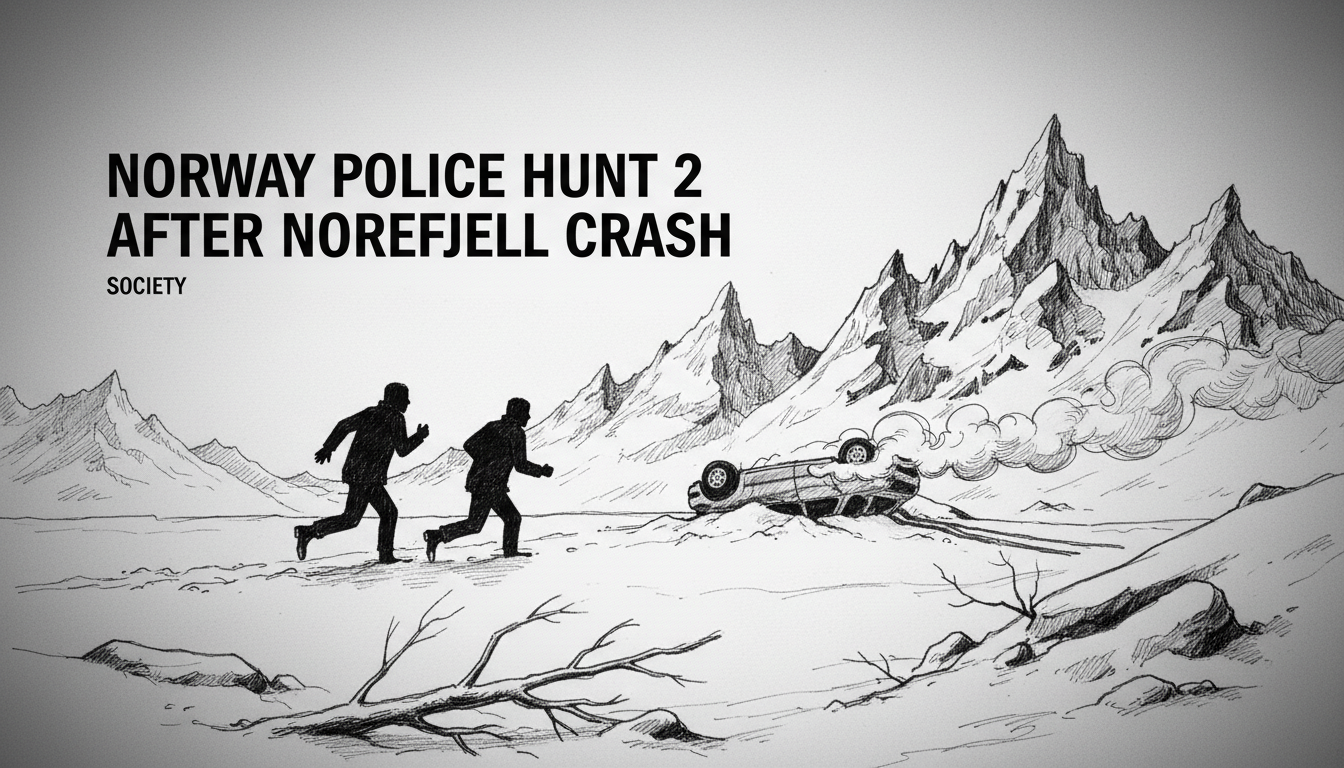
Norway police launched a major search operation Sunday after two people fled the scene of a multi-vehicle accident on the mountainous Norefjellveien road. Witnesses reported seeing the individuals run from one of the involved cars into the surrounding terrain near the popular Norefjell ski resort area.
The Buskerud Police District responded with multiple patrol units, a dog team, and two police helicopters. The search continued for hours across the rugged landscape of Krødsherad municipality. No physical injuries were reported from the crash itself, which occurred around 9:30 AM, but the suspects' flight triggered a significant law enforcement response.
A Dramatic Flight into the Wilderness
Operational commander Marius Fosvold confirmed the details in a police log. "Witnesses observed two persons running from one of the involved vehicles and out into the terrain," Fosvold's statement read. This immediate flight, rather than remaining at the accident scene, transformed a routine traffic incident into a criminal investigation.
The choice of terrain for escape is significant. Norefjell presents a challenging environment for search operations, with dense forests, steep slopes, and variable weather conditions even in late spring. The deployment of two Bell 412 police helicopters from the National Police Directorate's aviation service indicates the seriousness with which authorities are pursuing the individuals.
Expert Analysis: Why Flee an Accident?
Criminologists and legal experts point to several plausible reasons for such behavior. "In a standard traffic accident with no injuries, there is little logical reason to flee into difficult mountain terrain unless there are other factors at play," says Lars Holt, a professor of criminology at the University of Oslo. "This immediately raises flags for police. The most common reasons are driving under the influence of alcohol or drugs, driving without a valid license, or the vehicle being connected to other criminal activity."
The legal consequences for fleeing an accident scene in Norway are severe. Under Norwegian road traffic law, all parties involved in an accident have a duty to stop and exchange information. Leaving the scene can result in fines, license suspension, or imprisonment depending on the circumstances and whether the accident caused injury. The act of fleeing itself becomes a separate criminal charge.
The Logistics of a Mountain Manhunt
The police operation showcases Norway's specialized search capabilities. Dog patrols, often using German Shepherds or Malinois trained in tracking human scent, are a first-line resource. The helicopters provide aerial thermal imaging, which can detect human body heat against the cooler ground, especially effective in the forested and open areas around Norefjell.
Local knowledge is also critical. Krødsherad is a municipality with a small, dispersed population. Police would likely coordinate with local officials and possibly cabin owners in the area. The road involved, Norefjellveien (County Road 287), is a primary access route to the Norefjell ski and hiking area, but side roads and forest trails branch off extensively.
The Broader Context of Norwegian Traffic Enforcement
This incident occurs amid ongoing national discussions about road safety and police resources. Norway has some of the world's strictest laws against driving under the influence, with a general blood alcohol concentration limit of 0.02%. Enforcement is rigorous, and the social stigma is high.
A high-profile search operation like this also tests resource allocation. Mobilizing helicopters and multiple patrol units has a significant cost. The police must balance this against the principle of upholding the law and the potential risk the individuals might pose if they are not apprehended. The lack of immediate physical injury from the crash does not diminish the legal imperative to investigate the flight.
Community Impact in Krødsherad
For residents of Krødsherad, an event of this scale is unusual. The municipality, with a population of just over 6,000, is known for its tranquil nature and outdoor recreation. The sight of police helicopters circling Norefjell would be a stark contrast to the normal Sunday morning atmosphere.
Local tourism could feel a minor, temporary impact. Norefjell is a destination for families and outdoor enthusiasts. While the search was confined to a specific area, news of a police manhunt might give some visitors pause. The municipality's official website promotes its "peaceful and beautiful" setting, a image momentarily challenged by Sunday's events.
What Happens Next?
As of late Sunday, the outcome of the search was not publicly disclosed. The police typically provide updates when a search concludes or if public assistance is needed. If the individuals are not located, the investigation will shift to forensic examination of the abandoned vehicle. Police will check registration, ownership, and any contents left behind.
This forensic link is often key. The vehicle identification number (VIN) can establish registered owner, who then becomes a person of interest. Traffic cameras on major roads leading to Norefjell may have captured the vehicle's approach. Mobile phone data from towers in the area could also be part of a subsequent investigation if a criminal case is prioritized.
The incident serves as a reminder. Even in Norway's seemingly orderly society, unexpected events unfold. A Sunday morning drive in the mountains can rapidly escalate into a national news story when individuals choose to break fundamental social and legal contracts. The vast Norwegian landscape offers freedom, but it also provides few places to hide when the full apparatus of the state begins a search.
The ultimate question remains: what prompted two people to choose a desperate run into the wild over facing the consequences of a traffic accident? The answer, when police provide it, will reveal much more than the cause of a crash.