
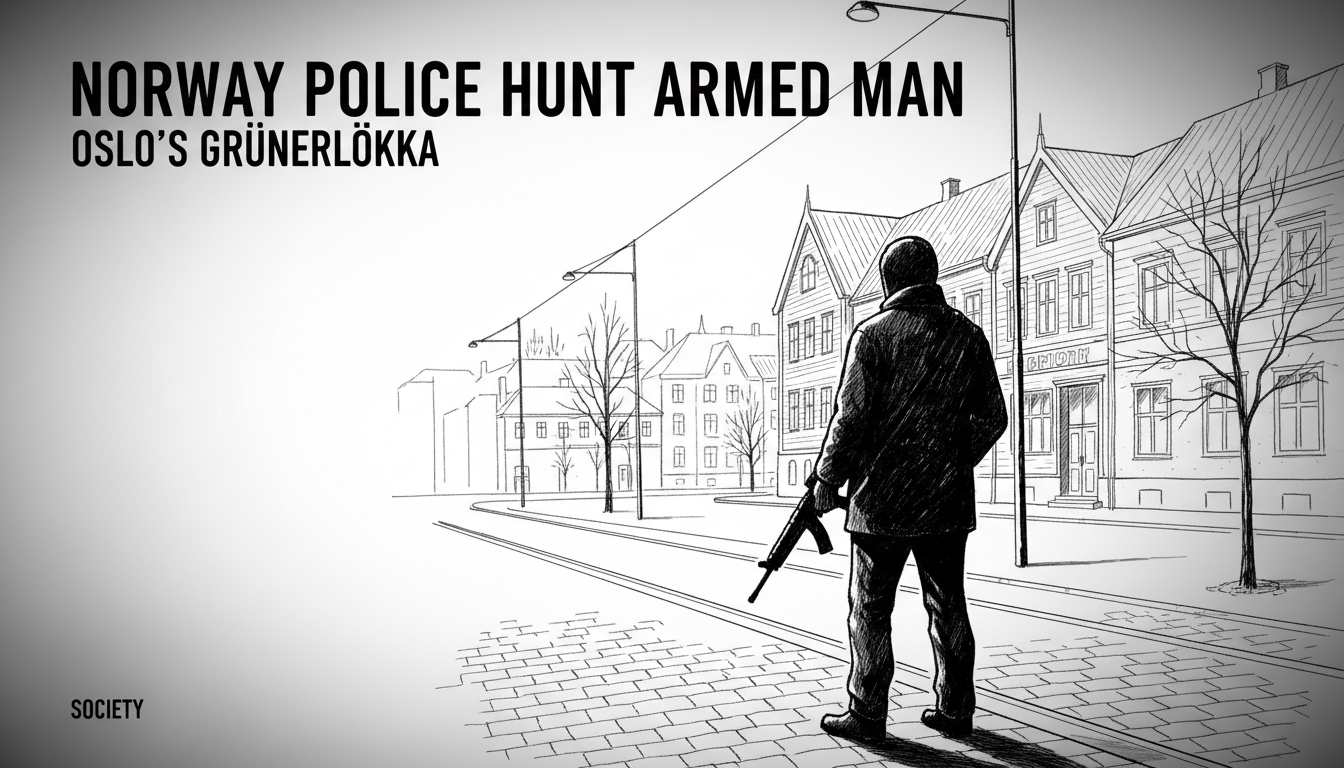
Norway police deployed a major operation to Oslo's Grünerløkka district Monday evening following reports of a man seen with a possible firearm. Witnesses observed an individual carrying an object that resembled a gun, prompting a significant police response in the densely populated area. Operations leader Bjarne Pedersen confirmed the search was ongoing but stated there was no information anyone had been threatened or injured.
A Tense Evening in a Vibrant District
Grünerløkka, known for its bustling cafes, vintage shops, and vibrant street life, experienced an unusual lockdown as police units combed the area. The incident began in the early evening, a time when residents and visitors typically fill the parks along the Akerselva river and the neighborhood's many restaurants. Police focused their search on the location where the individual was last seen, but by 6 PM, they were close to concluding the operation without locating the man or confirming the presence of a weapon. "We have searched where he was last seen, without making any finds," Pedersen said. The decision to scale down the search reflects a common police calculus: balancing public safety with the reality of unconfirmed, single-source reports.
The Challenge of Urban Threat Assessment
This incident highlights the complex protocol Oslo police follow for potential armed threats in urban centers. A rapid response is standard procedure, especially in a crowded borough like Grünerløkka. However, operations must constantly weigh the credibility of witness reports against the risk of causing public panic. "Every report of a possible weapon is treated with the highest priority initially," says security analyst Henrik Lunde, a former police advisor. "The challenge is that in a split-second observation, what appears to be a firearm could be anything from a toy to a tool. The police's gradual scaling down of the operation indicates their assessment of immediate threat likely lowered as the search progressed." The police's clear communication that no one was hurt or directly threatened was a deliberate move to manage public anxiety while the operation was active.
Oslo's Safety Record in a Nordic Context
Scares involving potential firearms are relatively rare in Oslo, particularly compared to other European capitals. Norway maintains strict gun control laws, and legal firearm ownership is predominantly linked to hunting or sport. However, high-profile incidents, such as the 2022 Oslo nightclub shooting and the 2011 Utøya attack, have left a lasting impact on national security psychology. Police are consequently trained to respond decisively to any potential weapon report. This proactive stance is evident in the Grünerløkka response, where the mere possibility of a firearm triggered a substantial deployment. The incident serves as a live test of inter-agency communication and rapid response capabilities in a dense urban environment.
The Human Factor: Witness Reliability and Public Response
Eyewitness accounts form the bedrock of most police responses, but they are also a known variable in security equations. In a lively, distracted environment like Grünerløkka on a Monday evening, the reliability of a single observation can be difficult to immediately verify. Police must act on the information available, often erring on the side of caution. For residents, the sight of a heightened police presence can be both reassuring and alarming. "It's unsettling, of course, but you also feel they are taking it seriously," said one local business owner who asked not to be named. The police's visible activity can reinforce a sense of security, even as the reason for it causes concern. This dual effect is a key part of modern policing in community-focused areas.
Balancing Alertness with Normalcy
As the search concluded without finding the individual or a weapon, the focus shifts from response to aftermath. For Oslo Police District, the event will be logged and assessed. Could the response have been more targeted? Was public communication effective? For Grünerløkka's residents and business owners, life quickly returns to its familiar rhythm. Yet, the evening's events linger as a reminder of the fragile balance between normalcy and alertness in any major city. Norway's low crime statistics do not make it immune to threats, real or perceived. The system's strength is tested not only by tragedies but by how it manages these ambiguous, unresolved incidents. The police operation in Grünerløkka shows a protocol that prioritizes immediate action, then adjusts based on evidence—or the lack thereof.
A Look at Broader Urban Security Strategies
This event, while ultimately inconclusive, fits into a broader discussion about safety in Oslo's public spaces. The city has invested in community policing and visible patrols, particularly in nightlife areas, to prevent crime and build public trust. An incident like Monday's tests that trust. The professional, measured police response aims to demonstrate capability without escalating fear. In the coming days, local police may increase their visibility in Grünerløkka as a confidence-building measure. The ultimate goal is to ensure that one unconfirmed report does not diminish the district's renowned openness and vitality. As the lights of the cafes and bars again define the evening atmosphere, the question remains: How does a society committed to openness protect itself from unseen, unverified threats without compromising the very character it seeks to safeguard?