
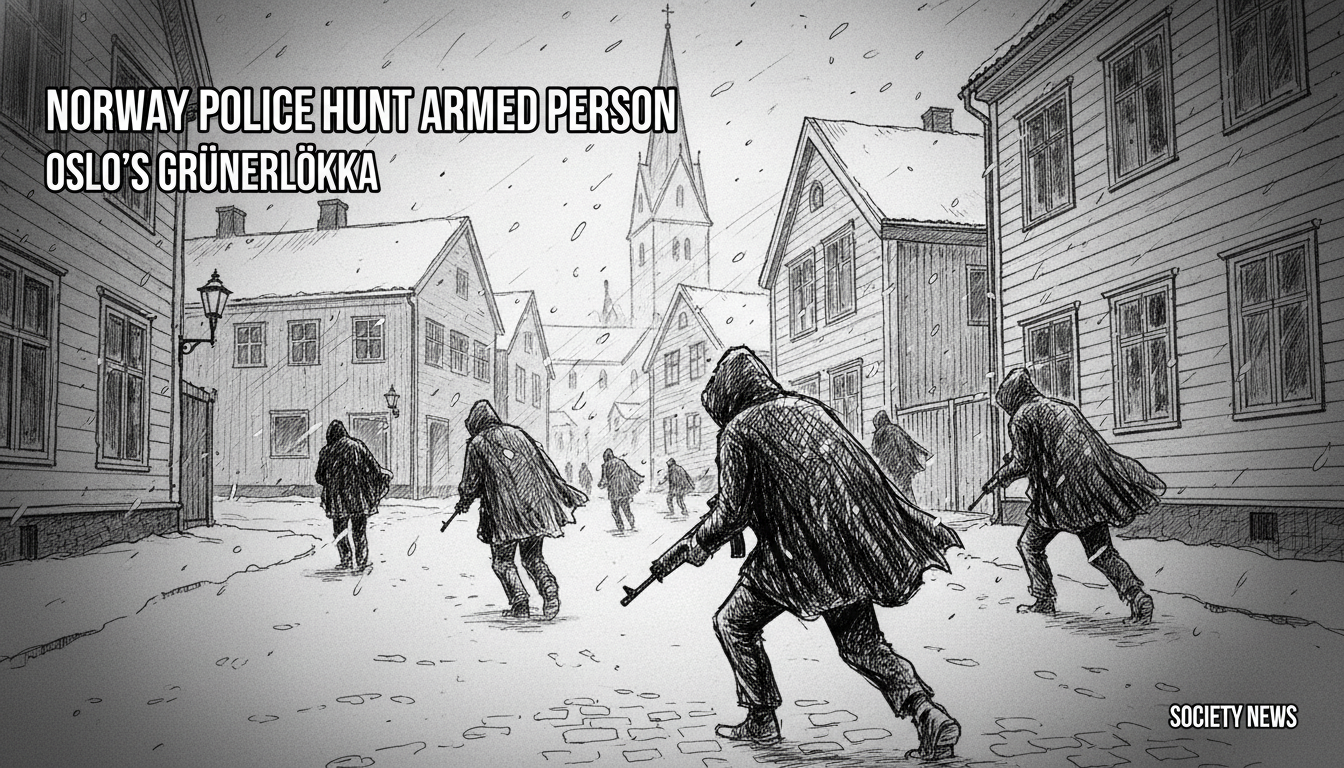
Norway police deployed large forces to Oslo's Grünerløkka district following reports of a person seen with a possible firearm. Witnesses observed an individual carrying an object that appeared to be a gun, prompting a significant police response in the densely populated area. Operations leader Bjarne Pedersen stated authorities are working to locate the person to determine if the object is indeed a weapon, while emphasizing this is not currently considered a threat situation.
A Tense Afternoon in a Vibrant District
For several hours on Tuesday afternoon, the usual lively atmosphere of Grünerløkka was punctuated by police presence. Officers cordoned off sections near popular cafes and vintage shops as they conducted their search. The operation centered on the area around Olaf Ryes Plass, a central square known for its green space and social gatherings. Residents and visitors reported seeing multiple patrol cars and officers on foot moving systematically through the neighborhood.
This response reflects standard Norwegian police protocol for potential weapons sightings. Even unconfirmed reports trigger substantial deployment to ensure public safety. The Oslo Police District maintains a policy of overwhelming response to possible armed incidents, a approach developed through years of operational experience. Police spokespeople later confirmed the operation concluded without locating the individual described by witnesses.
Understanding Norway's Strict Firearms Framework
The incident highlights the context of Norway's stringent gun laws, which stand in contrast to the country's high rate of legal firearm ownership. Approximately 30 registered firearms exist per 100 inhabitants, according to the Small Arms Survey. This statistic reflects Norway's deep-rooted traditions of hunting and sport shooting, particularly in rural regions. Ownership requires comprehensive licensing, mandatory safety courses, and strict storage regulations.
"The police response we saw today is precisely how the system is designed to function," said security analyst Henrik Lunde, who has studied Nordic law enforcement protocols. "Any potential breach of firearm regulations, especially in an urban center, is treated with utmost seriousness. The priority is always to isolate the situation and verify facts before drawing conclusions." He noted that the absence of a declared "threat situation" indicates police were operating on precaution rather than confirmed danger.
Urban Safety Perceptions in a Low-Crime Nation
Norway recorded 32 homicides nationwide in 2022, a figure that remains low by international standards. Gun violence represents a small fraction of these incidents. Most firearm-related crimes in Norway involve illegal weapons smuggled across borders, not licensed hunting rifles or sports guns. This distinction is crucial for understanding the police's investigative focus during the Grünerløkka operation.
Public reactions in the neighborhood were mixed. Some residents expressed concern, noting the unusual sight of heavy police presence in an area known for its relaxed vibe. Others voiced confidence in the authorities' handling of the situation. "You see the police taking it seriously, and that actually makes you feel safer," said Marius Berg, a local café owner. "They're here, they're visible, and they're checking everything. That's how it should work."
Grünerløkka itself has transformed from a working-class industrial area to a gentrified cultural hub over recent decades. This transformation means any incident draws immediate attention from both long-term residents and newer arrivals. The borough's high population density and constant foot traffic make rapid police assessment essential.
The Protocol Behind the Police Response
Norwegian police operations follow a clearly defined escalation ladder. Initial reports of a possible weapon trigger a Level 2 response, which includes multiple patrol units and an operations commander on scene. Officers are trained to secure the area, gather witness statements, and attempt to locate the individual without creating unnecessary public alarm. The statement from Operations Leader Pedersen that there was "no threat situation" was a deliberate communication strategy.
"That terminology is carefully chosen," explained former police superintendent Eva Thorsen. "It informs the public that there is no active shooter scenario, no ongoing danger requiring lockdowns. But it does not mean police are taking the report lightly. They are actively investigating to downgrade or confirm the risk. It's a balance between public reassurance and operational secrecy."
This protocol was refined following national reviews of police responses to critical incidents. The emphasis is on containment, verification, and de-escalation. Police did not issue a general public warning during the Grünerløkka search, suggesting their intelligence indicated a limited, localized concern.
Broader Implications for Norwegian Society
Incidents like today's, while ultimately unconfirmed, spark discussion about urban safety in one of the world's most secure nations. Norway's murder rate is among the lowest globally, yet public sensitivity to potential weapon sightings remains high. This sensitivity reflects a social consensus that weapon-related threats have no place in public spaces.
Parliamentary representatives from the Oslo region often face questions about police resources in inner-city districts. The Storting recently approved increased funding for Oslo Police District patrol capacities, with specific allocations for rapid response teams. Today's deployment likely involved some of these newly bolstered resources.
Comparisons with other Nordic capitals are inevitable. Stockholm and Copenhagen have faced greater challenges with gang-related gun violence in certain neighborhoods. Oslo's experience remains different, with fewer firearm incidents linked to organized crime. The Grünerløkka operation appears unrelated to criminal networks, focusing instead on an isolated individual's behavior.
A Resolution Without Answers
As police units withdrew from Grünerløkka by late afternoon, the central question remained unanswered. Was the object a genuine firearm, a realistic replica, or something entirely benign mistaken by witnesses? Police confirmed the search had concluded but the investigation remains open. They will review CCTV footage from local businesses and public cameras along the Akerselva river.
Norwegian law treats the illegal carrying of a firearm in public as a serious offense, punishable by imprisonment. Even brandishing a replica weapon in a threatening manner can lead to charges. The police investigation will now shift from immediate response to forensic analysis of evidence and detailed witness interviews.
The incident serves as a real-time test of Oslo's urban security apparatus. It demonstrated rapid deployment, clear public communication, and a measured use of force. No injuries were reported, no property was damaged, and daily life resumed quickly. For the residents of Grünerløkka, the event will likely become a brief topic of conversation rather than a marker of declining safety.
Yet the underlying tension persists. In a nation proud of its peaceful civic culture, the mere possibility of a weapon in a public park triggers profound institutional response. This reaction reveals Norway's deep commitment to preserving its low-crime society, even when faced with unverified reports. The system's default setting is caution, a principle on full display in Oslo today.