
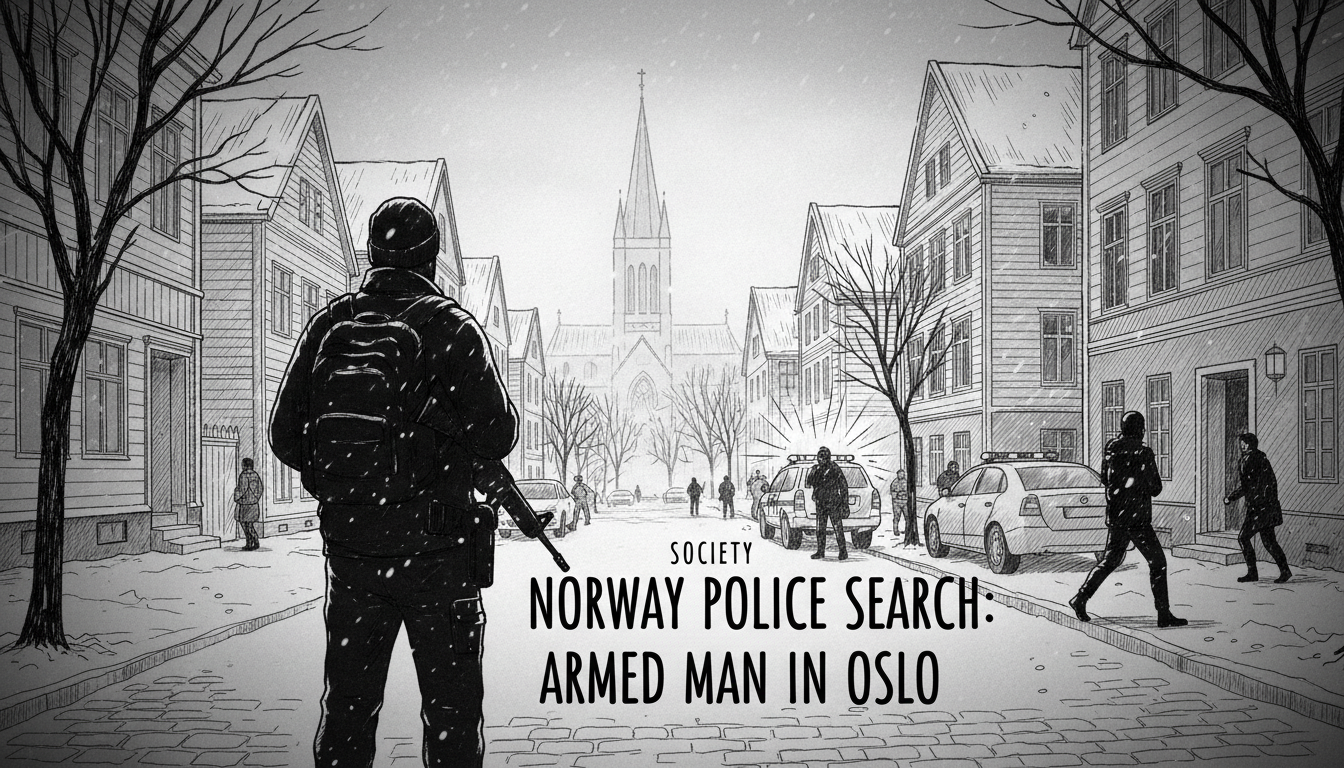
Norway police deployed a large force to Oslo's Grünerløkka district Monday evening following reports of a person seen with a possible firearm. The incident, which triggered a significant public safety response, ended without locating the individual or confirming the presence of a weapon, highlighting the swift and serious reaction to any potential gun threat in the capital.
"Witnesses have seen someone carrying something that could appear to be a firearm," said operations leader Bjarne Pedersen. Police worked through the evening to locate the person and determine if a weapon was actually involved. By 6 p.m., the search was winding down. "We have searched where he was last seen, without making any finds," Pedersen stated, adding that there was no information anyone had been threatened or injured.
A Swift and Serious Response
The police response was immediate and substantial. Grünerløkka, a borough known for its dense population, trendy cafes, and vibrant nightlife, saw an increased police presence as officers conducted searches. This rapid mobilization reflects standard Norwegian police procedure for any report involving a potential firearm. In a country with strict gun control, such sightings are treated as high-priority incidents, even when the threat remains unconfirmed.
Public safety protocols in Oslo are designed to minimize risk. The operation focused on locating the individual for clarification, a process police describe as precautionary. The absence of any reports of threats or injuries allowed authorities to conduct a methodical search without escalating to a full-scale emergency lockdown of the area, which can disrupt the lives of thousands of residents and businesses.
The Context of Norway's Gun Laws
This incident gains its significance from Norway's rigorous firearm regulations. The country has some of the strictest gun control laws in Europe. Ownership of most firearms requires a permit, which is typically granted only for hunting, sport shooting, or professional purposes like farming. Applicants must pass background checks, demonstrate a clean criminal record, and often complete safety courses. Automatic weapons are generally prohibited for civilian ownership.
These laws contribute to a society where gun violence is statistically rare. According to official statistics, Norway experiences low levels of homicide compared to international averages. In 2022, there were 32 homicides in the entire country, with only a fraction involving firearms. The public display or implied threat of a gun is therefore an abnormal and alarming event that commands an outsized police response, as seen in Grünerløkka.
Expert Analysis on Public Safety and Perception
Security analysts note that the police's approach balances caution with proportionality. "The Norwegian model is to take all reports of potential weapons seriously to prevent any possibility of escalation," says a researcher from the Norwegian Police University College. "This creates a high threshold for response, but it is a cornerstone of maintaining public trust and a low-crime environment."
The effectiveness of this system is evident in public confidence levels. Surveys consistently show Norwegians have high trust in their police force. Incidents like the one in Grünerløkka test this protocol. The outcome—a search that found no suspect or weapon—can be viewed in two ways: as a successful de-escalation of a potential threat, or as a resource-intensive response to a possible misunderstanding. Experts argue the former perspective is paramount for preventive policing.
However, analysts also point to the psychological impact on a community. Even an unconfirmed report can create temporary anxiety. "In a place like Grünerløkka, with its open parks and crowded streets, the idea of a weapon feels deeply incongruent," a local sociologist commented. "The police response reassures the public that this incongruence is taken as seriously as they feel it should be."
Life in a Vibrant Urban District
Grünerløkka is not a typical high-crime area. Once an industrial working-class district, it has transformed into one of Oslo's most sought-after neighborhoods. It is characterized by renovated brick apartments, independent boutiques, and a high concentration of restaurants and bars. The area along the Akerselva river is a popular recreational spot for families and joggers. This context makes a report of a possible firearm particularly jarring for residents and visitors accustomed to its generally safe and open atmosphere.
The police presence in the district is normally visible but low-key, focused on community policing and managing nightlife. Monday's event represented a shift to a high-alert operational mode. Business owners and residents reported seeing more patrol cars and officers on foot, but described the atmosphere as one of focused investigation rather than panic. The normal evening activity in the area continued, albeit with an awareness of the ongoing police activity.
The Broader Implications for Urban Security
This incident serves as a live exercise in Oslo's urban security preparedness. It tests communication between emergency services, the deployment of personnel, and the management of public information. Police were careful to release statements that were factual and avoided speculation, a practice designed to inform without inciting unnecessary fear.
Comparatively, similar unconfirmed weapon reports in major European capitals might not always generate the same scale of response. Norway's approach is rooted in its overall security strategy, which prioritizes the prevention of rare but high-impact violent events. Every such report is filtered through the memory of national tragedies, leading to an unwavering policy of immediate and thorough investigation.
This strategy has implications for resource allocation. Oslo police must balance these necessary, precautionary responses with other daily duties. The fact that the search was concluded within hours suggests a calibrated system where resources can be surged quickly and then stood down when the initial threat is assessed as unsubstantiated or contained.
A Return to Normalcy
By late Monday evening, police operations in Grünerløkka had concluded. The streets returned to their usual pace. The incident, while unresolved, was filed as an unconfirmed report. For the police, the case may remain open for follow-up if new information emerges, but the immediate threat assessment was closed.
For residents, the event is a reminder of the security infrastructure that operates quietly in the background. It reinforces a social contract where the public is encouraged to report suspicious activity, and authorities are expected to respond with seriousness. The lack of a found weapon or suspect does not diminish the validity of that process in the eyes of law enforcement.
Norway's gun control framework remains unchallenged by this event. If anything, the response reaffirms the societal consensus behind it. The sighting of a possible weapon in a populous Oslo district is a notable exception that proves the rule of a generally firearm-free public space. The system reacted exactly as designed: with speed, visibility, and thoroughness, aiming to ensure that a potential threat does not become a real one.
As the night settled over Grünerløkka, the questions from the evening remained unanswered. Who was the reported individual? What were they actually carrying? The ambiguity is unsatisfying but ultimately reflects a common outcome in urban policing. The greater certainty—that such reports will mobilize a decisive and precautionary response—is what defines public safety in the Norwegian capital. In a world where urban threats are often discussed in abstract terms, Oslo's protocol remains concrete: see something, say something, and expect a significant response.