
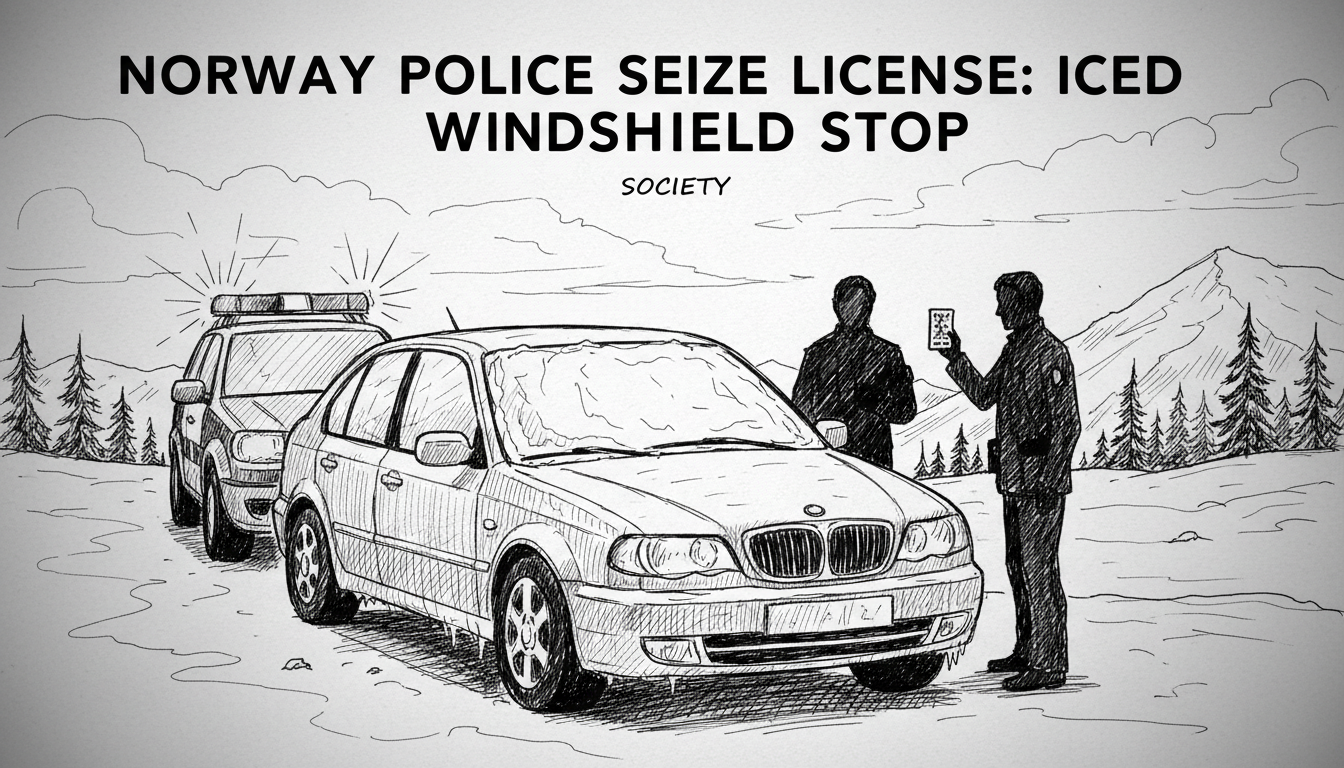
Norway police stopped a car with a fully iced-over windshield on the Rasta roundabout in Lørenskog Saturday evening. The driver had his license confiscated immediately and was questioned at the scene, according to a police statement from the Eastern region. This routine winter traffic stop highlights the uncompromising enforcement of road safety laws that define Norwegian driving culture, especially during the long, dark months where visibility is paramount.
A Common Yet Critical Violation
The incident, while brief, is far from isolated. Every winter, Norwegian police conduct hundreds of stops for vehicles with poorly cleared windows. The legal basis is clear and strict. Section 3-1 of the Norwegian Road Traffic Act states that a vehicle must be in such a condition that it does not pose a danger or unnecessary inconvenience to anyone. More specifically, regulations mandate that the driver must have a clear and unobstructed view forward and to the sides. A completely iced windshield, as described in the Lørenskog case, constitutes a direct and severe breach of this fundamental rule. "The driver's field of vision is the single most important safety system in the car," explains a senior traffic safety advisor with the Norwegian Public Roads Administration. "When that is compromised, especially in winter conditions with potential ice, poor light, and other hazards, the risk of a serious accident multiplies dramatically."
Police authority to act is equally unambiguous. Under the Act, an officer can confiscate a driver's license on the spot if they believe the driver represents an immediate danger to traffic safety. This power, exercised in Lørenskog, is a preventive measure. It removes the risk instantly by taking the driver off the road. The confiscation is typically administrative and temporary, pending a formal review and potential fine, but it underscores the seriousness with which authorities treat such violations. The subsequent fine for driving with an obstructed view can reach several thousand kroner, depending on the circumstances and the driver's record.
The Human Factor in Harsh Conditions
Why would a driver set out with a frozen windshield? Road safety experts point to a combination of haste, underestimation of risk, and overconfidence. "It's a classic case of convenience overriding safety," says a behavioral researcher at the Institute of Transport Economics in Oslo. "People are running late, they scrape a small 'porthole' and think it's sufficient for the short trip. They fail to account for the reduced peripheral vision, the glare from oncoming lights on the frosted glass, or the possibility of a pedestrian or cyclist appearing from the obscured area." In the dense traffic network of Greater Oslo, where Lørenskog is situated, such a decision affects not only the driver but countless others sharing the road.
The location of the stop is itself indicative. The Rasta interchange is a major transportation hub east of Oslo, connecting the E6 and E18 highways. Traffic volume is high, and speeds are significant even on the access ramps and roundabouts. A vehicle with near-zero forward vision navigating this complex is a clear public safety hazard. Police patrols in the region are specifically attuned to vehicle readiness during winter months, conducting checks not just for ice, but for defective lights, bald tires, and inadequate clearing of snow from the car's roof, which can slide onto the windshield during braking.
A Culture of Proactive Safety Enforcement
This enforcement philosophy is rooted in Norway's broader approach to road safety, which has produced some of the world's lowest fatality rates. The policy is proactive and prevention-focused. Rather than only responding to accidents, police actively intervene to stop dangerous behavior before it leads to a crash. The immediate license confiscation is a tool of deterrence, sending a strong message to the individual driver and the broader public. Legal analysts note that the system is designed for swift action. "There is little room for debate on the spot," says a lawyer specializing in traffic law. "If the officer's assessment is that the view is dangerously obstructed, the law supports immediate intervention. The driver's arguments are for the subsequent hearing, not the roadside."
This contrasts with approaches in some other countries where a warning or a ticket might be the first response. In Norway, the principle is that the danger is present and immediate, thus the response must be too. This is particularly true for impairments that directly affect vehicle control—like visibility, intoxication, or extreme fatigue. The goal is to create a strong social norm where preparing your car for winter driving is as automatic as buckling your seatbelt.
Beyond the Traffic Stop: Broader Implications
While the Lørenskog incident is a single event, it connects to larger conversations about urban planning and winter readiness. Municipalities like Lørenskog have a responsibility for road maintenance, including salting and plowing, but the ultimate responsibility for the vehicle's condition rests with the driver. The case also touches on the debate about technology versus responsibility. While modern cars offer heated windshields and advanced defrosting systems, they are aids, not replacements for the driver's duty to ensure a safe departure.
Road safety campaigns in Norway repeatedly emphasize the "five-minute rule"—taking those extra few minutes before driving to properly clear all windows, mirrors, lights, and the roof. The alternative, as this driver discovered, is a sudden and costly interruption to your journey, a lost license, and a day in court. For visitors and new residents, understanding this aspect of Norwegian law is crucial. The expectation to drive a fully winter-ready vehicle is non-negotiable, and enforcement is predictable and strict.
A Clear Message as Winter Deepens
As temperatures drop and daylight hours shrink across Akershus county, the police stop on Rasta serves as a timely reminder. Norwegian driving laws prioritize collective safety over individual convenience. The iced windshield is not a minor nuisance; it is a critical failure in vehicle preparation that police are mandated to address decisively. The driver in Lørenskog will face legal and financial consequences, but the broader lesson is for every motorist: in Norway, safe winter driving begins not when you start the engine, but when you pick up the ice scraper. The clear view from the driver's seat is not just a recommendation—it is the law, and it is enforced with the full expectation that it saves lives. Will this zero-tolerance approach continue to define Norway's path toward its vision-zero traffic safety goals?