
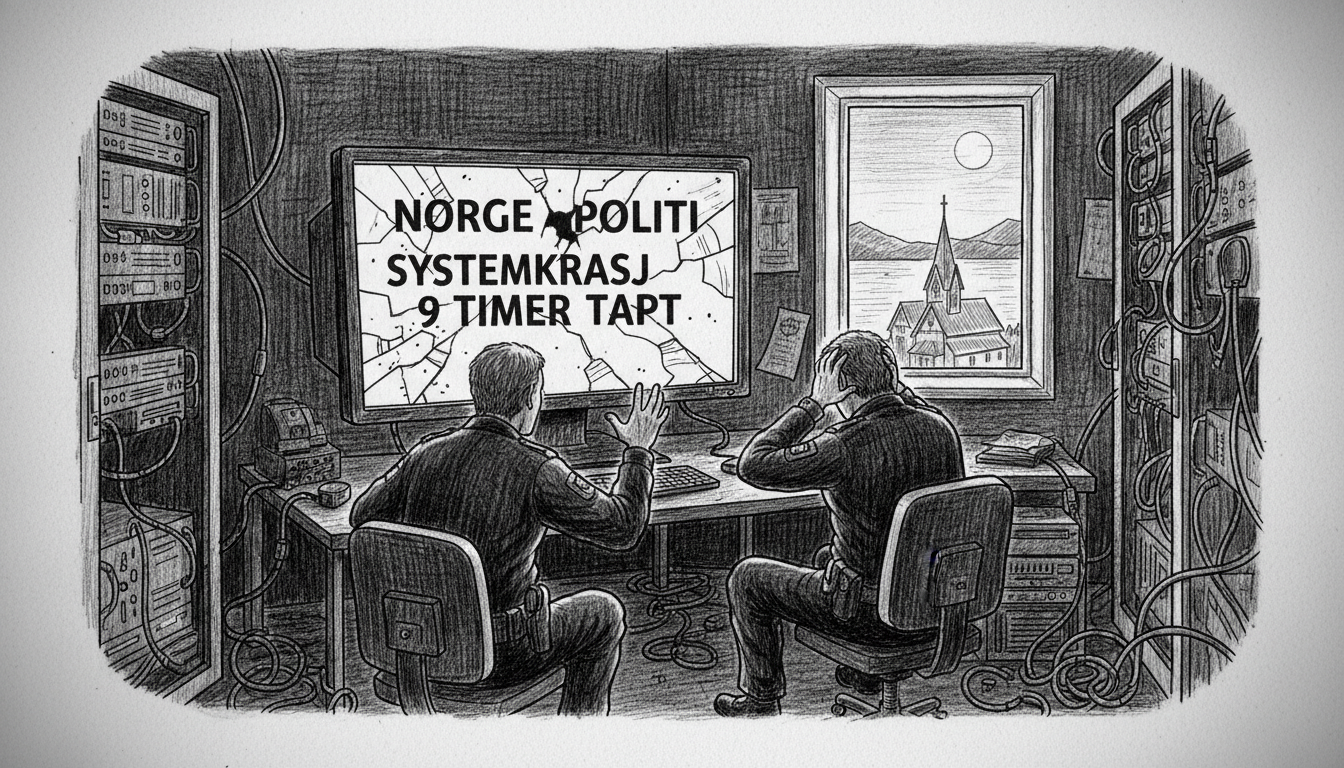
Norway's primary police website politiet.no collapsed for nine consecutive hours on Friday, blocking public access to emergency forms, crime reporting, and official alerts. Citizens attempting to visit the national police portal were met only with a stark '404 Page Not Found' error on a blank white screen, raising immediate concerns over digital resilience and public communication channels.
The outage began in the morning and persisted into the afternoon, severing a critical link between the public and Norway's unified police service. The site hosts essential services including the ability to report non-emergency crimes, apply for permits, access safety advice, and read official press releases. While emergency calls to 112 and 02800 remained operational, the digital blackout highlighted a significant single point of failure for day-to-day police contact.
A Single Point of Failure Exposed
Technical experts contacted for analysis pointed to the simplicity of the error message as a key detail. The generic '404' notice typically indicates the server cannot locate the requested resource, often due to internal configuration errors, failed updates, or severe server malfissions. "For a major public service, this is not just an inconvenience," said IT security analyst Kari Johansen. "The complete lack of a fallback or status page suggests an underlying infrastructure problem, not a planned maintenance window. In an era of hybrid threats, availability is a core component of public trust."
The Norwegian Police Service, which falls under the Ministry of Justice and Public Security, confirmed the outage in a brief statement. They attributed the disruption to "an internal technical error" during a routine update process, ruling out external cyber attacks. Service was fully restored by late afternoon. However, the statement did not detail why redundancy measures failed or what specific update caused the cascade failure.
Communication Shift to Social Media
During the outage, the police pivoted to social media platforms X (formerly Twitter) and Facebook to communicate with the public. This shift underscores a growing, if unofficial, reliance on private platforms for core public information dissemination. "It shows we have a backup, but it also fragments official communication," noted Lars Bekken, a researcher in digital public administration. "Not everyone uses these platforms. The official .no domain must be the anchor of reliability."
The incident prompts scrutiny of Norway's broader digital public infrastructure. In recent years, the Norwegian Digitalisation Agency (Digdir) has pushed for more cohesive and resilient online public services under the 'Digital Norway' strategy. High-profile outages, whether in police, tax, or health services, test the strategy's real-world execution. This single-point failure contrasts with Norway's advanced digital reputation, built on a robust fiber-optic network and high internet penetration.
Comparative Resilience and Global Context
While brief, the nine-hour outage places Norway in a global conversation about the resilience of essential services. Other Nordic countries have faced similar challenges. Sweden's Transport Agency suffered a major IT crisis in 2017 after a controversial outsourcing deal, while Denmark periodically grapples with outages in its MitID digital identification system. Norway's incident was shorter but notable for affecting a law enforcement agency.
Security analysts emphasize that even outages with benign causes, like a failed update, can erode public confidence. They also create a smokescreen that could be exploited by malicious actors. "Every unplanned outage must be treated as a potential security incident until proven otherwise," Johansen stressed. "The response time, transparency, and restoration protocol are all part of the security posture. A clear, public post-mortem would be a positive step."
The Road to Reliable Digital Services
The silent white error page serves as a metaphor for a communication breakdown. It offered no explanation, no estimated restoration time, and no redirect to alternative resources. For a service that handles sensitive crime reports and public inquiries, this lack of crisis communication is as significant as the technical fault. The police's social media team performed adequately, but the primary web portal's silence was glaring.
This event will likely trigger internal reviews within the Police IT service (Politiets IT-tjeneste) and questions from the Storting's Standing Committee on Justice. The committee has previously examined cybersecurity preparedness across public sectors. The core question is whether investments in digitalization have been matched by investments in stability and fail-safes. As one ministry official remarked off the record, "The public's tolerance for digital downtime in essential services is now effectively zero."
Norway's police website is back online, but the Friday outage reveals a fragile layer in the nation's digital infrastructure. It underscores that for all Norway's advancements in oil, gas, and maritime technology, the basic digital plumbing of public service requires constant, vigilant maintenance. The true test will be what the police and the Ministry of Justice learn from this nine-hour window of digital silence, and how they apply those lessons before the next inevitable system stress occurs. In a nation increasingly governed through screens, a blank page is more than an error—it's a warning.