
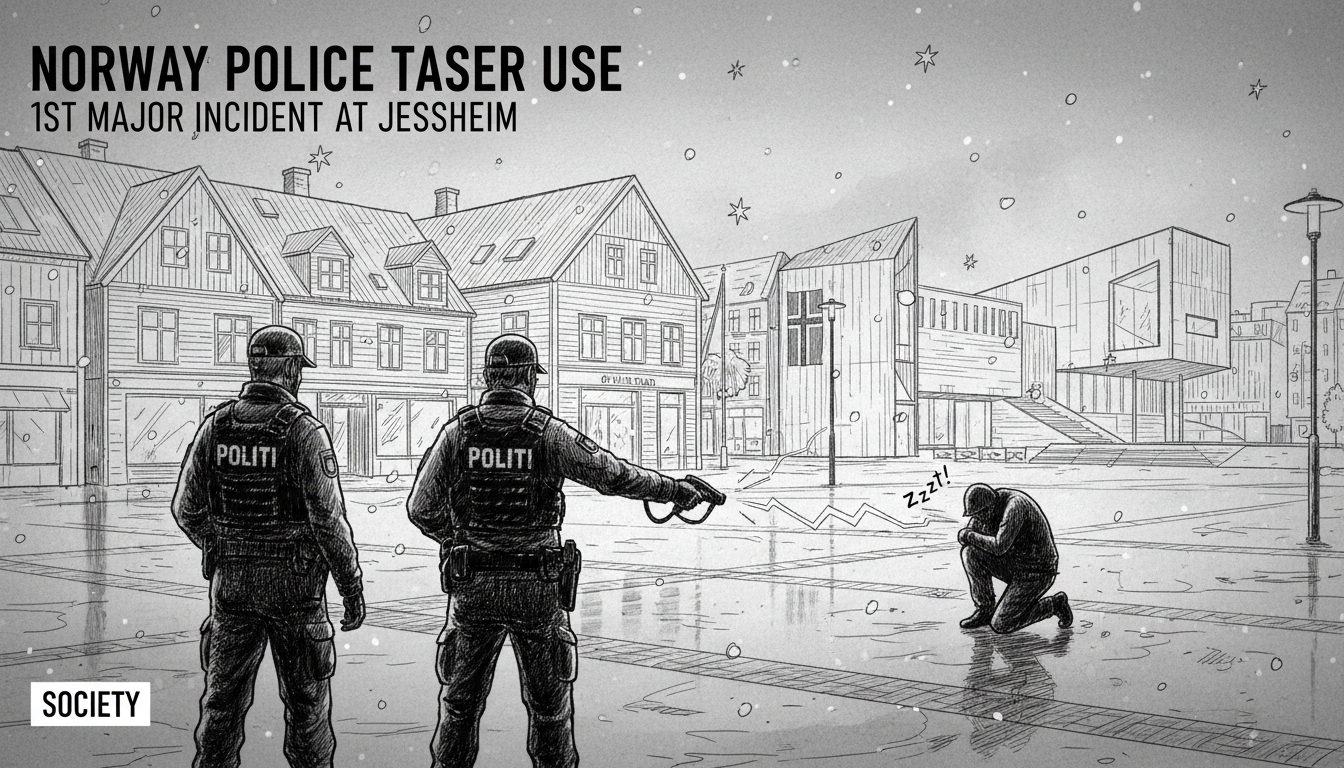
Norwegian police deployed an electroshock weapon to subdue a threatening individual at Jessheim station early Wednesday morning. The incident marks one of the most significant public uses of a taser since national rollout began, testing Norway's strict use-of-force protocols. Officers from the Øst police district responded to a theft report where a person claimed their mobile phone was stolen. The suspect, present at the scene, then behaved in a threatening manner toward the police patrol. Authorities used the conducted electrical weapon to gain control before taking the individual into custody at a local arrest cell. This event near Oslo Gardermoen Airport puts a spotlight on the tools available to Norwegian officers and the ongoing debate about policing methods in one of the world's most peaceful nations.
A Night at Jessheim Station
The confrontation occurred in Ullensaker municipality, a key commuter hub northeast of Oslo. Police were initially contacted by a person reporting a stolen mobile phone. When officers arrived at Jessheim station, they located both the complainant and the alleged thief. The situation escalated when the suspect directed threatening behavior toward the uniformed officers. Faced with a volatile and potentially dangerous individual, the patrol decided to deploy their issued electroshock weapon, commonly known as a taser. The weapon delivers a high-voltage, low-amperage electrical charge designed to temporarily incapacitate a person by causing involuntary muscle contractions. The suspect was subdued, arrested, and transported without further incident, according to the Øst police district's statement.
From Pilot Program to Standard Issue
This incident is not an isolated test but part of a deliberate national strategy. Norwegian police began a carefully monitored pilot program for tasers in 2015, restricting them to select districts and highly trained officers. The evaluation period lasted years, with authorities collecting data on deployment frequency, effectiveness, and outcomes. In 2022, based on the pilot's findings, the Ministry of Justice and Public Security approved the nationwide rollout. The decision mandated equipping all police districts with these weapons. The official policy states tasers serve as an alternative to firearms in situations posing a risk of serious violence. They are intended to fill a gap between physical restraint, batons, and lethal force, providing a tool for distance management.
The Proportionality Principle in Practice
Every use of force by Norwegian police is measured against the legal principle of proportionality. This principle, enshrined in Norwegian law and police guidelines, requires that any force used must be the minimum necessary to achieve a legitimate policing objective. De-escalation tactics are always the primary strategy. The incident at Jessheim will undergo a standard review process. Supervisors will examine whether the threat level justified deploying the electroshock weapon or if other, less forceful options were available. This internal accountability is a cornerstone of the Norwegian model. "The threshold for using force in Norway remains very high," said a senior police instructor who wished to remain anonymous as they are not the official spokesperson. "The taser is not a compliance tool; it is a weapon for managing imminent threats of violence."
Expert Views on Tools and Trust
Criminologists and human rights experts follow the implementation of tasers closely. The debate centers on a fundamental tension. On one side, police unions and some policymakers argue officers need effective, less-lethal options to protect themselves and the public without resorting to guns. Norway has a notably unarmed police force in daily operations, with firearms locked in patrol cars. A taser can theoretically resolve a dangerous situation without permanent injury. On the other side, experts warn of "mission creep" and the risk of overuse. "The introduction of any new use-of-force tool requires immense focus on training, oversight, and culture," said Dr. Lena Larsen, a researcher at the University of Oslo focusing on policing. "The key question is whether this tool reduces overall police violence or simply introduces a new form of it in situations that could be resolved verbally." Public trust, exceptionally high in Norway compared to many countries, depends on transparent evaluation of each incident.
Comparative Context: A Nordic Exception?
Norway's cautious approach contrasts with some of its neighbors and other Western nations. In Sweden, police have used tasers for a longer period but also under strict regulations. Danish police employ them as part of their standard kit. The United States and the United Kingdom have seen widespread deployment and subsequent controversy over misuse and health risks. Norway's model is distinct for its phased, evidence-based introduction and its integration into a policing philosophy that prioritizes communication. The Jessheim case provides a real-world data point. Was the individual armed? What specific threats were made? The answers will help determine if the deployment aligns with Norway's goal of using tasers only as a firearm alternative, not as a general compliance device.
Training and Accountability Mechanisms
Officers authorized to carry electroshock weapons undergo rigorous training. The program includes legal frameworks, technical proficiency, scenario-based drills, and de-escalation techniques. Each weapon is equipped with a data port that records the time, date, and duration of every activation. This creates an immutable record for review. Following any deployment, like the one in Jessheim, officers must file a detailed report. An independent oversight body, the Norwegian Bureau for the Investigation of Police Affairs, can be called upon to investigate serious incidents if there are allegations of misconduct or significant injury. This multi-layered system of checks aims to prevent arbitrary use and maintain public confidence.
The Road Ahead for Norwegian Policing
The early-morning incident at a quiet commuter station is more than a local crime brief. It represents a milestone in Norwegian law enforcement's evolving toolkit. As tasers become a common sight on officers' belts across the country, from the busy streets of Oslo to the remote communities of Finnmark, their application will continue to spark discussion. Future debates in the Storting may focus on funding for ongoing training and the publication of aggregated deployment statistics. The essential balance Norway seeks is clear: empowering police to safely do their jobs while upholding the nation's deep commitment to humane and proportionate state authority. The resolution of the Jessheim case, and the official review of the officers' actions, will inform that balance. It serves as a test of both technology and principle.