
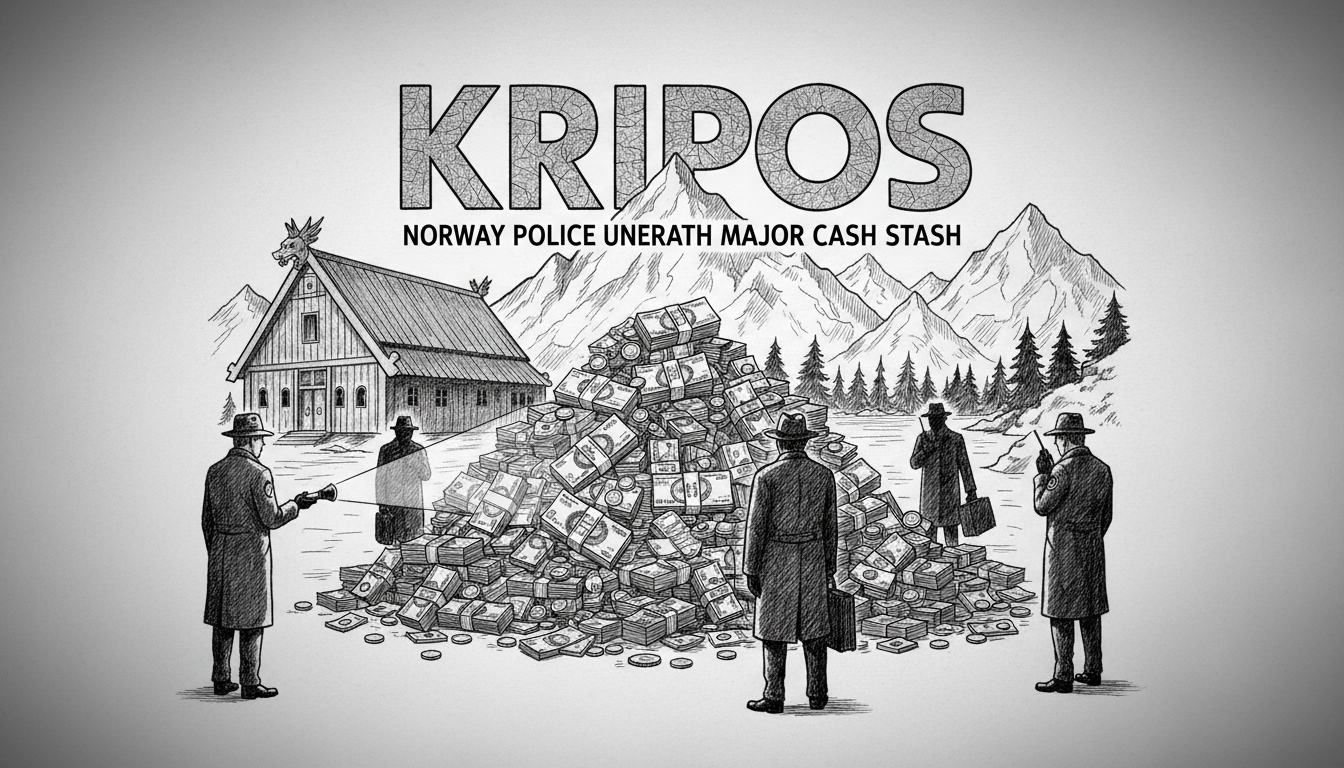
Norway's police are investigating a significant cash discovery after construction workers unearthed a large sum of money buried in a Sandnes street. The find in Oalsgata on Tuesday afternoon has prompted the involvement of the national criminal investigation service, Kripos, signaling a potential link to serious organized crime. Officers secured the money, described only as a substantial amount potentially reaching hundreds of thousands of kroner, and have launched a formal investigation.
"The cash must be handled in a way so that we don't destroy anything. It could easily be several hundred thousand kroner, more or less," said operations manager Roger Litlatun. He declined to specify the age of the banknotes or the exact total, citing the ongoing probe. The money is now in police custody as forensic experts examine it for clues.
A Discovery That Points to Deeper Crimes
The immediate involvement of Kripos, Norway's National Criminal Investigation Service, is the most telling aspect of this case. Kripos does not typically assist with minor lost-and-found incidents. Its mandate focuses on complex, serious, and organized crime that crosses police district boundaries. This includes major financial crime, money laundering, and large-scale narcotics operations.
"When Kripos is called in at this early stage, it strongly indicates the local police have reasonable grounds to suspect the money is proceeds from crime," explains Lars Jacob Gjertsen, a former financial crimes investigator. "A private citizen burying legitimate savings in a public street is highly improbable. The investigation will now focus on tracing the origin of these notes, their age, and any forensic evidence like DNA or fingerprints."
The location adds another layer of intrigue. Sandnes is part of the Stavanger metropolitan area, the wealthy oil capital of Norway. The region has seen its share of financial crime linked to the high-income energy sector. Buried caches of cash are often associated with criminals seeking to hide assets from authorities or other criminal groups, a practice known as "banking in the ground."
The Forensic Path to Answers
Police face a meticulous forensic challenge. Modern Norwegian banknotes contain security features, but if the money is older or consists of foreign currency, tracing becomes harder. Experts will examine the serial numbers, the condition of the notes, and the materials used to wrap or contain them. Soil analysis on the money and the burial site could help establish how long it was hidden.
"Every step is crucial to avoid contaminating evidence," said Litlatun, highlighting the care being taken. The excavation site itself will be thoroughly examined. Police are likely reviewing local crime reports for large thefts or unsolved cases where such a sum went missing. They will also be alert to patterns; similar buried cash discoveries in Norway have sometimes been linked to drug trafficking networks storing profits.
Under Norwegian law, finding lost property carries an obligation to report it. If the owner cannot be identified, and if the money is not proven to be linked to a crime, it could eventually be claimed by the finder. However, given Kripos's role, the path to a lawful claimant appears narrow. The state is the most likely ultimate recipient if the money is deemed criminal proceeds.
The Broader Context of Cash and Crime in Norway
This discovery occurs within Norway's ongoing push against financial crime and money laundering. As a largely cashless society with robust banking oversight, large physical cash hoards are increasingly anomalous. Their existence often points to activity operating outside the formal financial system.
Norway's National Authority for Investigation and Prosecution of Economic and Environmental Crime (Økokrim) regularly highlights that cash remains the lifeblood of organized crime segments for paying operatives and laundering profits through businesses. A buried stash suggests someone needed to physically hide value, possibly from law enforcement, tax authorities, or criminal competitors.
"This isn't just about finding money; it's about following a trail," Gjertsen notes. "Who buried it? Why there? Why not in a safe deposit box? The answers to those questions could lead to a much larger investigation. This sum might be a single transaction's profit or a small part of a much larger hidden fortune."
Police have not indicated any suspects or linked the find to any active investigation. They have stated they cannot release further details due to investigative considerations. This silence suggests they are pursuing active leads and do not want to alert potential suspects.
What Happens Next in the Investigation
The investigation will proceed on parallel tracks. Forensically, the cash itself is the primary witness. Operationally, police will likely conduct door-to-door inquiries in the neighborhood, check for any surveillance camera footage in the area, and analyze financial records of any persons of interest. The involvement of Kripos provides access to national databases and intelligence on criminal networks.
For local residents in Oalsgata, the discovery is a startling disruption. The quiet residential street has become a crime scene, a reminder that illicit activities can surface anywhere. The police presence and ongoing investigation will likely continue for some time as they meticulously work the case.
The ultimate outcome hinges on what the evidence reveals. If the money can be traced to a specific crime, such as a major robbery or drug sale, it will be held as evidence for a prosecution. If its origin remains a mystery but is still deemed suspicious, the state may still move to confiscate it under asset forfeiture laws designed to deprive criminals of their resources.
This case underscores a reality of modern policing: significant criminal evidence often comes to light by accident. A routine construction project has potentially exposed a hidden financial secret, giving authorities an unexpected opportunity to disrupt criminal activity. The careful, methodical work of the Sandnes police and Kripos will now determine whether this buried treasure yields a far more valuable prize: justice.