
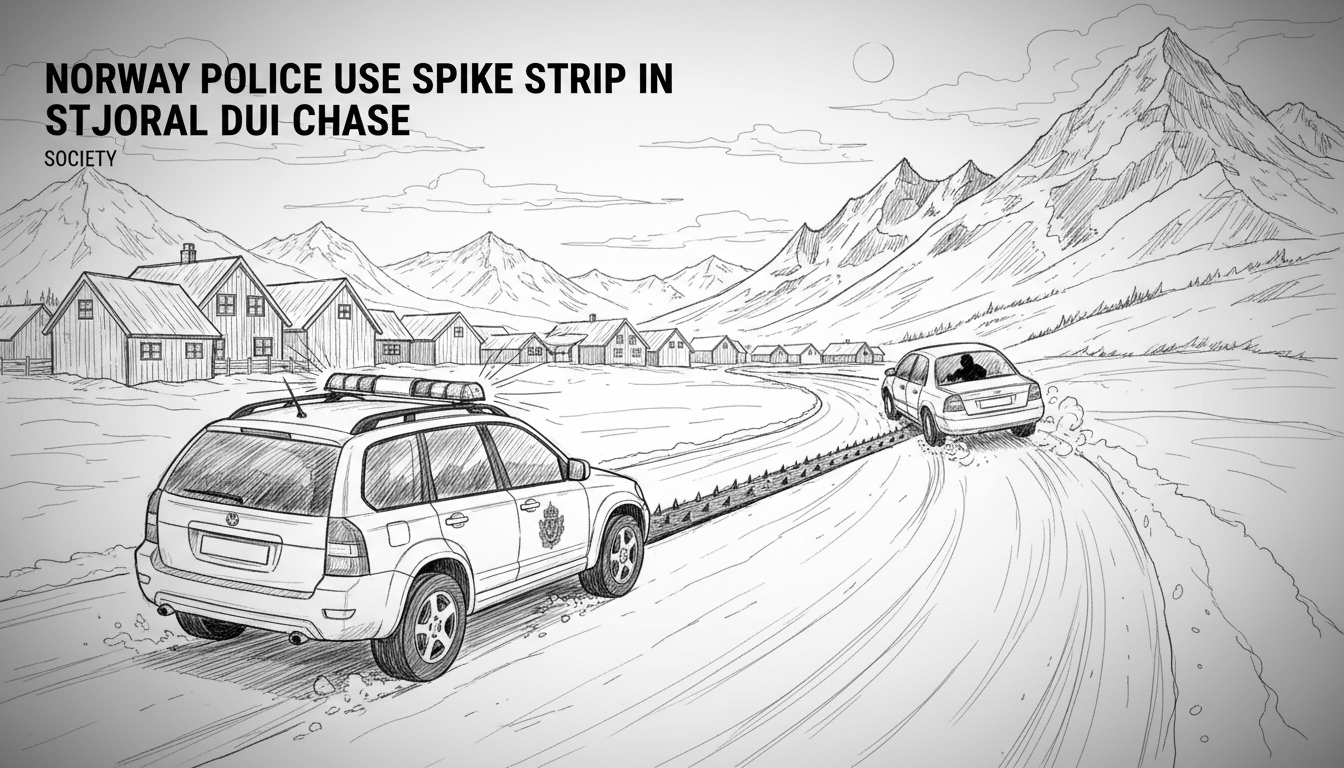
Norway police in Trøndelag deployed a spike strip to stop a suspected drunk driver who refused to pull over for a routine check in Stjørdal early Sunday morning. The dramatic intervention highlights the lengths to which Norwegian law enforcement will go to enforce the country's strict impaired driving laws. A man in his 50s now faces charges for driving under the influence and failing to obey a police order to stop.
A Dramatic End to a Dangerous Flight
The incident began as a standard traffic control operation in the municipality of Stjørdal. When the driver refused to stop, a pursuit ensued. Police quickly determined the fleeing vehicle posed a significant risk to public safety. Operational commander Svein Helgetun from the Trøndelag Police District authorized the use of a tire deflation device, commonly known as a spike strip or spikermatte. The device was successfully deployed, puncturing the vehicle's tires and bringing the chase to a controlled conclusion. No injuries were reported from the stop itself.
“The driver’s decision to flee turned a traffic check into a dangerous situation,” Helgetun said in a statement. “Our priority is always public safety. Using the spike strip was a measured tactic to end the pursuit before anyone could be hurt.” The driver was subsequently arrested and tested for alcohol impairment. Police confirmed they are charging the man with drunk driving and for refusing to stop for police, both criminal offenses in Norway.
The Zero-Tolerance Backdrop of Norwegian DUI Law
This incident did not occur in a legal vacuum. It is a stark example of Norway's uncompromising stance on driving under the influence. The legal blood alcohol content (BAC) limit for drivers in Norway is 0.02%, one of the lowest in the world. This is not a limit for “drunk” driving, but for any alcohol-impaired driving. The policy reflects a societal consensus that even minimal alcohol consumption impairs driving ability and poses an unacceptable risk.
Penalties are severe and escalate quickly. A first-time offender caught with a BAC between 0.02% and 0.05% faces an automatic three-month license suspension and a substantial fine based on income. Higher BAC levels, repeat offenses, or driving under the influence of drugs lead to longer bans, mandatory prison sentences, and the permanent confiscation of the vehicle. The charge of refusing to stop for police carries its own separate penalties, including imprisonment for up to one year.
“The law is intentionally strict to create a clear deterrent,” explains legal scholar Kari Nesse, who studies Nordic traffic legislation. “Norway’s approach is rooted in the principle of zero tolerance for behavior that endangers others on the road. The high penalties and low limit are designed to remove any ambiguity: if you drink, you do not drive. Period.”
The Tactical Calculus of the Spike Strip
The use of a spike strip, while dramatic, is a recognized police tactic in Norway for terminating high-risk vehicle pursuits. The goal is to disable the vehicle in a controlled manner, minimizing the chance of a high-speed crash. Police are trained to deploy the strips in locations that allow the vehicle to slow down safely, such as on straight stretches of road away from dense traffic or intersections.
Security and policing experts note that the decision involves a rapid risk assessment. “The spike strip is a tool of last resort in a fleeing vehicle scenario,” says former police tactics instructor Lars Fjellstad. “The officer must weigh the immediate danger of the fleeing car against the controlled risk of deflating its tires. A prolonged chase at speed through populated areas like Stjørdal is often considered the greater evil. The strip allows police to regain control and end the threat.”
Critics sometimes argue the tactic can itself cause accidents. However, Norwegian police guidelines emphasize that a properly executed deployment on a suitable road section is designed to cause a gradual stop, not a sudden loss of control. The successful resolution of the Stjørdal incident, with no collateral damage or injuries, will likely be viewed internally as a textbook application of the procedure.
A Broader Pattern of Enforcement in the Region
Trøndelag, like other Norwegian counties, maintains a visible and active police presence on the roads, especially during weekends and holidays. Random checkpoints and mobile patrols are common. The region’s mix of long, dark rural highways and urban centers like Trondheim creates varied challenges for traffic safety. Drunk driving, particularly in rural areas with less public transport, remains a persistent, though declining, problem.
This enforcement culture is part of a broader Nordic model where high levels of public trust in authorities are met with strict, consistently applied laws. The social stigma attached to drunk driving in Norway is significant. It is not seen as a minor traffic infraction but as a serious social transgression. The police’s willingness to employ a spike strip sends a clear signal: evading a DUI check is a grave escalation that will be met with a proportionate response to protect the public.
The Road Ahead for the Accused Driver
The man now charged faces a difficult legal path. The evidence against him appears strong, combining the alleged act of fleeing with subsequent toxicology reports. Norwegian courts show little leniency in such clear-cut cases of refusal to stop and DUI. Beyond the immediate criminal penalties, a conviction will have long-term consequences. It will mean a lengthy driving ban, a criminal record, and dramatically increased insurance costs for years. In some professional fields, a DUI conviction can also threaten employment.
The Stjørdal case is a powerful reminder of the Norwegian system’s mechanics. The low BAC limit sets the trap, the aggressive enforcement springs it, and the severe penalties deliver the consequence. The spike strip is merely the exclamation point on a sentence the driver began writing the moment he decided to drive after drinking and then compounded by choosing to run. His case will now proceed through that system, likely serving as another cautionary tale in Norway’s ongoing campaign to eliminate drunk driving entirely. As this incident proves, the authorities are equipped and prepared to stop offenders by any legal means necessary, making the choice to flee not just illegal, but ultimately futile.