
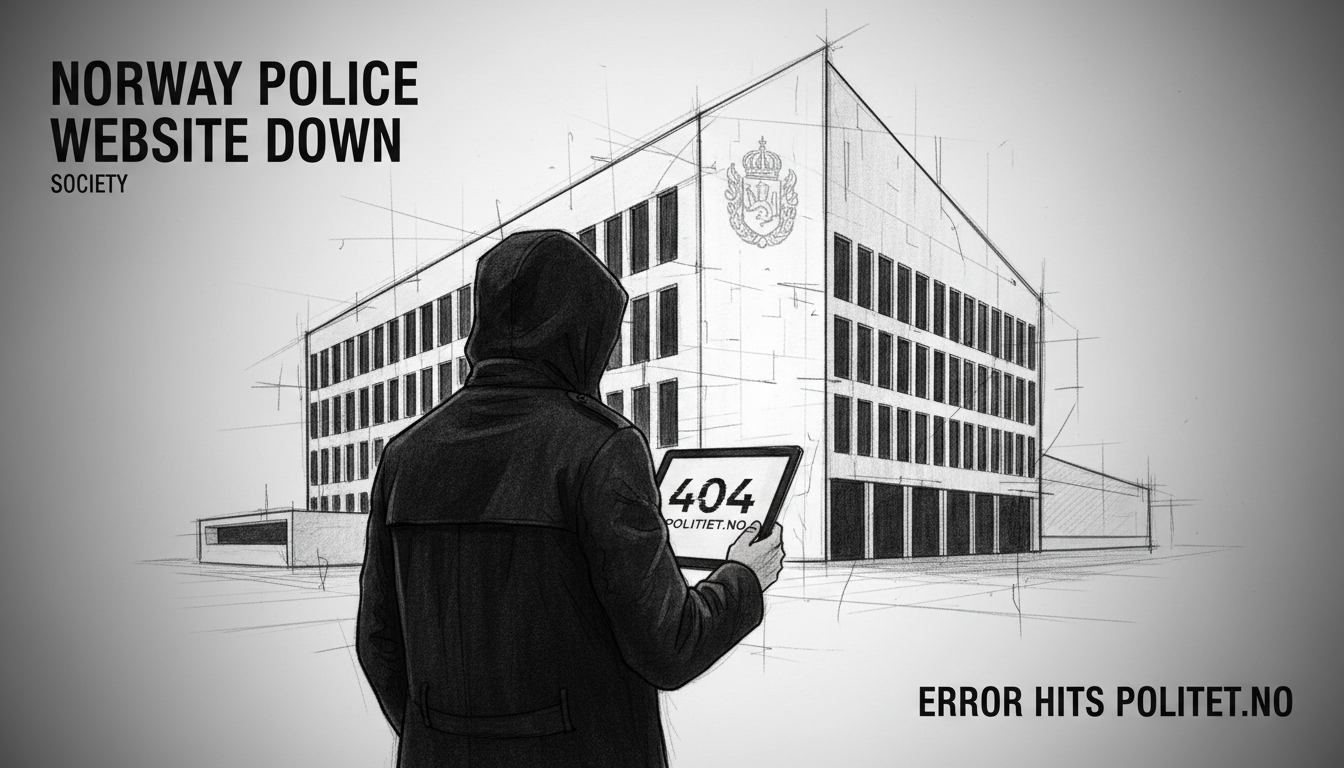
Norway's official police website, Politiet.no, is inaccessible, displaying only a 404 error message to citizens attempting to access online services. The outage disrupts a key digital portal for filing crime reports and accessing official information, raising immediate questions about technical resilience and public access to essential services. The Police Directorate confirmed it is investigating the cause, but provided no timeline for restoration as of Thursday afternoon.
A 404 error, while common on the internet, carries significant weight when it appears on a government service platform. It indicates the server hosting Politiet.no is technically online and reachable, but the specific webpage cannot be located or served. This points to an internal configuration error, a failed update, or a problem with the site's content management system rather than a broader network failure.
For Norwegians, the site is more than a simple information page. It is the primary digital interface for non-emergency interactions with the national police force. The inability to file an online report for theft, vandalism, or lost property creates a tangible barrier. It forces citizens to either visit a physical police station or call emergency lines for non-urgent matters, potentially straining other channels.
A Critical Service Halted
The Politiet.no website serves as a central hub for public safety information and civilian services. Beyond online crime reporting, it provides updates on travel documentation, passport applications, and border control regulations. It hosts official warnings, crime prevention advice, and contact information for all local police districts across the country's vast geography, from Oslo to Svalbard.
This outage underscores a growing public reliance on digital government services, a transition accelerated in recent years. 'When a critical public infrastructure like this goes down, it's not just an IT issue; it's a service delivery failure,' said Lars Ingebrigtsen, a cybersecurity researcher at the University of Oslo. 'It interrupts the legal process for reporting crime and erodes trust in the system's availability.'
Technical experts note that while outages occur, the public nature of this failure is notable. 'The 404 error is a public-facing failure mode,' explained IT consultant Marius Holm. 'For a high-profile government site, you would expect more graceful failure handling—a maintenance page or a status update—rather than a generic web error. This suggests an unplanned incident.'
Impact on Public and Police Workflow
The timing and duration of such an outage directly influence its impact. A prolonged failure could delay the filing of reports for insurance purposes or the official documentation of minor crimes. While emergency services operate on separate, secured systems, the online reporting tool is a efficiency measure for both the public and police administrative staff.
In a statement, the National Police Directorate said it was 'aware of the issue and working to resolve it.' The statement did not specify the cause, but such incidents typically stem from software updates gone wrong, server malfunctions, or domain name system (DNS) issues. The Directorate has not indicated any suspicion of malicious cyber activity, though that possibility is rarely ruled out in initial assessments.
This event occurs within a broader context of heightened focus on Norwegian cybersecurity. The country's critical infrastructure, including energy and governmental platforms, is considered a potential target for state-sponsored and criminal cyber groups. The Police Security Service (PST) has repeatedly warned about such threats in its annual risk assessments.
Digital Dependence and Systemic Vulnerability
The incident highlights the vulnerability inherent in centralized digital systems. Norway has been a leader in digitizing public services, with platforms like Altinn for business and Skatteetaten for taxes enjoying high public trust. The police website is another pillar of this digital society. Its failure, even temporarily, exposes the fragility of this model when a single point of failure emerges.
'We design these systems for convenience and efficiency, which is good,' said Ingebrigtsen. 'But we must invest proportionally in their stability, redundancy, and crisis communication. The public needs to know what happened, why, and when it will be fixed. Silence or vague statements can be more damaging than the outage itself.'
There is also a question of alternatives. Does the police force have a documented contingency plan for such digital failures? Are there backup methods for submitting digital reports, or does the workflow revert entirely to analog processes? The answers to these questions define the true resilience of the service.
Looking Beyond the 404 Message
For the average user, the 404 error is a dead end. It offers no redirect to relevant information, no explanation, and no estimated time for restoration. This communication vacuum is often where public frustration grows. Best practices for critical service websites include having a resilient status page hosted separately from the main infrastructure, precisely to communicate during outages.
The Norwegian Police Directorate now faces not only a technical challenge but a communications one. Restoring service is the first priority. Subsequently, providing a clear, transparent account of the root cause will be essential to maintaining public confidence. Was it an internal error? A third-party service provider failure? The explanation matters for accountability.
This outage, while likely temporary, serves as a real-world stress test. It reveals how dependent law enforcement's public interface has become on a single digital domain. It tests the organization's incident response protocols in the public eye. And it reminds citizens that the digital tools they rely on are built and maintained by fallible systems.
As Norway continues to integrate technology into every facet of governance, the stability of platforms like Politiet.no becomes synonymous with the stability of the service itself. The 404 message is more than an error code; it is a signal that the seamless digital society has a breaking point. The response to this incident will show how well the system can bend without breaking, and how quickly it can recover when it does.