
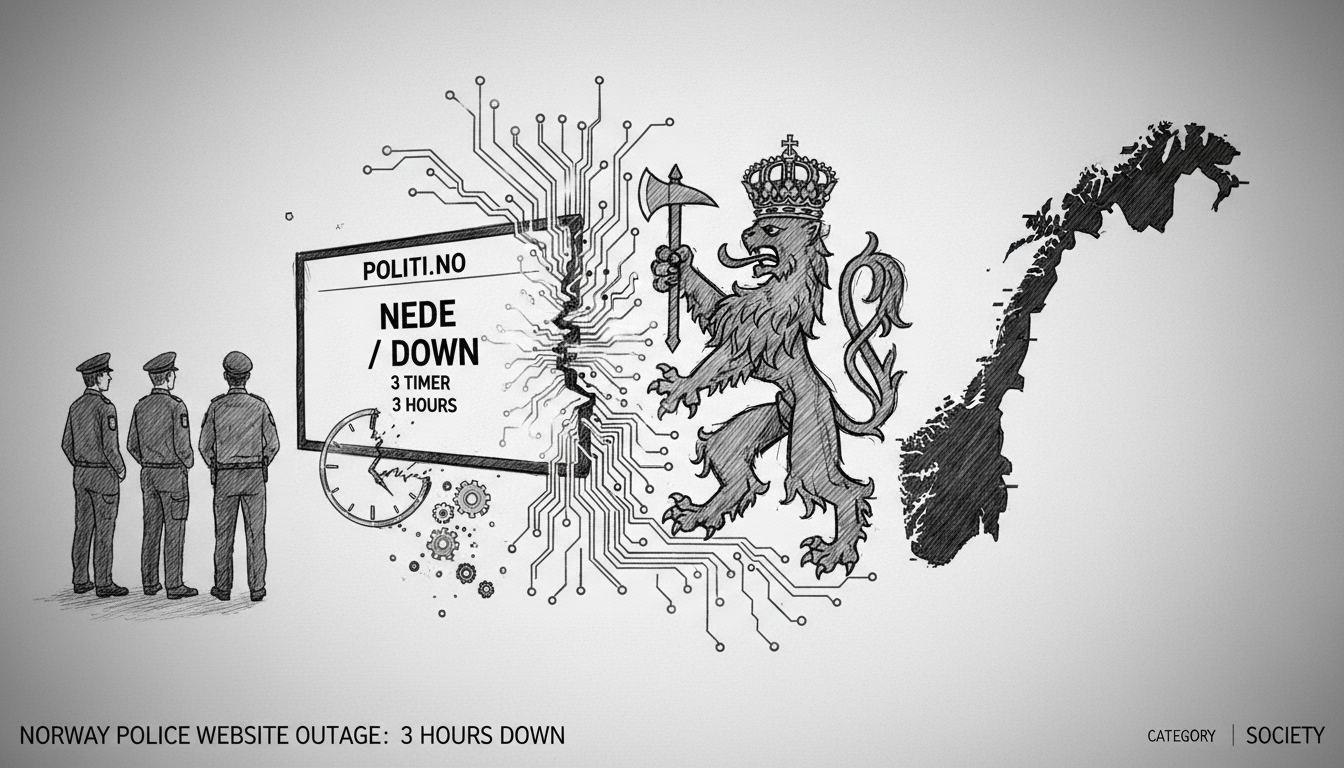
Norway's national police website experienced a significant outage on Friday morning, leaving citizens unable to access critical services for approximately three hours. The site, politiet.no, went offline around 9 AM and remained inaccessible until just after noon. The Norwegian Police Service confirmed the disruption but has not yet provided a detailed explanation for the cause. This incident highlights the growing dependence on digital public infrastructure and the potential vulnerabilities within it.
For a nation consistently ranked among the world's most digitally advanced, such outages in core government services are rare. The police website serves as the primary digital interface between the public and law enforcement across Norway's 12 decentralized police districts. It is not merely an informational portal. Citizens use it to report non-emergency crimes, locate local stations, access official forms, and find guidance on a wide range of legal and safety matters. Its sudden unavailability creates a tangible gap in public service delivery.
A Digital Lifeline Goes Dark
The timing of the outage, during standard weekday business hours, maximized its impact. Individuals attempting to file reports for thefts or minor incidents found themselves unable to do so digitally. Those seeking information on passport controls or border regulations were met with error messages. While emergency services via phone lines like 112 remained fully operational, the disruption affected the routine, day-to-day interactions between the public and the police. This separation of emergency and non-emergency digital channels likely prevented a more severe crisis, but the outage nonetheless undermined a key pillar of modern policing: accessibility.
Norway's police structure, with its independent districts and central units like Kripos and Økokrim, relies on a cohesive digital platform to present a unified front. The national website funnels users to district-specific pages and services. Its failure represents a single point of failure for this digital ecosystem. The police's brief statement, acknowledging the downtime and confirming restoration, followed standard protocol. However, the lack of immediate technical details is notable. In an era of heightened cyber threat awareness, transparency following such events is increasingly expected by both the public and security experts.
Cybersecurity and Public Trust
Any extended outage of a government security website immediately triggers questions about cybersecurity. While the most likely cause is internal technical failure—a server issue, failed update, or network error—the possibility of an external attack cannot be instantly dismissed. Norway's critical infrastructure, including its energy and public sectors, has been a declared target for state-sponsored cyber actors in the past. The Police Security Service (PST) regularly warns of such threats. This context makes any disruption to a site like politiet.no more sensitive than a similar outage for a cultural or tourism portal.
"When a core public safety platform goes offline, it tests the resilience of our digital society," said a cybersecurity analyst specializing in Nordic infrastructure, who spoke on condition of anonymity due to the sensitivity of the topic. "The immediate focus is on restoring service, but the crucial follow-up is a forensic analysis. Was this a routine IT glitch, or does it indicate a need for stronger defenses? The public's trust depends on the competence demonstrated not just in fixing the problem, but in explaining it and preventing recurrence."
The analyst emphasized that robust cybersecurity involves not just preventing breaches, but also ensuring high availability through redundant systems. For a service of this importance, even a few hours of downtime can be seen as unacceptable. The incident will likely prompt internal reviews within the National Police Directorate and the Ministry of Justice and Public Security, which oversees the force. Questions about server capacity, backup protocols, and incident response plans are now on the table.
The Broader Trend of Digital Reliance
This event is a microcosm of a national challenge. Norway has aggressively pursued a digital-first strategy for government services, from tax filings (Altinn) to health records (Helsenorge). This shift offers tremendous efficiency and convenience. However, it also concentrates risk. The police website outage is a reminder that digital systems, for all their sophistication, are not infallible. When they fail, the analog alternatives—like visiting a police station in person or relying on phone lines—must be clearly communicated and readily available.
Compared to its Nordic neighbors, Norway's digital government services are generally highly stable. A similar outage in Sweden or Denmark would attract equal scrutiny. The region's interconnectedness means that cyber threats are a shared concern, often discussed in forums like the Nordic Council. This single incident, while resolved quickly, may contribute to broader discussions about pan-Nordic cooperation on protecting shared digital infrastructure standards.
For the average Norwegian, the outage was likely a temporary annoyance. But it underscores a deeper reality: the seamless function of daily life is increasingly tied to the silent, uninterrupted operation of digital platforms they rarely think about. The police website is a utility, akin to electricity or running water. Its availability is assumed. Friday's disruption broke that assumption, if only briefly.
Looking Ahead: Transparency and Resilience
The Norwegian Police Service now faces a simple but important task: providing a clear post-mortem. To maintain public confidence, they need to disclose what caused the outage, what measures were taken to restore service, and what steps are being implemented to prevent a repeat. A technical explanation, even a complex one, is better than silence. Silence allows speculation to flourish, which can be more damaging to trust than a straightforward account of a server malfunction.
Investment in IT infrastructure is often less visible than new patrol cars or police stations, but it is equally vital for modern policing. This event may serve as a catalyst for reviewing the budget and priorities allocated to the digital backbone of the police force. It also highlights the need for continuous public communication about how to access services during digital disruptions. Clear guidelines on alternative reporting methods during a website outage should be part of standard public safety information.
Norway's reputation for stable, trustworthy governance is one of its greatest assets. That reputation extends into the digital sphere. Incidents like Friday's website outage are not just technical hiccups; they are small tests of institutional competence and transparency. The swift restoration of service was the first step. The next steps—analysis, explanation, and improvement—will determine whether this event is forgotten as a minor glitch or remembered as a catalyst for a more resilient digital police service. In a world where cyber threats are evolving daily, can any critical public service afford to treat a three-hour outage as routine?