
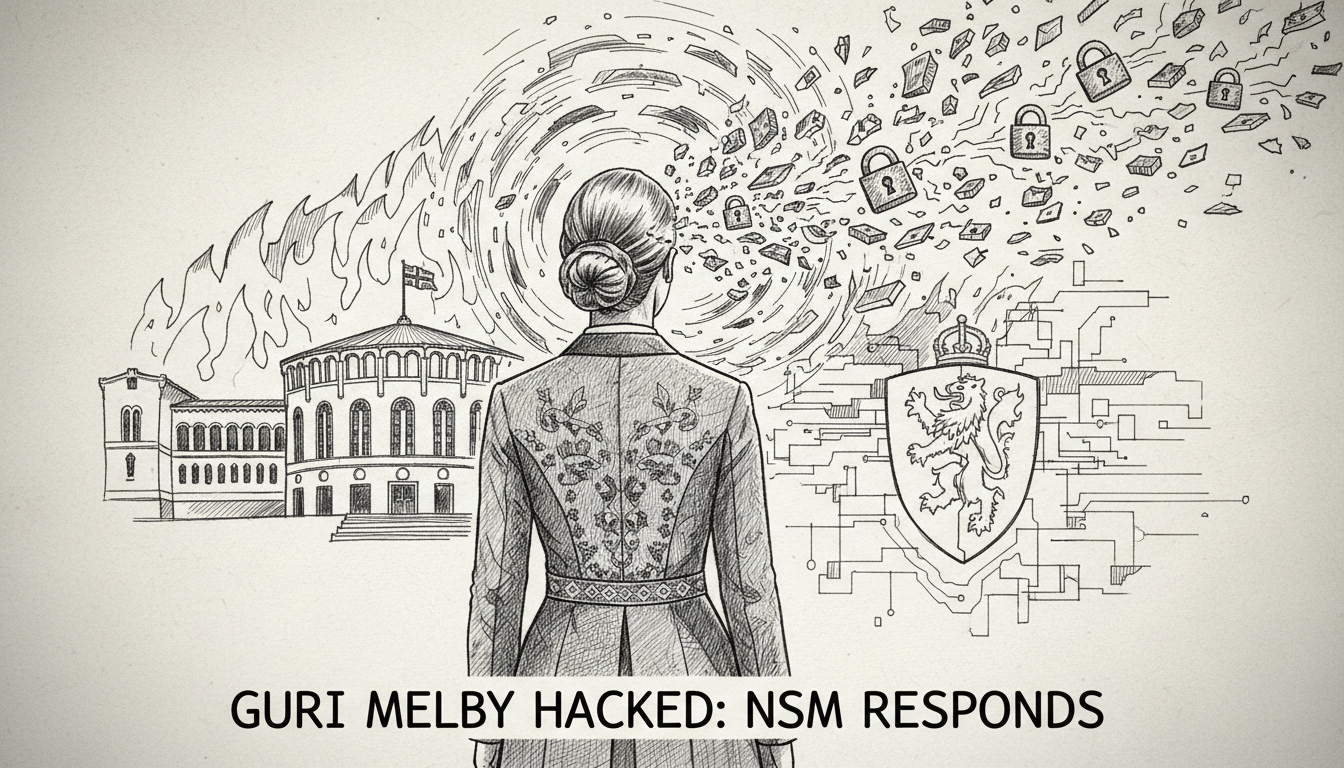
Norway's political cyber security faced a direct test this week when Guri Melby, leader of the Liberal Party Venstre, had her official X account compromised. The hack, which saw the account briefly display cryptocurrency branding, triggered an immediate response from the Norwegian National Security Authority (NSM), highlighting the persistent digital threats facing public figures.
A Digital Intrusion in the Political Sphere
The breach was first noticed when Melby's X profile picture and banner were replaced with the logo of Flare Network, a blockchain platform. Several promotional posts from the company were published from the account before it was secured. While no overtly political or damaging messages were sent, the incident exposed a vulnerability. Mari Lerdal, press officer for NSM, confirmed the authority was notified and had contacted X for assistance in resetting the account. This swift involvement of Norway's top digital security agency underscores the seriousness with which such breaches are now treated, even when they appear financially motivated rather than overtly political.
For Guri Melby, who has led Venstre since 2020 and serves as a key opposition figure, the hack represents a violation of a primary communication channel. Venstre, a centrist party with a historical focus on education, civil liberties, and climate policy, relies heavily on digital platforms to reach voters. The incident temporarily silenced that voice and raised questions about the security protocols protecting Norway's elected officials and party leaders.
The NSM's Role in Political Security
The Norwegian National Security Authority operates under the Ministry of Defence, tasked with preventing and investigating IT security incidents that threaten national interests. Their rapid engagement in a politician's social media hack signals an evolving threat landscape. "The NSM's role is not just about protecting military secrets or critical infrastructure like oil platforms," explains a cyber security analyst familiar with Norwegian policy. "Disinformation and the compromise of trusted public voices are now clear national security concerns. A hacked account can be used to spread false information, manipulate financial markets, or erode public trust in institutions."
This incident follows a broader pattern across the Nordic region, where politicians from Sweden to Finland have faced similar attacks. The response protocol activated for Melby—direct NSM contact with the social media platform—demonstrates a formalized process for high-profile cases. It moves the issue beyond personal IT trouble-shooting to an official security response.
Expert Analysis: Beyond Simple Passwords
Cyber security experts point out that attacks on political figures rarely aim for financial gain alone. While the Flare Network branding suggests a "crypto-jacking" motive, where accounts are used for promotional scams, the access gained could have far worse consequences. "Think of it as a burglar testing a window lock," says Dr. Henrik Larsen, a researcher at the Norwegian University of Science and Technology focusing on information warfare. "They might just take what's easily visible, but the fact they got in is the real story. For a political leader, that access could next time be used to release fabricated statements, cause diplomatic incidents, or spread panic during a crisis."
The experts emphasize that strong, unique passwords and mandatory two-factor authentication (2FA) are the absolute baseline for anyone in public office. However, they note that sophisticated phishing attacks targeting aides or exploiting mobile network vulnerabilities can sometimes bypass even these measures. "The human element is often the weakest link," Larsen adds. "Continuous security training for politicians and their staff is as crucial as the technical safeguards."
The Political and Policy Implications
This hack occurs amid ongoing debates in the Storting, Norway's parliament, about the nation's cyber resilience. Recent discussions have focused on protecting the energy sector—including crucial oil and gas infrastructure in the North Sea—and the financial system. The Melby incident brings the vulnerability of the political system itself into sharper focus.
Some parliamentarians are now calling for a review of the security support provided to party leaders and elected officials. While the Prime Minister and senior ministers receive extensive security details, digital protection for opposition leaders can be less formalized. This event may prompt parties to adopt standardized, NSM-vetted security protocols for all their high-profile members.
Furthermore, Norway's upcoming local and national elections make digital security a pressing issue. A compromised account could be used to spread false information about polling locations, candidate positions, or election results. The NSM likely treated this incident with elevated urgency precisely because of its potential to undermine electoral integrity if replicated on a larger scale.
A Nordic-Wide Challenge
Norway is not alone. Neighboring Sweden has established a specific agency, the Swedish Psychological Defence Agency, to combat disinformation and digital influence campaigns targeting its political discourse. Finland has integrated comprehensive cyber security education into its society as a deterrent to foreign interference. The Melby hack shows that Norway faces the same hybrid threats, where a simple social media account takeover can be a probe or a precursor to more aggressive actions.
The response also tests the cooperation between national security agencies and global tech giants like X. The speed with which X cooperated with NSM's request to reset the account will be noted. Delays in such situations can allow malicious actors to cause significant damage, making this relationship critical for national security.
Looking Ahead: Securing Democratic Discourse
The hack of Guri Melby's account is a minor incident with major implications. It served as an unscheduled drill for Norway's security apparatus, testing response times and coordination. No sensitive information appears to have been accessed, and no lasting political damage was done. Yet, the message is clear: the digital fronts of Norwegian politics are active battlefields.
As political campaigning moves increasingly online, the integrity of digital platforms becomes synonymous with the integrity of democracy itself. This event will likely lead to renewed scrutiny of how Norway's political parties protect themselves. Will the Storting allocate more resources for digital security training? Will parties demand better support from platforms? The quiet reset of a password may soon be followed by louder debates in parliament about how to shield Norway's democratic conversation from those who seek to hack it.
The final question remains whether this incident will be a forgotten footnote or a catalyst for strengthening the digital defenses around every public voice in Norway. In an era where a single hacked account can sway opinion, the answer will define the security of Norwegian democracy for years to come.