
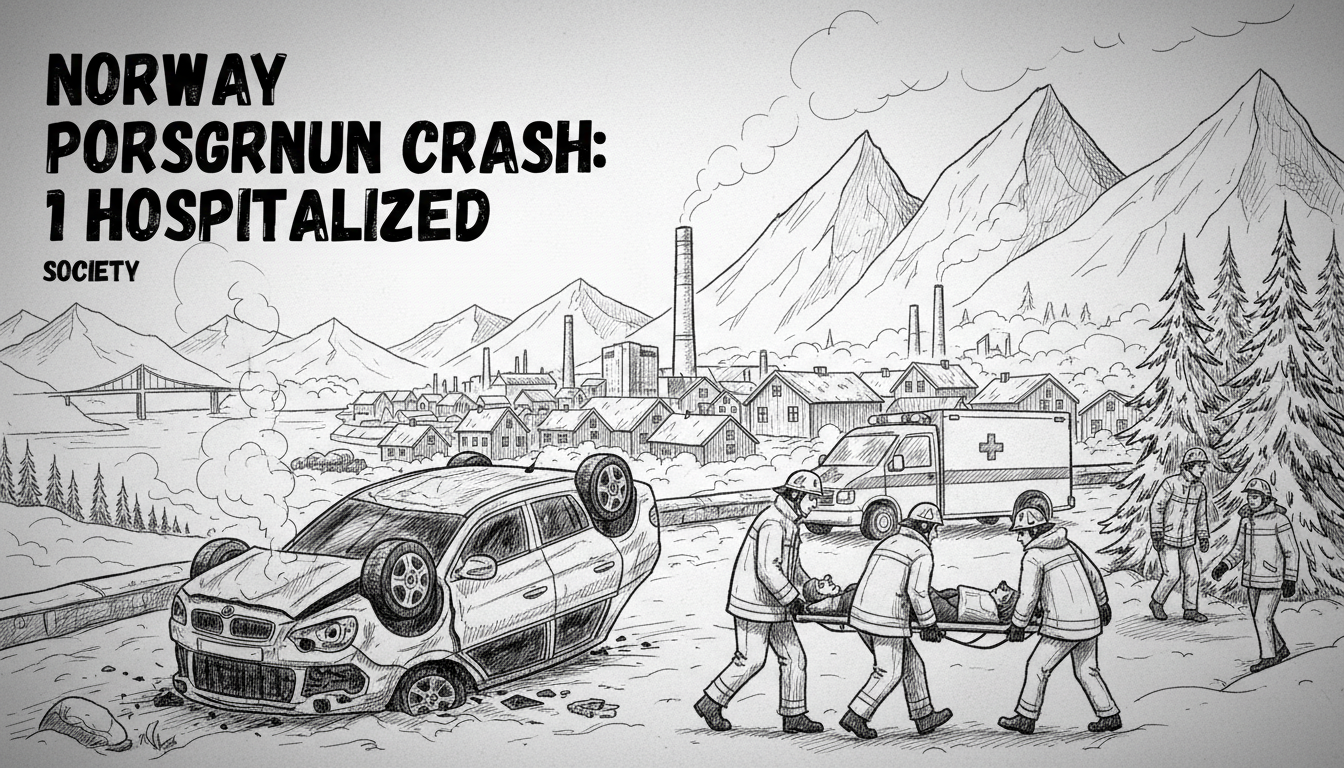
Norway’s roads, among the safest in Europe, recorded 117 fatalities in 2022. A single-car crash in Porsgrunn on Sunday afternoon served as a stark reminder that behind every statistic is a personal tragedy and a network of emergency response. The driver of a vehicle that collided with a tree in the Heistad area was transported to Oslo’s major trauma center, Ullevål Hospital, with serious injuries.
Emergency services from multiple agencies responded to the incident reported at 4:07 PM. The car was found on a slope after leaving the roadway and striking a tree. Operations Manager Vegar Dale Møane of the Southeast Police District confirmed all relevant emergency units were on scene. Initial police logs indicated the driver was seriously injured, but a later update confirmed the individual was conscious and alert before transport.
Emergency Response in Heistad
The coordination between police, fire, and medical personnel at the Heistad site highlights Norway’s integrated emergency response system. The suburban area of Porsgrunn, a city in Vestfold og Telemark county, presents typical Nordic road challenges—varied terrain and weather conditions that can change rapidly. The police log’s detailed notation of the vehicle’s position on a slope suggests terrain may have been a factor in the crash sequence or the complexity of the extraction.
“All emergency agencies are on site. The car is on a slope and has collided with a tree,” Møane wrote in the official police log. This formal, precise communication is standard in Norwegian incident management, ensuring clear information flows to coordinating hospitals like Ullevål. The decision to transport the patient to Oslo, rather than a closer regional hospital, indicates the severity of the suspected injuries and the central role of Ullevål’s trauma specialists.
The Path to Ullevål Hospital
The choice of Ullevål Hospital as the destination is significant. As Oslo University Hospital’s main campus, it is one of Norway’s largest and most advanced acute care facilities, equipped to handle the most severe trauma cases. The transport over a considerable distance from Porsgrunn—a trip of well over an hour—would involve careful medical monitoring en route. This reflects a triage system where patient outcome, not proximity, often dictates the choice of facility for major trauma.
Medical helicopters are frequently deployed for such transfers across Norway’s long distances, though police have not confirmed the mode of transport in this case. The hospital’ trauma center operates with a multidisciplinary team ready to assess and treat complex injuries, particularly those from high-impact events like car versus tree collisions. The patient’s conscious state upon leaving the scene is a positive sign, but such accidents often involve hidden internal injuries requiring advanced diagnostics.
Norway's Road Safety Paradox
This incident occurs within a national context of excellent, but constantly scrutinized, road safety. Norway’s preliminary figure of 117 road fatalities in 2022 places it near the top of global safety rankings. Yet, each accident triggers analysis. The Norwegian Public Roads Administration (Statens vegvesen) and the police relentlessly focus on the “Vision Zero” goal—eliminating all serious road injuries and fatalities.
Common investigation vectors after a single-vehicle crash like this include driver speed, potential impairment, vehicle mechanical failure, road surface condition, and signage. Heistad’s roads would be subject to this scrutiny. “The immediate priority is care for the injured,” said a road safety analyst familiar with Norwegian procedures, who asked not to be named as the investigation is ongoing. “But the subsequent work to determine why the car left the roadway is crucial. It informs everything from roadside barrier placement to public awareness campaigns.”
The Human Cost Behind the Data
While Norway’s fatality rate is low, the number of serious injuries resulting in lifelong consequences remains a core concern for transport authorities. A crash into a fixed object like a tree carries a high risk of severe trauma. The emotional and economic ripple effects of a single serious accident are vast, affecting families, workplaces, and community emergency service resources.
Local communities in areas like Porsgrunn often advocate for further traffic calming measures, improved lighting, or barrier installation following serious crashes. The data from this crash will feed into municipal and national databases used to prioritize infrastructure spending. Norway’s approach is famously data-driven; every kilometer of road and every accident is cataloged to identify high-risk locations.
A Look at the Broader Landscape
Norway’s safety success is attributed to strict enforcement of drink-driving laws, extensive use of safety technology in vehicles, and continuous road engineering improvements. However, challenges persist, including driver distraction, fatigue, and adapting to increasing numbers of electric vehicles which have different acceleration profiles and are often quieter. The roads around suburban areas like Heistad, which mix local and through traffic, are a particular focus for safety planners.
The response to the Porsgrunn crash demonstrates the system working as designed: rapid notification, coordinated multi-agency response, expert medical triage, and long-distance trauma care logistics. The true test of the system’s preventative side will come in the investigation’s findings and whether they lead to tangible changes on that stretch of road.
For now, the focus remains on the driver’s recovery at Ullevål Hospital. The incident closes a road for hours, fills a police log, and adds one more data point to Norway’s relentless pursuit of safer travel. It underscores that even in the world’s safest driving nations, the interaction between human, machine, and road remains a moment-to-moment calculation with profound consequences. As Norway aims for zero, every crash is a lesson, and every injury a call to refine the approach.