
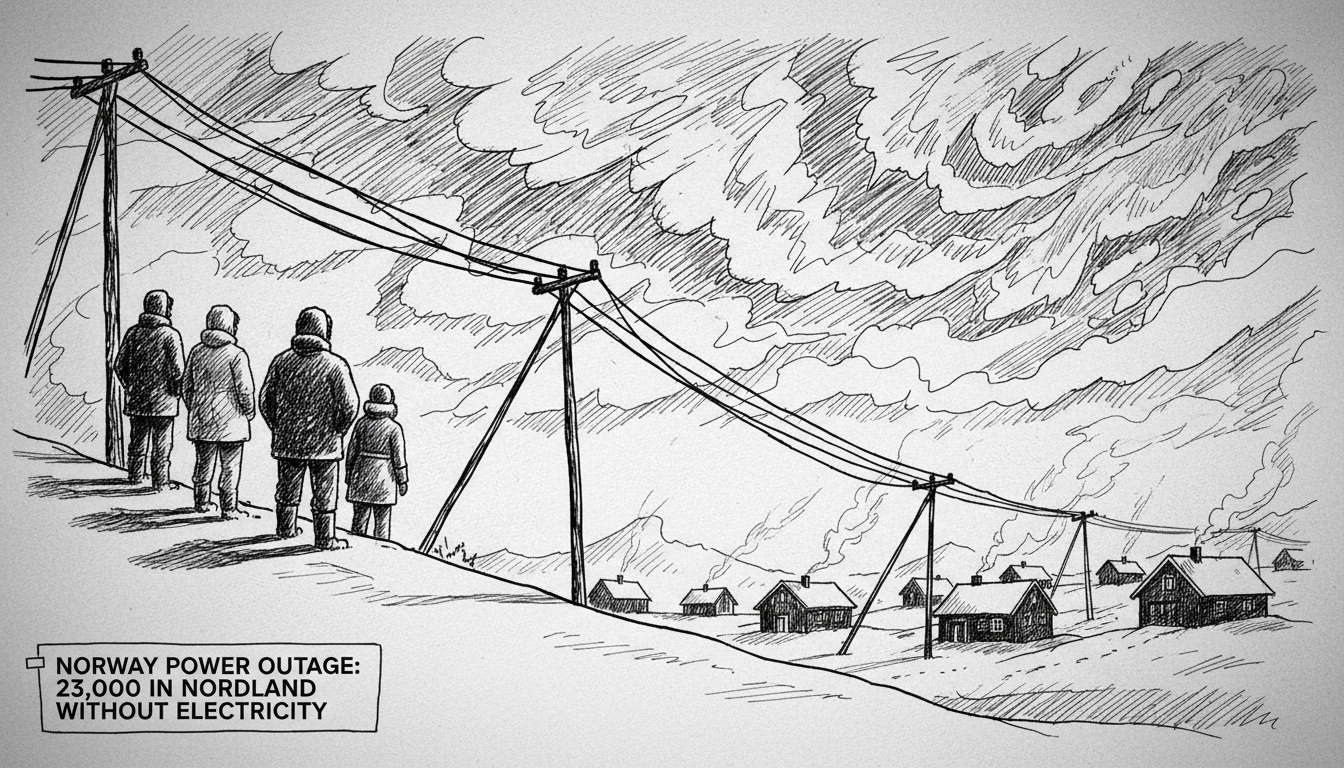
Norway's Nordland county is grappling with a major power outage leaving over 23,000 customers without electricity Saturday morning. The failure, which initially affected around 2,500 customers, escalated rapidly overnight, plunging a wide swath of the northern region into darkness. Technical crews are actively working to locate and repair the fault on the high-voltage grid. The scale of this disruption exposes the persistent vulnerabilities in supplying power to Norway's remote northern communities.
A Rapidly Escalating Crisis
The incident began with a localized fault affecting several thousand customers. Within hours, the situation deteriorated significantly, with the number of affected households and businesses multiplying nearly tenfold. The outage spans multiple municipalities across the vast county, which covers 38,450 square kilometers—an area larger than many European countries. For residents, the sudden loss of power on a weekend morning brings immediate practical challenges: heating systems shutting down, food spoilage in freezers, and severed communications in areas with poor mobile coverage. The timing, during a cold season, heightens concerns over welfare for vulnerable populations reliant on electric heating.
The Geography of Grid Vulnerability
Nordland's landscape of deep fjords, mountains, and scattered island communities presents a unique challenge for grid operators. Maintaining a resilient electricity network across such terrain is both technically demanding and enormously costly. Long-distance power lines are exposed to harsh Arctic weather, including heavy snow, ice accumulation, and strong winds, which can cause faults. "The geography in Northern Norway is the primary antagonist for grid security," explains Lars Mikkelsen, an energy infrastructure professor at the University of Tromsø. "The distances are enormous, the population density is low, and the climate is extreme. A single fault on a critical transmission line can have a cascading effect, isolating entire districts." This incident underscores the fragility of a system where a single point of failure can darken communities hundreds of kilometers apart.
Public Ownership and Accountability
Norway's electricity grid is predominantly publicly owned, with the state-owned enterprise Statnett responsible for the national transmission network. Regional and local distribution is managed by various county and municipal-owned companies. This public model places direct responsibility on government entities to ensure reliability and swift restoration. The outage in Nordland will inevitably trigger questions for local politicians and grid company boards about maintenance schedules, investment levels in grid hardening, and emergency preparedness. "When 23,000 people lose power, it's not just a technical issue, it's a significant breach of public trust in a critical service," says political analyst Kari Nilsen. "Residents in the north often feel their infrastructure is secondary to investments in the more populous south. Incidents like this fuel that perception."
Economic and Social Ripple Effects
The blackout's impact extends beyond darkened homes. Local businesses, from grocery stores to workshops, face operational paralysis and potential financial loss. The fishing industry, a cornerstone of Nordland's economy, relies on constant refrigeration; a prolonged outage could see significant spoilage of catch. Furthermore, Norway's increasing reliance on digital services for everything from banking to health consultations creates a domino effect when the power fails. Digital infrastructure collapses, isolating residents who may need emergency assistance. For an international audience, this outage provides a stark contrast to Norway's image as a hyper-connected, technologically advanced society. It reveals the underlying tension between modern digital dependence and the physical realities of maintaining century-old grid infrastructure in rugged environments.
Comparative Resilience and Future Investments
This event invites comparison with other Nordic nations facing similar geographic challenges. Sweden and Finland also manage extensive northern grids, yet major outages affecting tens of thousands are less frequently reported. Experts suggest this may point to differing investment philosophies in redundancy and underground cabling. "The debate always centers on cost versus reliability," Professor Mikkelsen notes. "Burying lines is exponentially more expensive, especially in mountainous terrain, but it drastically reduces weather-related failures. Norway must calculate if the economic and social cost of these large outages justifies greater capital expenditure." The Norwegian government's recent Long-Term Plan for the Energy Sector emphasizes grid reinforcement, but focused largely on connecting new industry and export cables. Critics argue more focus is needed on securing the basic supply for existing northern communities.
The Human Dimension in the Arctic
Beyond statistics and infrastructure policy, the outage is a deeply personal event for tens of thousands. For the elderly living alone, a loss of power can mean a cold, anxious wait without a working phone. For families with young children, it disrupts the fundamental routines of warmth and meal preparation. In the coastal and inland villages of Nordland, community resilience often fills the gap left by official response. Neighbors check on each other, and local community centers may open as warming shelters. This social fabric is the unofficial backup system when technology fails. Yet, as one resident from Bodø commented online, "We pay the same high electricity prices as everyone in Norway. We shouldn't have to rely on luck and goodwill to stay warm during a winter breakdown."
A Policy Flashpoint
This outage will resonate in political halls far beyond Nordland. It touches on core national debates about regional equality, the just distribution of tax revenues for infrastructure, and Norway's energy priorities. The Storting, Norway's parliament, frequently debates the North-South divide in public spending. Incidents like this provide tangible evidence for northern politicians arguing for a fairer share of investment. Furthermore, with national goals to electrify more sectors of the economy—including transportation and industry—the question of grid capacity and resilience becomes even more critical. Can Norway's grid be the backbone of a green transition if it cannot reliably deliver power to its own citizens during a technical fault? The answer to that question requires significant political will and financial commitment.
Looking Ahead: Restoration and Reassessment
As repair crews work to pinpoint the fault—potentially at a key substation or along a critical transmission corridor—the immediate focus is on restoring power. Statnett and local grid operators will follow strict protocols to safely re-energize the network without causing further damage. Once the lights are back on, the process of investigation and accountability begins. A formal report on the cause and response will be expected. More importantly, this outage serves as a stress test, revealing weaknesses in the system. It will force a reassessment of contingency plans, the stock of emergency equipment like transformers, and communication protocols with the public. For Nordland's residents, the hope is that this large-scale disruption translates into concrete action—and investment—that makes their power supply, a basic expectation of modern life, more robust against the next inevitable fault. The true measure of success will be seen not in the restoration time today, but in the prevention of a similar crisis tomorrow.