
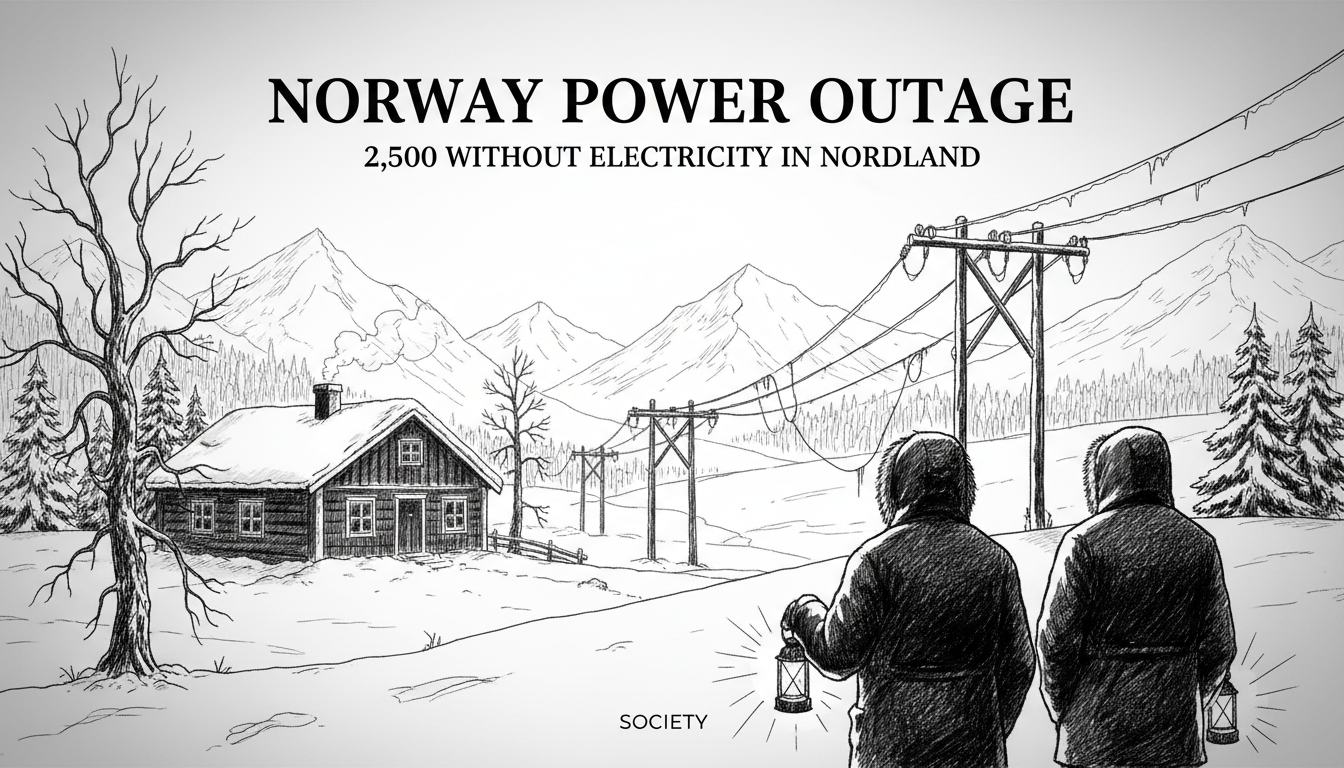
Norway's power grid faces a significant test as approximately 2,500 customers in Nordland county woke to a widespread electricity outage on Saturday morning. The disruption, affecting a remote and sparsely populated region of Northern Norway, highlights the persistent vulnerability of critical infrastructure in harsh Arctic climates. Repair crews are actively working to locate and fix the fault, but the incident underscores a national tension between Norway's reputation for reliable energy and the logistical realities of maintaining its vast network.
A Remote Region in the Dark
The outage struck Nordland, a county famed for its dramatic fjords, the Lofoten archipelago, and a population dispersed across challenging terrain. While 2,500 customers represents a fraction of Norway's total, in a region where settlements can be isolated, the impact is magnified. Each "customer" can represent an entire farm, a small village, or a critical service provider. The loss of power in early morning hours disrupts heating, communications, and basic daily functions, particularly for those reliant on electric heating in a climate where spring temperatures can still hover near freezing. Norway boasts a near 100% electrification rate, making such outages not just an inconvenience but a fundamental break in normalcy.
The Constant Challenge of Geography and Climate
Initial reports point to crews working to locate the fault, a process that in Nordland can be time-consuming. The causes of such outages are varied but predictable in this context. Severe weather, including late-season storms with high winds or heavy, wet snow, can bring down lines or damage equipment. Equipment failure in older sections of the grid is another possibility, as is accidental damage from other activities. The sheer scale of Norway's grid, which must stretch from its southern cities to its Arctic outposts, means resilience is uneven. "The Nordic grid is robust, but its extremities are sensitive," noted an energy infrastructure analyst familiar with northern regions. "Maintaining and upgrading lines in areas with low population density is a continuous economic and engineering challenge. Every outage, even a localized one, is a reminder of that equation."
Beyond the Immediate Repair: A National Energy Paradox
This outage occurs against a complex national backdrop. Norway is Europe's largest producer of petroleum and a significant exporter of hydroelectric power, yet its own domestic grid can experience localized fragility. The country is undergoing a massive electrification drive, transitioning transport and industry to renewable power, which increases demand and pressure on the grid. Simultaneously, it is investing in new interconnectors to export more electricity to the UK and Europe. These projects bring revenue and influence but also focus attention on core infrastructure. "An outage in Nordland may seem small on the national balance sheet," the analyst added, "but it asks a pointed question: are we investing enough in the resilience of our entire network, not just the profitable export cables?"
The Human and Economic Impact
For the affected residents, the discussion is less about high-level policy and more about practical consequences. Power outages can disrupt local businesses, from fish processing plants to tourism services that are vital to the northern economy. They pose risks to individuals dependent on medical equipment. They also test emergency preparedness, as municipalities and county governors must activate contingency plans. While most households in Norway are well-equipped to handle short disruptions, longer outages reveal dependencies. The incident reinforces the importance of local backup systems and community response protocols in regions where central help may be hours away.
A Look at Grid Resilience and the Future
The Nordland outage is unlikely to be a prolonged crisis, but it serves as a diagnostic moment. As Norway positions itself as the "green battery of Europe," the reliability of its domestic infrastructure is paramount to its credibility. Future investments will need to balance ambitious export projects with the less glamorous but critical work of hardening the national grid against climate and wear. This includes modernizing old sections, implementing more automated fault detection systems, and potentially decentralizing energy storage solutions. The stormy weather that may have caused today's fault is only expected to become more frequent and intense with climate change, turning a maintenance issue into a strategic one.
The Path to Restoration and Reflection
As repair crews navigate Nordland's landscapes to find the break, the restoration of power will be a welcome relief. However, the brief period of darkness should illuminate a longer-term discussion. Norway's energy success story is real, built on hydropower and natural resources. Yet, its foundation—the physical grid reaching every corner of the kingdom—requires constant, vigilant upkeep. For the 2,500 customers waiting for the lights to come back on, the promise of a resilient, fully electrified future depends not just on grand projects, but on the integrity of a single line running through a remote forest or over a mountain pass. The true test of a nation's power isn't just how much it generates, but how reliably it delivers it to every citizen, no matter how far north they live.