
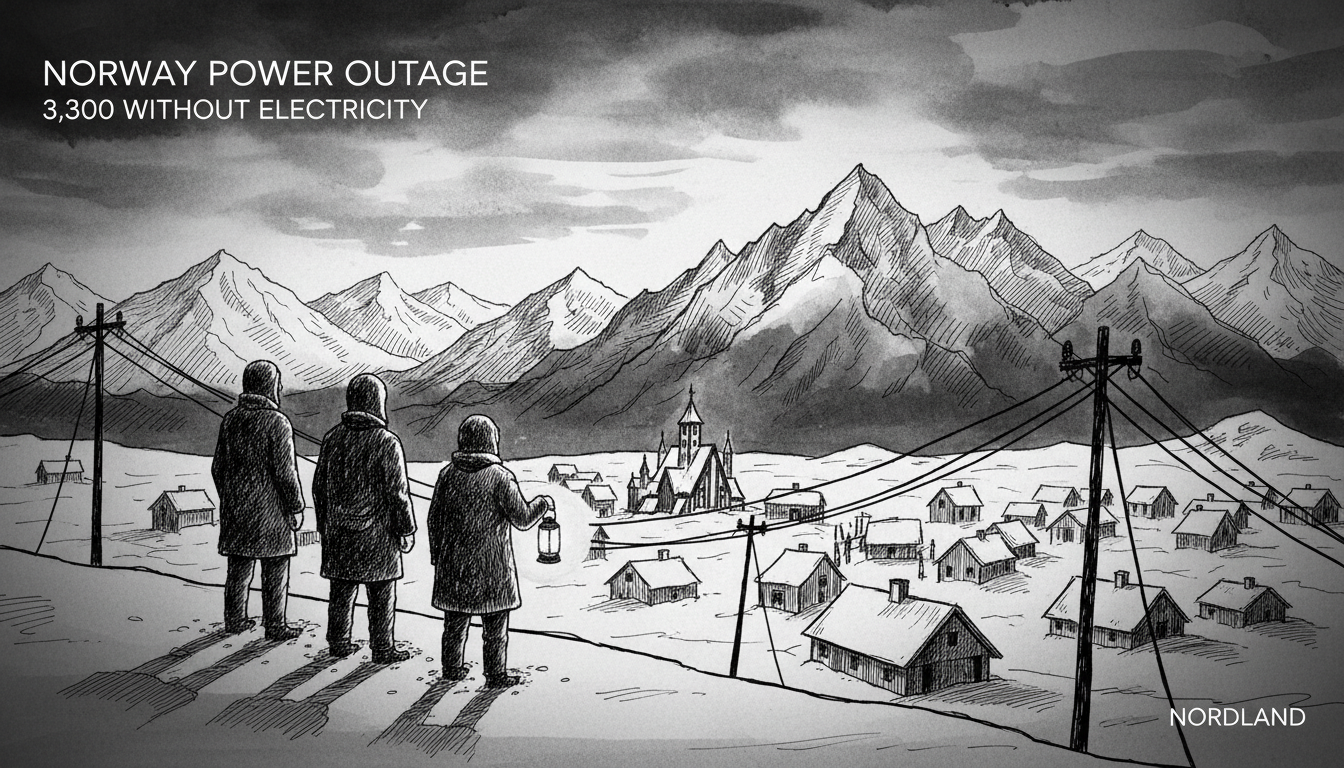
Norway's Nordland county faces a significant infrastructure crisis as thousands remain without power and mobile coverage following severe weather. As of late Saturday night, 3,300 electricity subscribers in the Helgeland region are cut off, while 125 of Telenor's 700 mobile base stations across the county are out of operation. Repair crews from grid operator Linea have paused for the night, with fresh teams scheduled to resume restoration efforts at 6:00 AM Sunday. This disruption highlights the persistent vulnerability of Norway's northern infrastructure to extreme weather, despite the nation's reputation for reliable energy and advanced telecommunications.
A Night of Isolation in the North
The outage has plunged communities across Helgeland into darkness and silence. For residents, the loss of both electricity and mobile connectivity creates a dual challenge: managing without heating, lighting, and refrigeration while also being cut off from emergency services, information updates, and contact with family. This is not merely an inconvenience but a serious safety issue, particularly for elderly or vulnerable individuals in remote areas. The timing, extending through a Saturday night, complicates response efforts and prolongs the period of isolation.
Linea, the regional grid company responsible for Helgeland, confirmed the scale of the outage. Their technicians, facing difficult conditions and potential hazards in the dark, made the operational decision to stand down overnight. This pause underscores the practical realities of emergency repairs in Norway's challenging terrain, where safety must be balanced against the urgency of restoration. The company's plan to deploy new crews at dawn is a standard protocol, aiming to maximize daylight working hours for efficiency and safety.
Mobile Network Failure Compounds the Crisis
The simultaneous failure of Telenor's mobile infrastructure significantly amplifies the crisis. With 125 base stations offline—nearly 18% of Nordland's total network—large swathes of the county have lost a critical communication lifeline. This failure points to a key weakness in network resilience: many base stations rely on the same commercial power grid as homes and businesses. When the grid fails, backup battery systems at remote sites have a limited duration, often just a few hours, before they too are exhausted.
"When the power grid goes down in these regions, our base stations are often on borrowed time," explained a telecommunications infrastructure expert who requested anonymity. "The economics of installing and maintaining permanent generator backups at every remote site are challenging. This incident will likely renew debates about mandating more resilient backup power solutions, especially for critical communication infrastructure."
This blackout illustrates a dangerous convergence. A power outage alone is manageable for many Norwegians accustomed to winter storms. But when it coincides with a mobile network collapse, it creates an information blackout. Residents cannot call for help, receive emergency alerts, or get updates from utilities on repair timelines. This lack of situational awareness can fuel anxiety and hinder community-led response efforts.
Geography and Economics of Northern Vulnerability
The Nordland outage is a stark reminder of the inherent tensions in maintaining national infrastructure across Norway's dramatic geography. The country boasts one of the world's most reliable and modern power grids, with abundant hydropower. Yet its long, rugged coastline and sparse population in northern counties like Nordland present unique challenges. Power lines and communication towers are exposed to some of Europe's most ferocious weather, stretching across mountains, fjords, and vast forests.
Helgeland, a traditional district within Nordland, epitomizes this challenge. Its landscape is a mix of coastal islands, deep fjords like the famous Velfjorden and Leirfjorden, and inland mountains. Building and maintaining infrastructure here is exponentially more expensive and difficult than in the urban south. The economic calculus for private companies like Telenor and state-mandated grid operators must balance service obligations with soaring costs.
Professor Lars Holt, an energy systems researcher at NTNU, notes the policy dilemma. "We have a national expectation of uniform reliability, but the cost of delivering that in the north versus the south is vastly different. Events like this force a conversation: what level of resilience are we willing to pay for in our most vulnerable regions? Is it sufficient to restore power after a storm, or must we invest to prevent it from failing in the first place?"
The Path to Restoration and Future Resilience
For the 3,300 affected customers, the immediate concern is the swift return of power. Linea's crews will be diagnosing faults that could range from downed lines and flooded substations to transformer failures. The process is methodical: ensuring lines are safe to energize, isolating damaged sections, and restoring power zone by zone. Some remote households may face prolonged outages if damage is severe or access is blocked.
The restoration of mobile coverage is tied directly to the power grid. Many base stations will come back online automatically once electricity is restored to their location. Others may require manual intervention if equipment was damaged by the same weather event that caused the power failure. Telenor's network operations center will be prioritizing sites that restore coverage to the largest population centers and critical facilities like hospitals or main roads.
This incident will inevitably lead to post-mortem analyses by both companies and regulators. The Norwegian Communications Authority (Nkom) and the Norwegian Water Resources and Energy Directorate (NVE) monitor the performance of telecom and grid operators, respectively. They will examine response times, communication with the public, and the underlying causes of the concurrent failures. Their findings often inform future regulations and investment guidelines.
A Broader Lesson for the Nordic Model
Norway prides itself on a societal model built on security, equality, and trust in public systems. A widespread, prolonged infrastructure failure in the north tests that model. It raises questions about regional equity and whether citizens in peripheral regions receive the same level of service and protection as those in Oslo or Bergen. The Storting has repeatedly debated infrastructure funding for the north, with arguments often centering on national security, settlement policy, and simple fairness.
The energy context adds another layer. Norway is Europe's largest gas supplier and a major oil producer, with critical offshore installations like those in the Norwegian Sea not far from Nordland's coast. The domestic grid's resilience is separate from export infrastructure, but such outages remind the nation that its own energy security cannot be taken for granted. As the country pushes forward with electrification of transport and industry, a stable grid becomes even more fundamental.
Will this weekend's outage in Nordland be a fleeting news item or a catalyst for change? For the families sitting in cold, dark homes, unable to call anyone, the answer is deeply personal. It underscores that in Norway's vast and beautiful north, the social contract depends on wires and signals that are, tonight, broken. The coming dawn will bring repair crews, but it should also bring a renewed commitment to hardening the vital networks that connect—and protect—the nation's most exposed communities.