
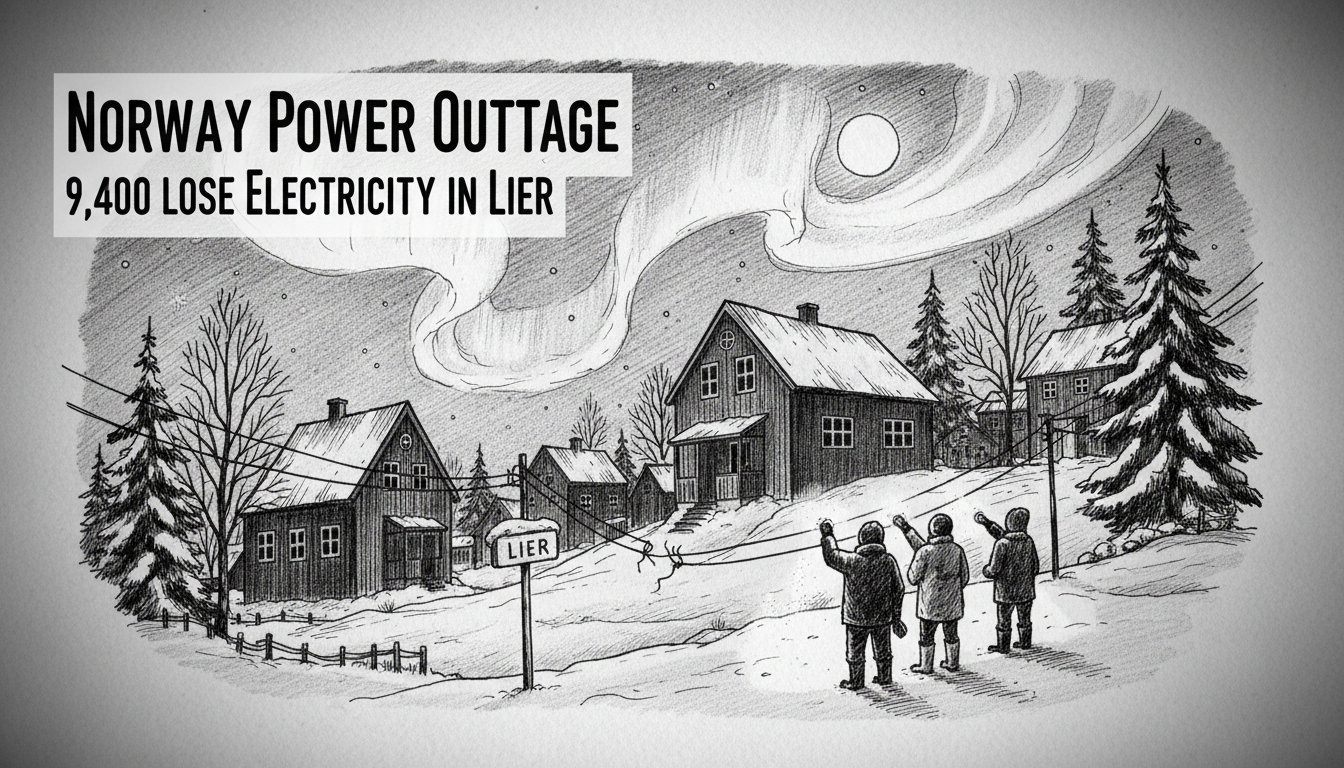
Norway's power grid operator Glitre Nett reported an unplanned outage affecting over 9,400 customers in the Lier municipality late Wednesday night. The disruption, marked in red on the company's outage map, began just before 11:05 PM and is estimated to last until 2:00 AM Thursday, leaving thousands of households and businesses in the Buskerud region without electricity.
Residents who have lost power but cannot find the incident registered on the outage map are instructed to contact Glitre Nett directly. The company has activated its emergency response protocols, though the specific cause of the fault remains undisclosed. Technical teams are now working through the night to diagnose and repair the issue on the regional distribution network.
A Night of Disruption in the Drammen Region
Lier, a municipality nestled in the traditional Buskerud region west of Oslo, is experiencing widespread darkness. The outage primarily impacts this community of approximately 27,000 people, disrupting normal nighttime routines. For a nation with one of the world's most reliable and modern electricity grids, such a significant unplanned outage is a notable event. It highlights the inherent vulnerabilities in even the most advanced infrastructure systems.
Glitre Nett, as the regional grid company, is responsible for the distribution network—the final leg of electricity delivery from the main transmission grid to end users. Their outage map, a public tool for transparency, uses red markers to indicate unplanned incidents, distinguishing them from scheduled maintenance work shown in blue. This visual distinction is crucial for managing public expectations during a crisis.
The Mechanics of Grid Failure and Response
Power outages can originate from multiple points of failure. Common causes include equipment malfunction at substations, damage to overhead lines or underground cables, and protection systems activating due to a fault. Severe weather, though not reported in this instance, is a frequent culprit. The speed of restoration depends entirely on locating the fault's origin, which can be the most time-consuming part of the process for engineers.
"Grid operators like Glitre Nett have detailed contingency plans for these scenarios," explains an energy infrastructure analyst familiar with the Nordic sector. "The priority is always safety first—ensuring lines are dead before crews work—then isolation of the fault, and finally restoration. An outage affecting a concentrated area like this suggests a problem at a substation or a main feeder line, rather than scattered damage."
For affected customers, the immediate consequences range from mere inconvenience to potential risk. Homes lose lighting, heating, and refrigeration. Digital connectivity fails as routers and mobile towers switch to backup batteries with limited capacity. The outage also poses challenges for vulnerable individuals reliant on electrically powered medical equipment, underscoring the critical nature of reliable power supply.
Norway's Energy Paradox in Focus
This localized failure occurs against the backdrop of Norway's status as a European energy powerhouse. The nation is a massive net exporter of electricity, generated almost exclusively from hydropower, and a major supplier of oil and natural gas. Its domestic grid is renowned for high reliability, making tonight's disruption in Lier an anomaly that will prompt internal review at Glitre Nett.
The incident also brings attention to the ongoing national debate about grid capacity and modernization. As Norway electrifies its transportation and industry, demand on the distribution network grows. Investments are being made to reinforce grids, but aging infrastructure in some areas remains a concern. Events like this provide concrete examples for policymakers at the Norwegian Ministry of Petroleum and Energy and regulators at the Norwegian Water Resources and Energy Directorate (NVE) when prioritizing infrastructure spending.
The Human and Economic Cost of a Blackout
While lasting only a few hours, the outage carries real costs. Local businesses that operate late, such as convenience stores or data centers, face immediate revenue loss and potential data integrity issues. Food spoilage begins in household refrigerators after approximately four hours. The psychological impact of sudden disconnection from the digital world adds a layer of modern anxiety to the physical darkness.
For Glitre Nett, the financial implications include the cost of emergency crews, overtime wages, and replacement equipment. The company's performance is also measured by metrics like SAIDI (System Average Interruption Duration Index) and SAIFI (System Average Interruption Frequency Index). A prolonged, widespread outage negatively affects these reliability indices, which are monitored by regulators and can influence future tariff approvals.
A Test of Preparedness and Communication
The effectiveness of Glitre Nett's response will be judged on two fronts: restoration speed and communication clarity. Providing an accurate restoration estimate of 2:00 AM is a critical part of managing the situation. If power returns significantly earlier, customers are pleasantly surprised. If repairs take longer, frustration grows rapidly. Maintaining updated information on their website and through media channels is essential for public trust.
This event serves as a live exercise for municipal emergency services in Lier as well. They must be prepared to respond to incidents exacerbated by the blackout, such as traffic accidents if streetlights are out or fire risks from alternative lighting sources like candles. The coordination between the grid operator and local authorities is a key component of effective crisis management.
Looking Beyond the Immediate Fix
Once the lights are back on in Lier, the analysis will begin. Glitre Nett's engineers will conduct a root cause analysis to determine exactly what failed and why. This report will inform preventative maintenance schedules and potentially guide investment in more resilient equipment or network architecture. It may also lead to reviews of maintenance protocols for the specific component that failed.
For Norwegian energy consumers, this outage is a brief reminder of their dependence on a complex, interconnected system. It reinforces the importance of personal preparedness, such as having flashlights with fresh batteries and a backup power source for essential medical devices. On a societal level, it underscores the non-negotiable value of continuous investment in energy infrastructure, even in a country blessed with abundant resources.
Norway's energy system is built on a foundation of hydrological and geological fortune, transformed by engineering excellence. Yet, as over nine thousand customers in Lier are acutely aware tonight, that foundation is maintained one cable, one transformer, and one timely repair at a time. The true test of a system's strength is not that it never fails, but how quickly and transparently it recovers when it does.