
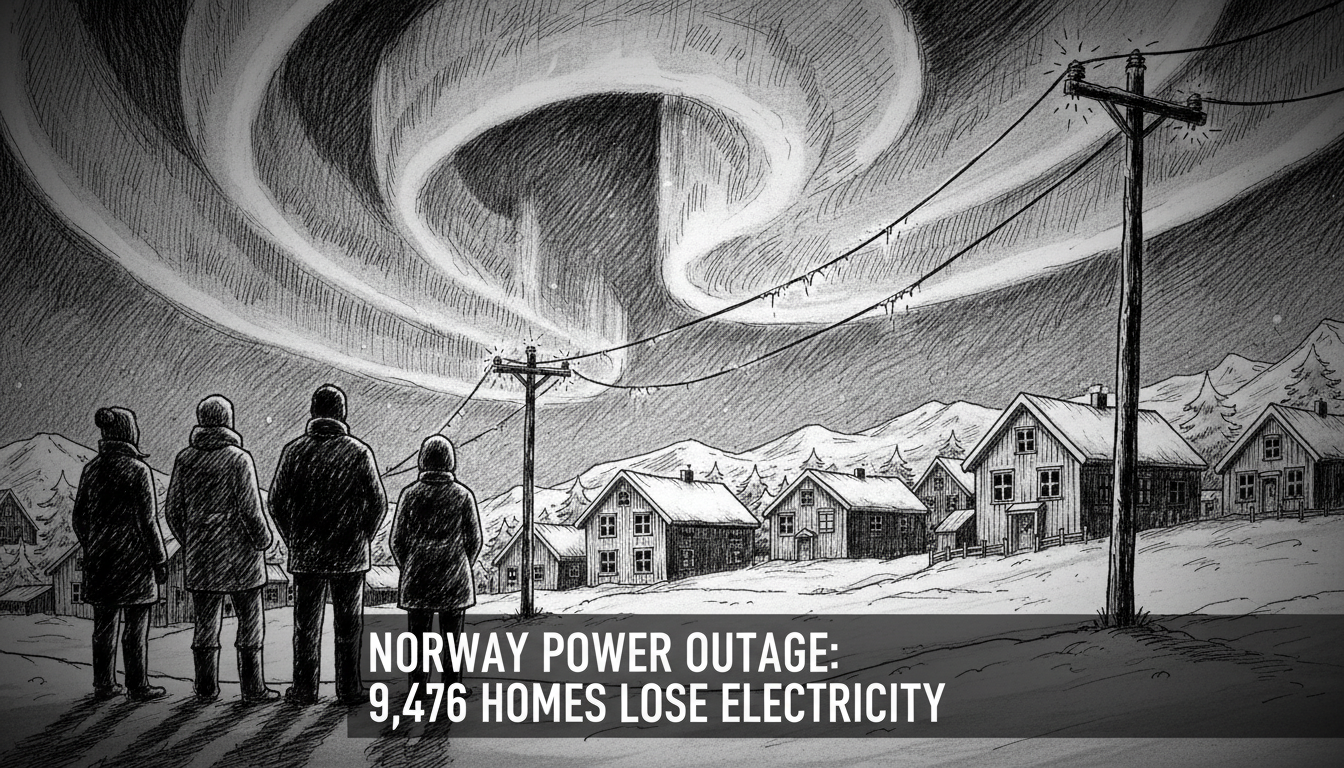
Norway's electricity grid faced a significant disruption Wednesday evening as nearly an entire municipality was plunged into darkness. A major power outage in Lier, Buskerud, left 9,476 subscribers without electricity, affecting almost every household in the community. The incident highlights the vulnerability of even the most robust energy systems and raises questions about grid resilience in the face of increasing demand and extreme weather.
A Community Plunged into Darkness
Residents of Lier, a municipality southwest of Oslo known for its historic town of Lierbyen and scenic fjord landscapes, reported a sudden and complete loss of power shortly before midnight. The central office of grid operator Glitre Nett received the first alert at 23:03. Initial reports indicated 3,635 customers were affected, but that number quickly ballooned as the full scale of the failure became apparent. By the peak of the outage, the vast majority of the municipality's homes and businesses were without power.
"Foreløpig vet vi ikke noe mer enn det, det er mannskap på vei ut for å sjekke hva som er feil," said Nils Tore Augland, communications chief for Glitre Nett, in a statement. His words, translating to "At the moment we don't know anything more than that, crews are on their way out to check what is wrong," underscored the initial uncertainty surrounding the cause. Repair crews were immediately dispatched into the night to locate the fault and begin restoration work.
The Race to Restore Power
Utility workers faced the challenging task of diagnosing and repairing the fault in darkness. The response followed standard emergency protocols for such widespread failures. Crews worked to isolate the damaged section of the grid to prevent further cascading issues while identifying the precise point of failure. Progress was measured in the gradual restoration of power to clusters of homes.
By 23:45, the number of affected customers had been reduced to 4,669, indicating repair teams were making headway. The effort to restore power to an entire municipality is a complex logistical operation, requiring systematic checks of transformers, power lines, and substations. For residents, the wait was marked by uncertainty, with many relying on mobile phones for updates until batteries drained.
Norway's Hydro-Dependent Grid Under Scrutiny
This incident brings Norway's unique energy infrastructure into focus. The country generates over 90% of its electricity from hydroelectric power, a system heavily reliant on predictable water flows and a vast network of dams, turbines, and transmission lines. While this provides generally clean and reliable power, the distribution network—the final link to homes—remains susceptible to localized failures from equipment malfunction, falling trees, or severe weather.
"Every major outage is a stress test for the system," explains energy analyst Henrik Larsen, who studies Nordic grid stability. "Norway's generation is robust, but distribution networks, especially in rural and semi-rural areas like Lier, face constant pressure from environmental factors and aging infrastructure. Investment in smart grid technology and redundancy is critical to minimizing these disruptions."
Lier's situation is not isolated. Similar localized blackouts occur periodically across Norway, particularly in forested regions where storms can topple trees onto power lines. However, the scale of this outage—affecting nearly an entire municipality—is less common and points to a failure at a critical nodal point in the local grid.
The Human and Economic Impact of a Blackout
Beyond the inconvenience, a prolonged power outage has tangible consequences. Modern homes, reliant on electricity for heating, lighting, refrigeration, and communication, become difficult to inhabit. For businesses, the cost can be immediate, with lost revenue, spoiled inventory, and operational shutdowns. Critical services, while often having backup generators, still face increased strain.
In Lier, the outage occurred during evening hours, disrupting family routines, homework, and evening meals. As the hours ticked by, concerns would have grown regarding food spoilage and the ability to heat homes, especially for vulnerable populations. The psychological impact of being suddenly cut off from the digital world and left in literal darkness also plays a role in these events, highlighting society's deep dependence on continuous electrical supply.
Grid Resilience in the Age of Electrification
This outage arrives as Norway pushes aggressively toward full electrification of its economy. The national strategy involves phasing out fossil fuels, with electric vehicles becoming the norm and industries shifting to electricity from natural gas. This policy success, however, increases the stakes for grid reliability. A higher dependency on electricity for transport, heating, and industry means the societal and economic cost of outages rises exponentially.
"We are asking the grid to do more than ever before," Larsen notes. "The transition to a green economy is fundamentally an electrification project. That makes events like the Lier blackout important case studies. They force utilities and regulators to ask: Is our infrastructure ready to be the backbone of everything?"
Investment in the grid has become a major political topic. Parties in the Storting debate the pace and funding of upgrades needed to fortify the network against both everyday faults and more extreme climate-related events. The government balances the need for investment against the desire to keep electricity costs manageable for consumers and businesses.
Communication and Public Trust During Crises
A key component of managing any outage is effective communication. In the initial chaotic phase, information is often scarce. Utility companies like Glitre Nett must balance providing timely updates with ensuring their information is accurate. The statement from Augland was a candid admission of the unknown, which can be frustrating for the public but is often more honest than speculation.
Modern expectations demand real-time updates via apps, websites, and social media. How a utility manages this communication affects public trust. Transparent timelines, clear explanations of cause once known, and regular progress reports are now part of the essential service provided during a crisis. The restoration of power for thousands of customers by midnight showed a responsive, if not instantaneous, resolution.
Looking Ahead: Preventing the Next Outage
The lights are back on in Lier, but the work for grid operators and policymakers continues. Each major failure is followed by a technical analysis to determine the root cause—whether it was a failed transformer, a cable fault, or external damage. This forensic engineering is crucial for preventing repeat incidents.
Long-term solutions involve a mix of hardening existing infrastructure, such as burying cables or better protecting overhead lines, and deploying new technology. Smart grids with self-healing capabilities can automatically detect a fault, isolate it, and reroute power in minutes, often before most customers notice an interruption. These systems represent the future of distribution but require significant capital investment.
For the residents of Lier, the episode is a reminder of the invisible infrastructure that powers daily life. It worked flawlessly until it didn't. As Norway continues its world-leading energy transition, ensuring that the foundation of that transition—the grid itself—is as resilient and modern as the ambitions it supports will be an ongoing challenge. The quiet night in Buskerud serves as a powerful prompt for that essential work. Can a nation built on abundant, clean power guarantee its constant flow to every citizen, even in the deepest Norwegian winter night?