
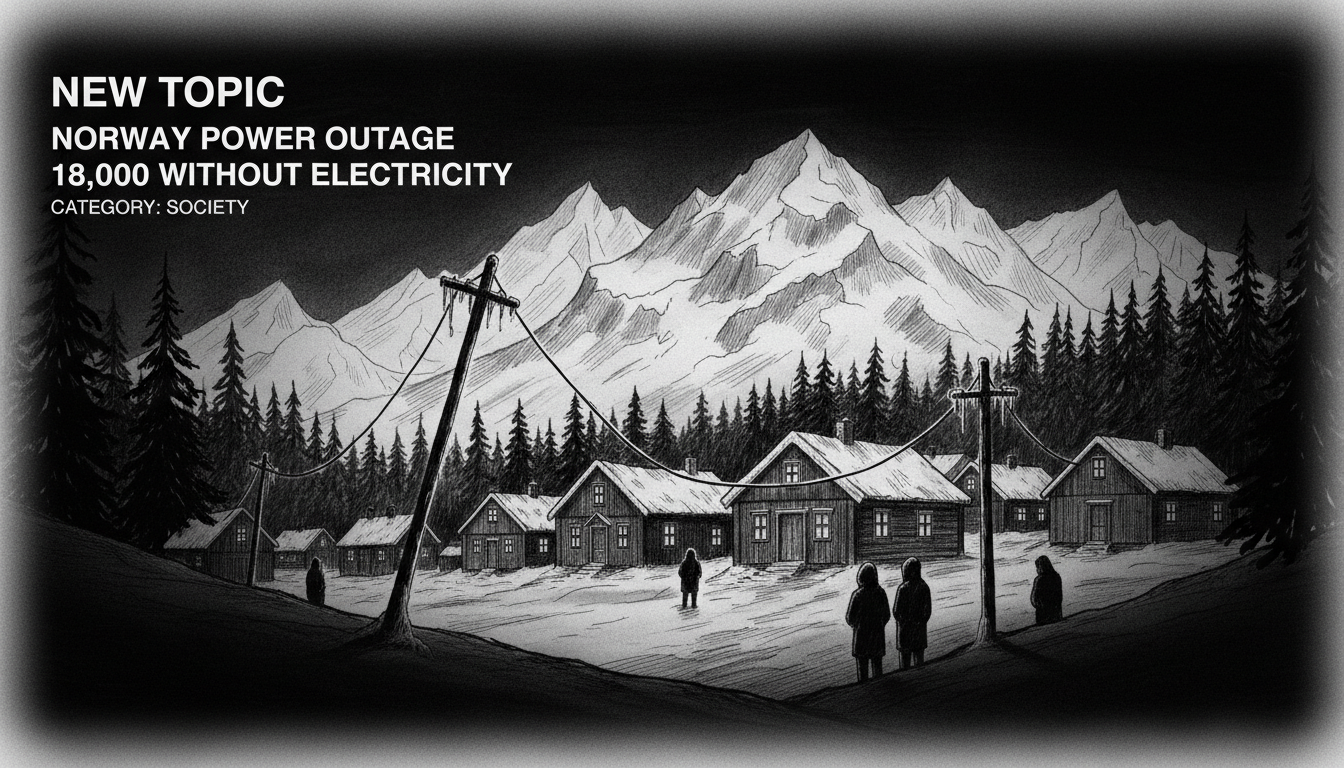
Norway’s northern county of Nordland faces a major disruption as over 18,000 electricity customers remain without power Saturday morning. Repair crews are working to locate and fix a significant fault on the grid, with the number of affected households rising sharply from initial reports of 2,500. The widespread outage highlights the persistent vulnerabilities of maintaining critical infrastructure in Norway’s vast and sparsely populated Arctic regions.
This incident strikes at the heart of a national paradox. Norway is a European leader in power generation and grid reliability, yet its northernmost communities regularly endure severe disruptions. Residents across Nordland are waking to a silent crisis: no heating, frozen pipes, and spoiling food as outdoor temperatures hover near freezing. The timing on a weekend complicates both the emergency response and daily life for thousands.
A Cascade of Failures in a Fragile Landscape
Initial reports pointed to a localized fault, but the situation deteriorated rapidly overnight. The fault’s location remains unspecified, though it is believed to be on a central part of the regional distribution network operated by local grid company Nordlandsnett. Such a cascading failure suggests a problem at a primary substation or a major transmission line. In Nordland’s challenging terrain of mountains and fjords, simply accessing the fault site can take hours, even before repairs begin.
“When a single point of failure can cut off tens of thousands, it reveals a strategic weakness in our network design,” said an energy infrastructure consultant who requested anonymity due to ongoing work with grid operators. “The grid in the north was built for a different era with lower demand. It lacks sufficient redundancy.” Aging infrastructure compounds the issue, with some lines and substations dating back decades, now facing more frequent and intense winter storms.
The Human Cost of a Powerless North
For the affected municipalities, from Bodø to rural villages in Salten and Lofoten, the outage is more than an inconvenience. It is a direct threat to safety and well-being. Nursing homes and other care facilities are running on emergency backup systems, while individuals reliant on medical equipment at home have been urged to seek assistance. Grocery stores with closed checkout systems cannot sell goods, and petrol stations cannot pump fuel.
Local emergency services are on high alert. “Our priority is checking on vulnerable citizens,” said a spokesperson for Nordland Police District. “We are coordinating with the Norwegian Civil Defence and the municipalities. People should check on their neighbors, especially the elderly.” Community centers in several towns have opened as warming shelters, providing hot drinks and information as residents wait for updates.
The economic impact is immediate. Small businesses face lost revenue, and the region’s important aquaculture industry must rely on backup generators to maintain oxygen levels in fish farms. A prolonged outage risks significant financial losses.
Infrastructure Challenges in Norway's Arctic
Nordland’s geography makes it inherently vulnerable. It is Norway’s second-largest county by area but has a population density of just 6 people per square kilometer. Maintaining and modernizing thousands of kilometers of power lines across this landscape is extraordinarily costly and logistically difficult. The climate imposes a brutal toll on equipment, with icing, high winds, and corrosion accelerating wear.
| Grid Reliability Metric | Norway (National Average) | Nordland (Typical) |
|---|---|---|
| System Average Interruption Duration Index (SAIDI) | ~1 hour | Significantly Higher |
| Key Vulnerability Factors | High investment, modern central grid | Aging assets, long distances, extreme weather |
Despite Norway’s impressive national SAIDI score—one of Europe’s best—these averages mask stark regional inequalities. The north consistently experiences longer and more frequent outages than the south. Statnett, the state-owned central grid operator, has invested heavily in major south-north transmission lines like the recently upgraded Ofoten line. Yet the local distribution networks, owned by municipalities and counties, often struggle with the investment needed for last-mile resilience.
Political Repercussions and Demands for Action
The outage has triggered immediate political reactions. Local MPs from both the Labour Party and the Centre Party have demanded explanations and faster action. “This is unacceptable in 2024,” said a Centre Party representative from the region. “We have been talking about securing the power supply for the north for years. Today’s event shows that talk is not enough. We need concrete plans and dedicated funding to harden the grid.”
The issue sits atop a larger political dilemma. Norway is undergoing a massive energy transition, electrifying its offshore oil platforms and onshore industries. This places unprecedented demand on the national grid. Critics argue that while the state focuses on exporting power and supplying new industrial projects, the basic security of supply for its own northern citizens is being compromised.
Furthermore, national security experts view reliable northern infrastructure as a matter of strategic importance. Nordland hosts crucial military installations and is a NATO frontier area. Persistent energy fragility is seen as a systemic risk.
A Future Tested by Climate and Demand
This outage serves as a stark stress test. Experts point to a necessary two-pronged solution: immediate hardening of existing infrastructure and a long-term strategy for decentralized resilience. “We need to consider more localized microgrids, increased use of backup battery storage, and smarter grid technology that can isolate faults faster,” said the energy consultant. “Relying on a single, long line from a distant hydro plant is an outdated model for these communities.”
For the residents of Nordland, Saturday’s crisis is a familiar frustration amplified by scale. As repair crews brave the elements to find the fault, the questions grow louder. Can Norway, a global energy superpower, finally keep the lights on reliably in its own Arctic north? The answer will define the region’s safety and economic future for decades to come. The resilience of Norway’s northern power grid is not just an engineering challenge—it is a fundamental question of political priority and equitable development.