
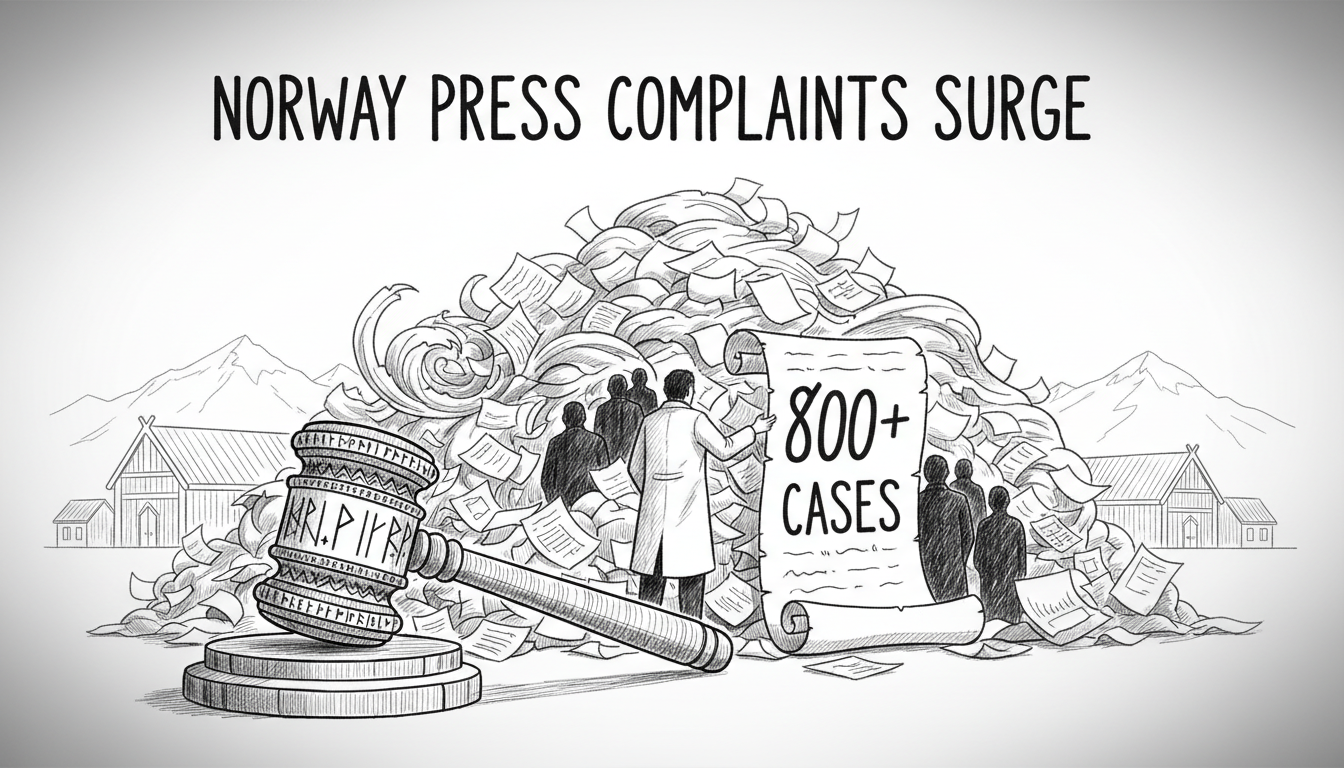
Norway's press ethics board has received over 800 complaints in a single year, setting a new record and raising alarms about media accountability. The Press Professional Board, known as PFU, documented this unprecedented volume of public grievances, surpassing all previous annual totals. Elin Floberghagen, Secretary-General of the Norwegian Press Association, confirmed the figure and expressed deep concern over the system's capacity to handle such an influx. This surge comes as Norwegian media were found in violation of ethical rules 46 times in 2025, according to reports. The trend highlights growing public scrutiny of journalism in a nation long praised for its high trust in media, prompting urgent reviews of complaint mechanisms and their role in democratic discourse.
Record Complaints Overwhelm Ethics System
The Press Professional Board (PFU) operates as Norway's primary self-regulatory body for print and online media, adjudicating complaints based on the press ethical code. With over 800 cases filed, the board faces operational strains that could delay resolutions and undermine public confidence. Floberghagen stated that the Norwegian Press Association has initiated a review to improve complaint quality and reduce volume. 'We have started work to see how we can ensure we receive complaints that are good enough to be processed, and to reduce the scope,' she said. This internal assessment aims to streamline procedures without compromising thorough evaluations, but details on potential reforms remain under discussion. The record number signals a shift in audience engagement, where readers are more willing to challenge journalistic content.
Understanding PFU's Critical Role
Established by the media industry itself, PFU embodies Norway's commitment to press self-regulation over state intervention. It investigates allegations of breaches in areas like accuracy, source protection, and privacy, issuing public rulings that can criticize or exonerate outlets. The board's decisions are not legally binding but carry significant moral weight, often prompting corrections or apologies. In 2025, its 46 violations against Norwegian media included cases from major newspapers and digital platforms, covering errors in political reporting and sensitive social issues. This system has historically bolstered trust by holding press to account, yet the complaint surge suggests it may be at a tipping point. Analysts note that PFU's effectiveness relies on manageable caseloads to maintain deliberative quality.
Drivers Behind the Public Backlash
Several factors contribute to the rising tide of complaints. Increased digital media consumption has expanded audience reach and interaction, making it easier for readers to file grievances through online portals. Political polarization in Norway, reflected in debates over immigration, energy policy, and EU relations, has fueled contentious coverage that sparks public backlash. Social media amplifies dissent, with viral posts often mobilizing coordinated complaint campaigns against specific articles or journalists. Additionally, heightened awareness of media ethics, spurred by global discussions on misinformation, may encourage more Norwegians to scrutinize reporting. Experts point to a broader trend of declining trust in institutions, where media is no exception, despite Norway's traditionally strong press freedom rankings.
Implications for Journalism and Democracy
The complaint overload poses risks to Norwegian democracy, which depends on a reliable and accountable press for informed public debate. If PFU becomes bogged down, legitimate grievances might go unaddressed, eroding trust further. Conversely, frivolous complaints could drain resources, diverting attention from serious ethical lapses. Floberghagen's call for 'good enough' complaints indicates a push for higher substantive thresholds, possibly requiring clearer evidence or relevance before processing. This approach might streamline workflow but could also deter valid criticisms from ordinary citizens. The Norwegian Press Association's exploration of changes will need to balance efficiency with accessibility, ensuring the system remains a credible pillar of media integrity. Stakeholders, including editors and ombudsmen, emphasize that proactive transparency from newsrooms is key to reducing conflicts.
Comparative Context and National Identity
Norway's media landscape is unique, with strong public broadcasting and a competitive private sector operating under strict ethical norms. The PFU system is often contrasted with state-led regulators in other European countries, where legal penalties are more common. Here, self-regulation aligns with Nordic values of consensus and responsibility, but the complaint surge tests this model. Historically, annual PFU complaints ranged from 400 to 600 in past decades, making the jump to over 800 a marked escalation. This occurs against a backdrop of national conversations on oil industry transparency and Arctic policy, where media coverage is closely watched. The record numbers may reflect a more assertive public, demanding higher standards as Norway navigates complex geopolitical and environmental challenges.
Expert Perspectives on Sustainable Solutions
Media scholars argue that the PFU must adapt to digital age realities without sacrificing its core principles. Professor Lena Hansen, a journalism ethics expert at the University of Oslo, notes, 'A high number of complaints isn't inherently negative—it shows an engaged populace. But the system must evolve to handle scale while preserving nuanced judgment.' She suggests enhanced digital tools for initial complaint screening and greater media literacy initiatives to help the public understand ethical boundaries. Others propose expanding PFU's resources or diversifying its panel to include more public representatives. From the industry side, editors highlight internal audits and pre-publication checks as ways to minimize offenses. The ongoing review by the Norwegian Press Association will likely incorporate such insights, aiming for a resilient framework that upholds Norway's press ethos.
Looking Ahead: Adaptation or Overhaul?
The path forward for PFU involves strategic decisions that could reshape Norwegian media accountability. Floberghagen's team is evaluating options like stricter filing criteria, faster-track procedures for minor issues, or enhanced dialogue between complainants and outlets before formal adjudication. These changes must be implemented carefully to avoid perceptions of elitism or reduced transparency. As Norway heads into local elections and debates on energy sovereignty, the press's role will remain under microscope. A functional ethics board is crucial for maintaining the social license that media enjoy in this democracy. The record complaint year serves as a wake-up call: in an era of information abundance, trust must be continuously earned through responsive and fair mechanisms. The coming months will reveal whether Norway's self-regulatory model can withstand modern pressures or requires fundamental rethinking.