
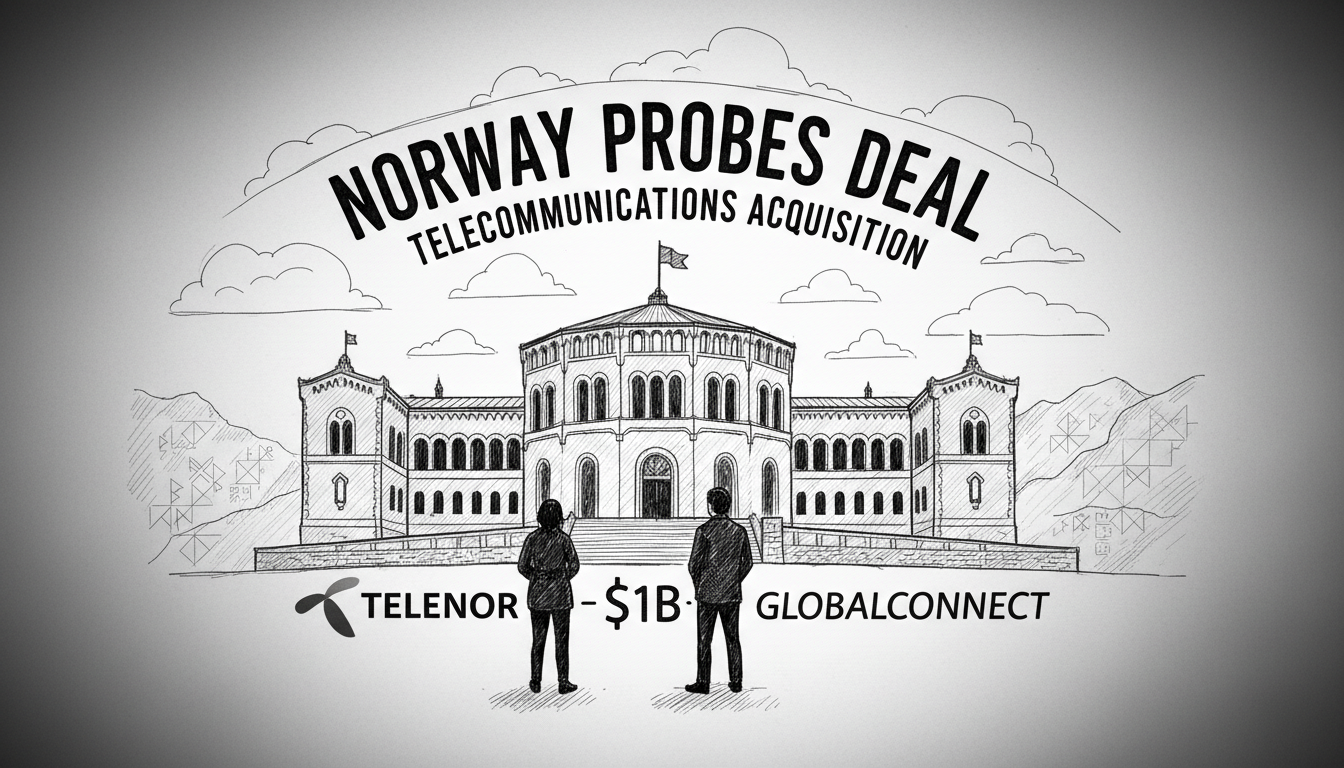
Norway's competition watchdog has launched a formal investigation into Telenor's proposed billion-dollar acquisition of GlobalConnect's private customer business. The Konkurransetilsynet warns the deal could weaken broadband competition, leading to higher prices and fewer choices for Norwegian households. This move places a major telecom merger under intense regulatory scrutiny, with significant implications for the future of Norway's digital infrastructure.
"If competition is weakened, it could lead to higher prices and fewer choices for customers," said Eva Nysæther, project manager at the Konkurransetilsynet, in a statement announcing the probe. The authority will examine whether the acquisition will make it harder for rival broadband providers to access Telenor's extensive network infrastructure. It will also assess potential negative effects on competition for TV services to private customers.
A Market at a Crossroads
The investigation centers on a fundamental question: does this consolidation represent necessary investment in national infrastructure, or does it risk creating an unassailable market leader? Telenor, Norway's dominant telecommunications provider, already holds a commanding position in mobile, internet, and TV services. GlobalConnect has been its most aggressive competitor in the fiber broadband segment, expanding its network and customer base significantly in recent years. By absorbing this key rival's private customer arm, Telenor would substantially increase its control over the fixed-line broadband market.
Industry analysts note this comes at a critical juncture. Norway is in the midst of a nationwide fiber rollout, transitioning from older copper-based DSL connections to high-speed fiber optics. Control over this next-generation infrastructure is seen as strategically vital. "The fiber network is the backbone of the future digital economy," said Lars Martin Aas, a telecom analyst based in Oslo. "Regulators must decide if having one dominant player accelerates deployment or stifles the innovation and price competition that comes from having multiple networks."
The Core Concerns: Access and Choice
The Konkurransetilsynet's primary concern is network access. Norway operates under a principle of infrastructure competition, encouraging multiple operators to build their own networks. However, it also has regulations requiring dominant players like Telenor to provide wholesale access to their physical infrastructure—like ducts and poles—to competitors at regulated prices. This allows smaller ISPs to offer services without building their own entire network.
The fear is that a post-merger Telenor, with reduced competitive pressure from GlobalConnect, could be less inclined to provide fair and timely access to its infrastructure. This could create bottlenecks for other broadband providers, hindering their ability to compete effectively. The investigation will meticulously review Telenor's past practices and future commitments regarding network access.
For consumers, the stakes are direct. A less competitive market often correlates with higher monthly subscription fees, slower introduction of new service tiers, and less responsive customer service. "History in telecom markets shows that when the number of significant network owners shrinks, consumer prices tend to rise over the medium term," explained Professor Kari Skotheim, who specializes in competition law at the University of Oslo. "The regulator's job is to model these long-term effects, not just the short-term business rationale."
The Broader Telecom Landscape
This probe does not occur in a vacuum. It reflects a broader, ongoing tension in European telecommunications between consolidation and competition. Operators argue that merging allows for greater economies of scale, generating the massive capital needed for continuous network upgrades, including the eventual shift to 6G and further fiber densification. They contend that fragmented markets with many small players cannot generate sufficient returns for this level of investment.
Competition authorities and consumer advocates counter that healthy rivalry is the true engine of innovation and fair pricing. They point to markets where a handful of infrastructure-based competitors have driven rapid technological adoption and kept prices in check. The Norwegian model has traditionally favored the latter approach, fostering a environment with several viable network operators beyond just Telenor.
The outcome of this investigation will signal Norway's regulatory direction for the coming decade. A blocked or heavily modified merger would reaffirm a commitment to a multi-operator market structure. An unconditional approval would mark a shift toward accepting greater consolidation as a necessary step for funding next-generation networks.
Potential Outcomes and Next Steps
The Konkurransetilsynet's investigation is a Phase II review, indicating it has identified serious preliminary concerns that warrant a deeper, several-month analysis. Possible outcomes are clear. The authority could approve the acquisition unconditionally, a scenario most analysts consider unlikely given the strong initial statement of concerns. It could approve the deal with binding conditions, known as remedies. These might include legally enforceable commitments from Telenor on wholesale access terms, or even a requirement to divest certain overlapping assets or customer groups to maintain market balance.
The most drastic outcome would be a full prohibition of the acquisition. This would be a major setback for Telenor's growth strategy in the domestic fixed-line market. Both companies will now submit detailed economic analyses and market data to the authority, aiming to convince regulators that the merger's benefits outweigh the competitive risks.
For Telenor, the argument will hinge on investment. The company is likely to present a plan demonstrating how the combined entity would accelerate fiber deployment in underserved areas, improve service quality, and create a stronger Norwegian champion in the Nordic telecom sector. Its success depends on proving these benefits are concrete, verifiable, and ultimately passed on to consumers.
A Decision with National Ramifications
The final decision, expected later this year, will ripple far beyond the boardrooms of Fornebu and Lysaker, where Telenor and GlobalConnect are headquartered. It will shape the competitive landscape for every internet service provider in Norway. It will influence the business cases for alternative network builders considering future investments. Most importantly, it will determine the range of choices and the level of bills facing Norwegian families and businesses for their essential broadband connectivity for years to come.
In an era where reliable, high-speed internet is no longer a luxury but a fundamental utility, this regulatory review is about more than market share percentages. It is a definitive test of how Norway balances corporate growth with consumer welfare in the digital age. The Konkurransetilsynet's verdict will answer whether the nation's broadband future is best built by one giant or by several strong contenders.