
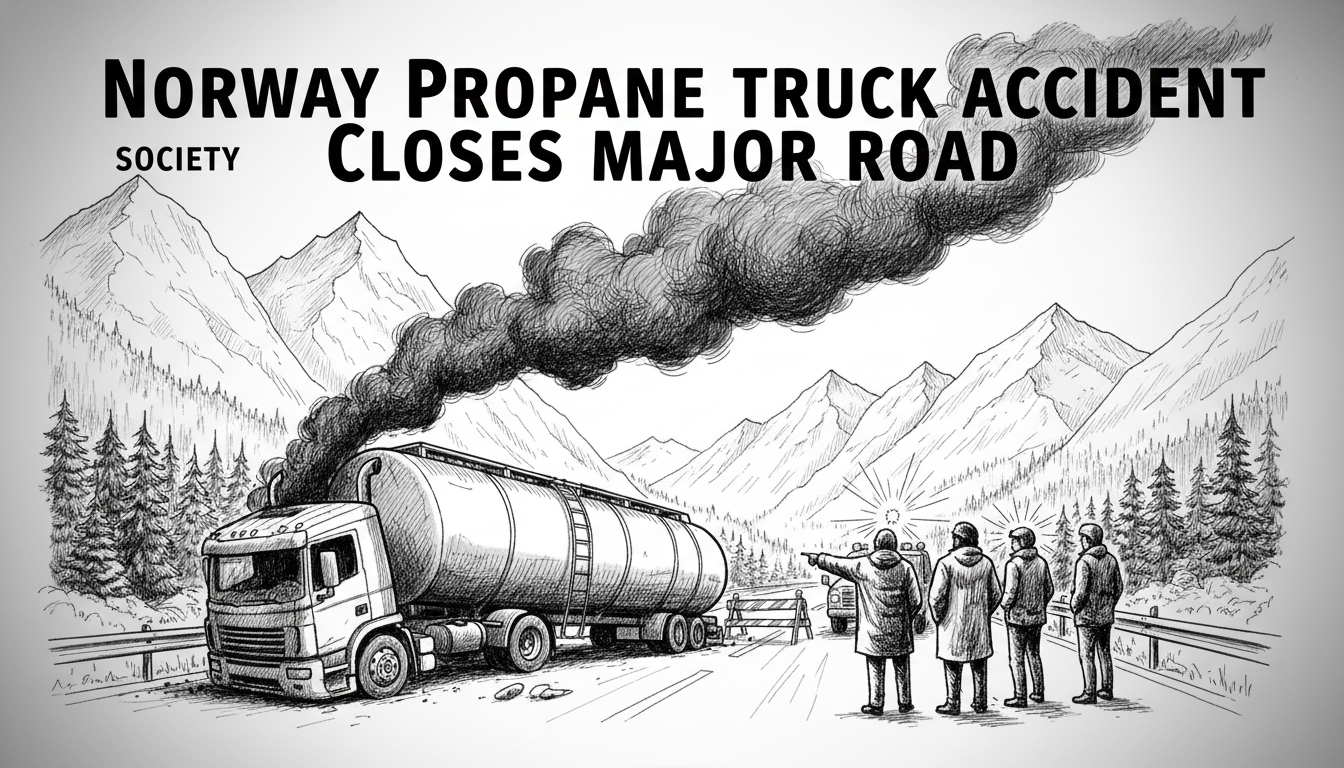
Norway's Riksveg 3 highway faces a full closure and local evacuations after a propane truck overturned near Kvikne in Østerdalen on New Year's Day. The major transport artery connecting Innlandet and Trøndelag counties will be shut for a critical four-hour salvage operation starting Friday morning, with authorities establishing a 300-meter safety zone around the hazardous site.
The accident occurred on January 1st, casting a shadow over the holiday period for residents and travelers in the eastern valley region. Police have coordinated with emergency services and the Norwegian Public Roads Administration to manage the complex recovery of the tanker, which remains full of highly flammable propane gas. This incident highlights the persistent risks of transporting hazardous materials through Norway's challenging terrain.
A Delicate and Dangerous Recovery Operation
Salvage crews face a meticulous and dangerous task. The primary objective is to safely upright the vehicle and transfer its volatile cargo to a secure container without triggering a leak or explosion. "Establishing the 300-meter exclusion zone is a non-negotiable safety protocol," a police operations coordinator said in a briefing. "Everyone within that radius has been notified and evacuated. Our absolute priority is preventing any ignition source near that truck."
The operation is scheduled to begin between 10:00 and 10:30 AM on Friday. Specialized heavy recovery vehicles and teams trained in hazardous material handling are on site. Experts explain that propane, while liquified under pressure in the tank, vaporizes rapidly if released, creating a heavy, invisible cloud that can travel along the ground and ignite explosively if it finds a spark.
Economic and Commuter Gridlock in Østerdalen
The closure of Riksveg 3 creates immediate logistical headaches. This road is a vital lifeline for the Østerdalen region, facilitating not only daily commuter traffic but also the movement of timber, goods, and supplies to remote communities. Alternative routes are limited, often consisting of smaller, winding mountain roads less suitable for heavy traffic and potentially hazardous in winter conditions.
Local businesses, particularly those reliant on just-in-time deliveries, anticipate disruptions. The four-hour closure window will likely cause significant congestion on detour routes, with delays stretching for hours as traffic is rerouted. This single accident underscores the vulnerability of Norway's transport network, where key routes through valleys like Østerdalen have few parallels.
Norway's Balancing Act: Energy Transport and Public Safety
This incident brings Norway's complex relationship with energy transportation into sharp focus. The country is a major producer and consumer of propane and other liquefied petroleum gases (LPG), used for heating in areas beyond the natural gas grid and in various industrial processes. Transporting these fuels by road through long, remote valleys is a daily necessity, but one fraught with inherent risk.
Safety records for hazardous material transport in Norway are generally strong, governed by strict EU and national regulations covering vehicle standards, driver training, and route planning. However, geography presents an immutable challenge. Roads like Riksveg 3 navigate steep gradients, sharp curves, and variable winter weather, all factors that increase accident potential. Each incident prompts renewed debate about the feasibility of shifting more hazardous cargo to rail, though Norway's limited rail network makes this impractical for many regions.
The Environmental Stakes of a Potential Spill
While the immediate danger is a catastrophic fire, environmental experts also note the risks of a propane spill. "Propane itself is not considered a long-term environmental contaminant like oil," said an environmental safety consultant familiar with such operations. "It evaporates. The greater environmental concern in this operation is actually from the ancillary response—potential fuel or hydraulic fluid leaks from the damaged truck, or soil disruption during the recovery. The response teams will have containment measures ready for those secondary risks."
The chosen salvage method will aim to minimize any release. The goal is a controlled, technical recovery where the product remains contained within the tanker's integrity or is pumped directly to another vessel. A successful operation means the environmental impact will be negligible, but the contingency plans for a larger incident are always part of the emergency response blueprint.
A Test of Preparedness and Communication
This event serves as a live test for Norway's multi-agency emergency response framework. Police, the Norwegian Public Roads Administration, the Fire and Rescue Service, and the company owning the tanker must collaborate seamlessly. Public communication is also critical; ensuring all residents in the evacuation zone are accounted for and that travelers have real-time information on road closures demands efficient coordination.
The timing, just after the New Year holiday, may have reduced regular commercial traffic but also finds many Norwegians still traveling to return home or visit family. The authorities' ability to clear the incident smoothly and reopen a major national highway will be closely watched. Any prolongation of the closure beyond the estimated four hours would have escalating economic and social costs for the region.
Looking Beyond the Immediate Crisis
Once the tanker is secured and Riksveg 3 reopens, the investigation will begin. The Norwegian Safety Investigation Authority will likely examine the causes, looking at factors like driver fatigue after the holidays, road conditions on January 1st, vehicle maintenance, and whether the chosen route was appropriate for that specific cargo. Their findings can lead to recommendations for improved safety measures nationwide.
For residents of Kvikne and the surrounding area, the sight of an overturned propane tanker on their doorstep is a stark reminder of the risks that roll past on a daily basis. It reinforces the importance of robust safety regulations and emergency planning. For Norway, it is another data point in the ongoing challenge of connecting a sprawling, rugged nation while protecting its people and environment from the dangers inherent in that connectivity. As the salvage teams move in on Friday morning, their careful work will determine whether this incident is remembered as a close call or a catastrophe averted.