
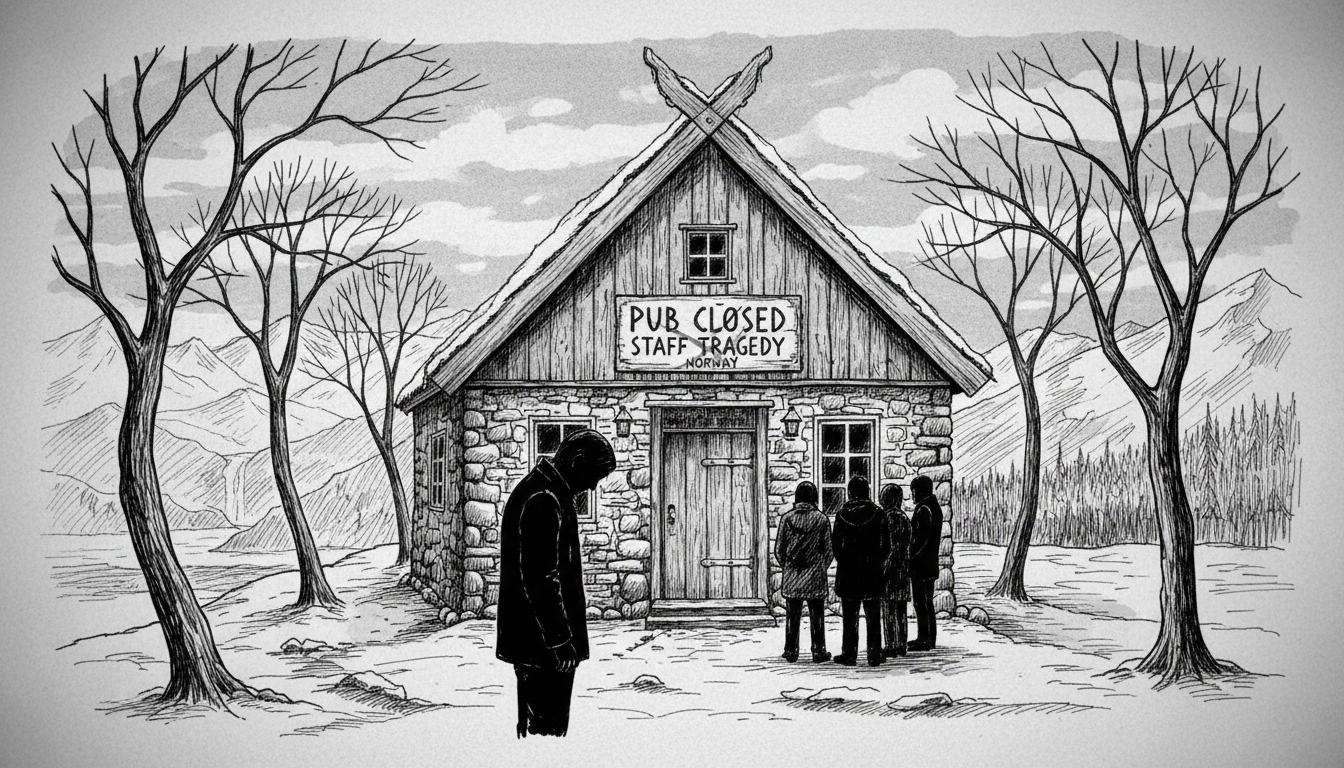
Norway's low crime rate offers little comfort in the small community of Løkken, where a local pub will remain shuttered for months following a murder between coworkers. The Bjørnlihiet pub and guesthouse in Orkland, Trøndelag, announced its closure for the rest of the year after a fatal incident last Saturday. Both the victim and the suspected perpetrator were employees at the establishment, casting a long shadow over the business and the tight-knit rural town.
A handwritten note taped to the pub's door conveys the profound shock. "Out of consideration for staff and relatives after the extremely tragic event, the pub is closed for the rest of the year. Our thoughts are with those affected and her family," it reads. Owner Tom Ketil Krogstad made the decision out of respect, prioritizing the wellbeing of his remaining staff and the victim's family over commercial concerns. This act underscores the intimate, personal impact of the crime in a setting where professional and private lives are deeply intertwined.
A Community Grapples with Unthinkable Violence
The tragedy strikes at the heart of Løkken, a community within the Orkland municipality known for its mining history and picturesque setting. In such areas, a local pub often functions as more than a business; it is a social anchor. The fact that the violence occurred between colleagues adds a complex layer of trauma, rupturing workplace trust and forcing other employees to reconcile their memories of both individuals with the brutal outcome.
"When violent crime happens in a small community, the shockwaves are felt by everyone," explains a Norwegian criminologist specializing in community impact, who requested anonymity due to the ongoing investigation. "There is no anonymity. The victim, the suspect, their families, and the witnesses are all your neighbors. The trauma is collective, and the process of healing requires significant local support systems." The closure of the pub removes a central gathering place, potentially hindering the informal community coping process while acknowledging the raw pain associated with the location.
Norway's Crime Paradox in Sharp Focus
This incident brings Norway's statistical safety into a stark, localized contrast. The nation consistently reports one of the world's lowest homicide rates, typically around 0.5 per 100,000 inhabitants. For context, this rate is roughly four to five times lower than the European Union average and over twenty times lower than that of the United States. Most Norwegian homicides occur in domestic settings or between individuals known to each other, often linked to substance abuse or mental health crises.
However, these national figures provide little solace when violence erupts in a quiet region like Trøndelag. The rarity of such events in rural Norway can amplify their psychological impact. Residents are forced to confront a brutal reality that feels imported from news reports about distant cities, not their own backyard. The systemic trust in public safety is challenged, however temporarily.
The Long Road Ahead for a Business and a Town
The decision to close until January is financially significant for a small hospitality business. It represents a complete forfeiture of autumn and winter season revenue, including potential holiday gatherings. This choice highlights a cultural prioritization of communal welfare and respect for the bereaved, values that often supersede pure economic logic in Norwegian society. It sets a tone of mourning and allows space for the initial, most intense phase of grief without the jarring presence of business-as-usual.
Local authorities and health services now face the critical task of providing targeted support. This includes counseling for the direct colleagues, the families involved, and potentially for regular patrons of the pub who are struggling with the news. The police investigation will proceed with meticulous care, but the community's need for psychological first aid and long-term support networks is immediate.
For the owner and remaining staff, the future is uncertain. Reopening in the new year will be a formidable challenge. They must navigate returning to a workplace saturated with tragedy, potentially rebranding or altering the establishment's atmosphere to help patrons and themselves create new associations. The pub's identity is forever changed.
A National Conversation on Localized Trauma
While Norway will not see a spike in its crime statistics from this single event, it ignites a necessary conversation about the uneven distribution of trauma. Resources and crisis response protocols designed for urban centers may need adaptation for rural municipalities where everyone is connected. The story of the closed pub in Løkken is not just a crime report; it is a case study in communal grief, the ethics of business in tragedy, and the deep scars left when violence invades a place defined by its peace.
Can a community space recover from becoming a crime scene? The locked door of the Bjørnlihiet pub is a silent testament to that difficult question, one the town of Løkken will spend the coming months, and likely years, working to answer.