
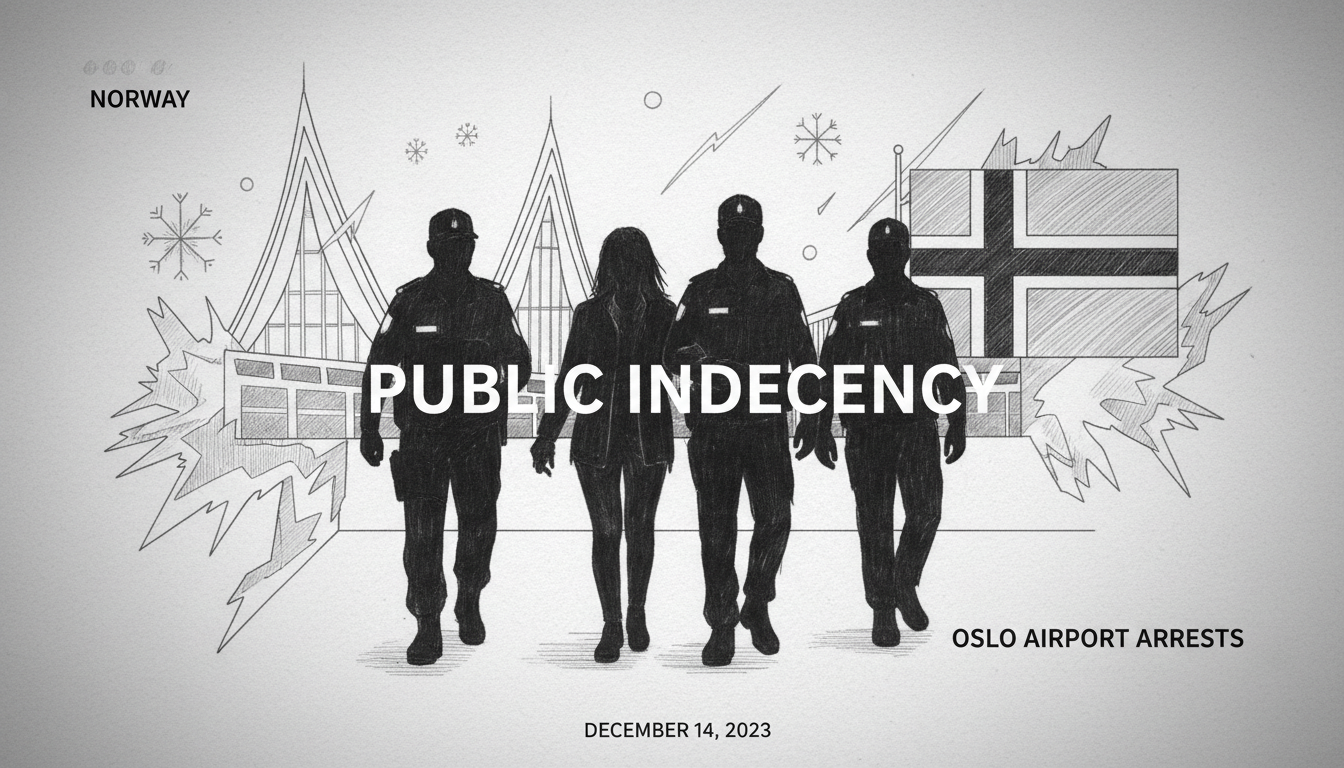
Norway police detained a man and a woman after they were caught having sex at a public bus stop near Oslo Airport on the night of December 26th. The incident occurred openly at a busy transit hub, prompting an investigation into public indecency laws. This case highlights the ongoing legal and social tensions between personal freedom and public order in Scandinavian society.
Operational manager Rune Isaksen confirmed the police response to a report of the act. "The incident happened openly at the bus stop with considerable traffic and people present," Isaksen said in a statement. The two individuals involved were identified as a man in his 20s from Northern Norway and a woman in her 40s from Eastern Norway. Police have stated no information suggests the act was non-consensual, but they opened a case because it occurred in a public, well-trafficked area.
A Legal Gray Zone at a Transit Hub
The bus stop at Oslo Airport, known as Oslo lufthavn, serves as a critical junction for thousands of travelers daily. Its location makes any public disturbance highly visible. Norwegian law on public indecency falls under provisions against disorderly conduct, primarily governed by the Penal Code's section on public nuisance. Enforcement hinges on whether an act is likely to cause offense or alarm to the public. Legal experts note the definition is intentionally broad, allowing police and courts to consider context, location, and the number of potential witnesses.
"The law isn't specifically about sex," explains Professor Lars Jacob Gjendem, a legal scholar at the University of Oslo. "It's about violating public order and decency. An act that might be ignored on a remote beach becomes a criminal matter at a major airport. The key factor is the reasonable expectation of not being exposed to such intimate behavior in a shared public space." The police decision to investigate reflects this standard, focusing on the open nature of the act in a designated transport area.
Societal Norms and the Scandinavian Context
This incident invites analysis of Norway's social contract, which balances liberal personal freedoms with a strong collective expectation of order and moderation. Norwegian society generally maintains clear boundaries between private and public sphere behavior. Public indecency cases are relatively rare but often involve locations like parks, public transport, or, as in this case, infrastructure nodes. The age difference between the individuals, with the woman being significantly older, adds another layer of public intrigue, though it holds no specific legal relevance if the act was consensual.
Sociologist Dr. Ingrid Moe suggests the airport setting is significant. "Airports are liminal spaces—places of transition where normal social rules can feel temporarily suspended for some," she says. "However, they are also highly regulated, monitored environments. This creates a clash between a potential sense of anonymity and the reality of constant public and security oversight. The act wasn't just public; it was in a hyper-public, security-conscious zone."
Police Procedure and Potential Outcomes
The Øst Police District's handling of the case follows a standard protocol for such incidents. After ensuring immediate public order was restored and separating the individuals, police would typically interview them separately to establish consent and context. Since initial findings indicate a consensual act, the investigation shifts from a potential sexual crime to a violation of public order. The individuals were likely issued a citation or summons for further questioning rather than being held in custody.
Potential penalties for a conviction on minor public indecency charges can range from fines to conditional discharges. The court would consider the specific impact on bystanders. Were children present? Did it cause a visible disruption? The police statement's emphasis on the area being "beferdet"—frequented or trafficked—is the central element of their case. A conviction would likely result in a fine, but the case could also be dropped with a formal warning if the individuals have no prior record.
The Broader Implications for Public Space
This event serves as a contemporary case study for Norway's ongoing dialogue about the use of shared spaces. It touches on themes of urban design, surveillance, and social tolerance. Bus stops and transit stations, while public, are essential utilities. Their function as places of waiting and transit creates an expectation of basic, non-intrusive conduct. The incident tests the limits of what the public is expected to tolerate in these necessary, sometimes impersonal, parts of the civic landscape.
Comparatively, Norway's approach is often less punitive than in some other European countries but stricter than its reputation for social liberalism might suggest. The law serves a pragmatic function of preventing public disturbance rather than enforcing moral codes. This distinction is crucial. The police are not investigating the sexual act itself but its location and its potential to disrupt public peace and cause offense to unwilling observers.
A Reminder of Legal Boundaries
While the incident may seem minor, it reinforces that Norway's famed personal freedoms are exercised within a framework of collective consideration. The case will likely conclude quietly with an administrative resolution. Yet, it momentarily pulled back the curtain on the legal machinery that maintains public order in one of the world's most orderly societies. It underscores that even in a nation known for its progressive values, there are clear, if occasionally ambiguous, lines between private behavior and the public domain.
As travel returns to pre-pandemic levels at Oslo Airport, this event remains a footnote. But it asks a persistent question: in an increasingly monitored and crowded world, where do we draw the line for personal expression in the spaces we all must share? The Norwegian police, with their focus on public order rather than morality, have given one very practical answer.