
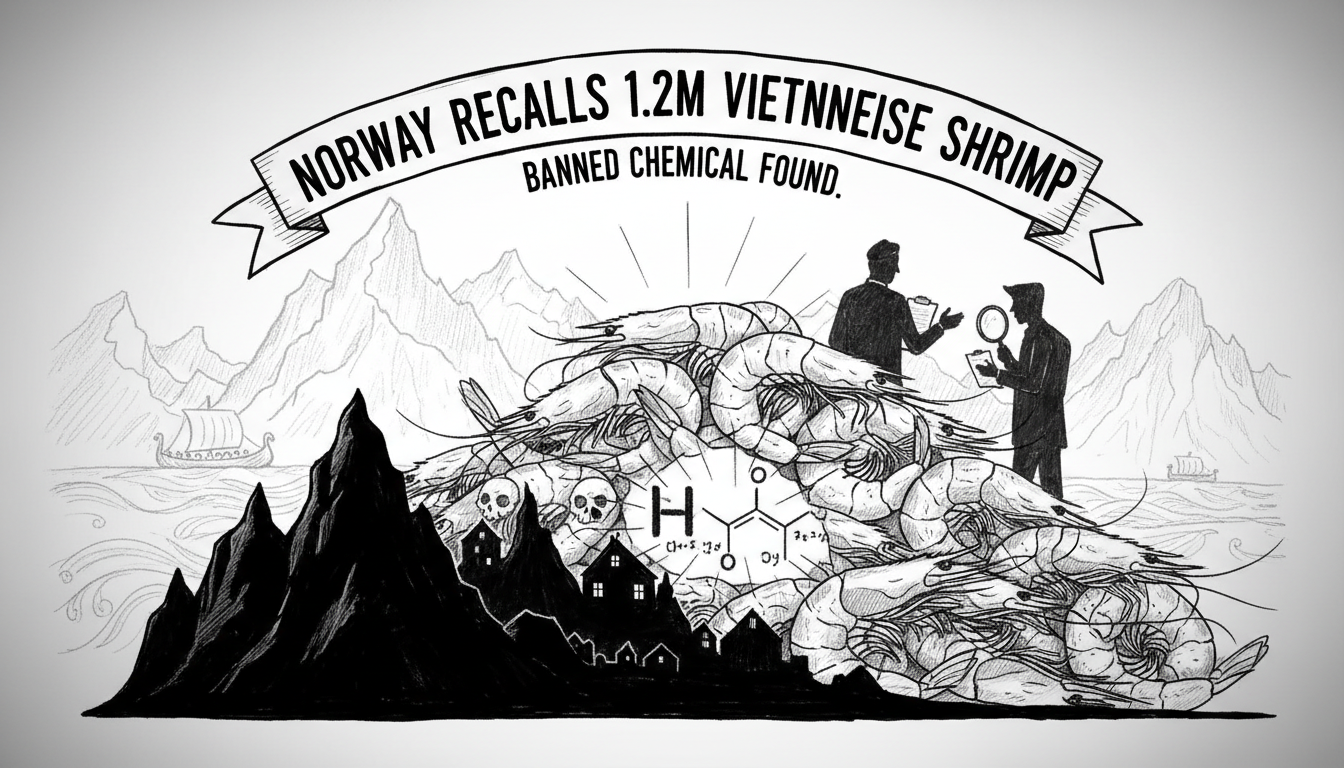
Norway's Food Safety Authority has ordered a major recall of Vietnamese shrimp after detecting a banned industrial chemical linked to potential cancer risks. The authority, Mattilsynet, found leukomalachite green in 'East Coast Whiteleg Shrimps' imported by Freshline AS and sold across Southern and Central Norway.
Consumers who purchased the product with 'best before' dates of October 15 or 16, 2026, are urged to return it or dispose of it immediately. The discovery highlights ongoing challenges in monitoring the global seafood supply chain, even in a nation with some of the world's strictest food safety standards.
A Chemical With a Dangerous History
The detected substance, leukomalachite green, is a metabolite of malachite green. This synthetic dye was historically used in aquaculture to treat fungal infections and parasites in fish farms. The European Union banned its use on food-producing animals in the 1990s after studies indicated it could damage genetic material and pose a carcinogenic risk to humans.
"Malachite green is not permitted for use on food-producing animals in the EU, but is used in some other countries," Mattilsynet stated clearly. "It is prohibited in the EU because studies show the substance can pose a health hazard to people." The chemical can persist in the environment and accumulate in animal tissue, making its presence in imported seafood a significant red flag for regulators.
The Recall's Scope and Consumer Response
The implicated shrimp arrived in Norway in May 2025. They were distributed to independent grocery stores, not the large national chains, throughout Sør- and Midt-Norge. This includes regions from the southern coast up through Trøndelag. The product is sold peeled with the shell on, but without the head, in various size grades.
Freshline AS, the importer, has notified its retail customers and initiated the withdrawal from the market. "Consumers who have bought the product are asked to return it to the store or throw it away," the official notice reads. For shoppers, the key identifiers are the product name 'East Coast Whiteleg Shrimps' and the specific best-before dates. No other batches or products from Freshline are currently affected.
Norway's Vigilant Seafood Surveillance
This detection was not accidental. It resulted from Mattilsynet's routine monitoring program for seafood, a critical component of Norway's food safety infrastructure. Given that Norway is the world's second-largest seafood exporter, with a reputation built on quality and safety, maintaining rigorous checks on both exports and imports is a top priority.
The system involves regular sampling and testing for a range of contaminants, including veterinary drug residues, heavy metals, and environmental toxins. Finding a banned substance like leukomalachite green triggers an immediate and public response. The process demonstrates the effectiveness of the surveillance net, but also exposes vulnerabilities when products from countries with different regulatory standards enter the Norwegian market.
The Global Seafood Trade's Persistent Challenges
The incident underscores a recurring tension in the globalized food industry. Norway maintains exceptionally high domestic production standards for its own salmon, cod, and shrimp. Its aquaculture regulations are among the strictest globally. However, as a consumer nation, it also imports seafood to meet demand, creating a potential gap between domestic standards and those applied in exporting countries.
Vietnam is a major global producer of farmed shrimp, primarily the whiteleg species (Litopenaeus vannamei). Its industry has faced international scrutiny in the past over antibiotic use and other chemical controls. While many Vietnamese producers operate to high standards to access markets like the EU, Japan, and the US, enforcement can be inconsistent. This recall will likely lead to increased scrutiny of Vietnamese shrimp consignments at Norwegian borders in the coming months.
Expert Analysis: Trust and Traceability
Food safety experts point to this case as a textbook example of why monitoring and traceability are non-negotiable. "The system worked as it should—testing identified a problem, and the traceability records allowed authorities to quickly pinpoint the batch and its distribution," says a senior food scientist familiar with EU regulations, who spoke on background. "The health risk from a single exposure is likely low, but the principle is clear: banned substances have no place in the food chain."
The expert emphasized that the metabolite found is a marker of prior illegal use of malachite green, either directly on the shrimp or in the farming environment. "This is why post-import monitoring is crucial. It acts as a final safety net."
For Norwegian consumers, the episode is a reminder to pay attention to food origin labels. It also reinforces the value of the country's transparent recall system. While alarming, the public, immediate disclosure builds trust in the long run, showing that authorities are actively checking and will act on findings.
Economic and Diplomatic Ripples
For Freshline AS, the recall involves logistical costs and reputational damage. The company must manage the return logistics, likely face fines or intensified inspections from Mattilsynet, and work to rebuild trust with retailers. The financial impact on the small independent grocery stores that sold the product, often competing with larger chains, could also be meaningful.
On a broader scale, the Norwegian authorities will now file a notification through the EU's Rapid Alert System for Food and Feed (RASFF). This alerts all EU member states to the issue, potentially triggering wider checks on Vietnamese shrimp across Europe. The Vietnamese export authorities will also be formally notified, potentially leading to investigations at the farm or processing plant of origin.
A Look at the Bigger Picture: Norway's Seafood Paradox
Norway finds itself in a paradoxical position. It is a global seafood superpower that meticulously controls its own production, yet it imports over 100,000 tonnes of shrimp annually, primarily for the peeled, cooked market where price competition is fierce. This recall highlights the inherent risk in this dependency. It raises questions about whether future food policy should incentivize more domestic production of certain products or demand even stricter certification for imports.
Some politicians, particularly from coastal and northern parties, have long argued for greater self-sufficiency in seafood. They contend that Norway's own cold-water shrimp fishery, though smaller in volume and different in species, could be better supported to replace some imports. Incidents like this provide fuel for that political argument, linking food safety directly to national production.
What Consumers Should Do Now
The advice from Mattilsynet is straightforward. Check your freezer for bags of 'East Coast Whiteleg Shrimps' from Vietnam. If the best-before date is 15.10.2026 or 16.10.2026, do not consume them. Return the product to the store for a refund or dispose of it with your household waste. No other shrimp products from other brands or with other dates are implicated.
For the average Norwegian, the likelihood of having purchased this specific product from an independent grocer is relatively low. But the story serves a broader purpose: it is a real-time demonstration of the food safety apparatus in action. It shows that the system, funded by public money, is actively working to identify and remove hazards.
The Path Forward from Here
Mattilsynet's investigation will continue. It will seek to determine how the contaminated batch slipped through checks at the Vietnamese export point and at the EU/Norwegian border. The focus will be on whether this was an isolated incident or indicative of a broader problem with the exporter or region.
The recall's success will be measured by the percentage of the contaminated product recovered. More importantly, its legacy will be its impact on policy. Will it lead to increased testing frequency for specific chemicals from specific countries? Will it result in stricter documentary requirements for importers? The answers will shape Norway's approach to food imports in the years ahead.
In the end, this story is about more than shrimp. It is about the invisible lines of defense that protect the dinner table. It is a case study in global trade's complexities, where a chemical banned decades ago in Europe can still find its way onto a Norwegian plate via a long and intricate supply chain. The swift recall confirms those defenses are active, but the breach confirms they must be eternally vigilant.