
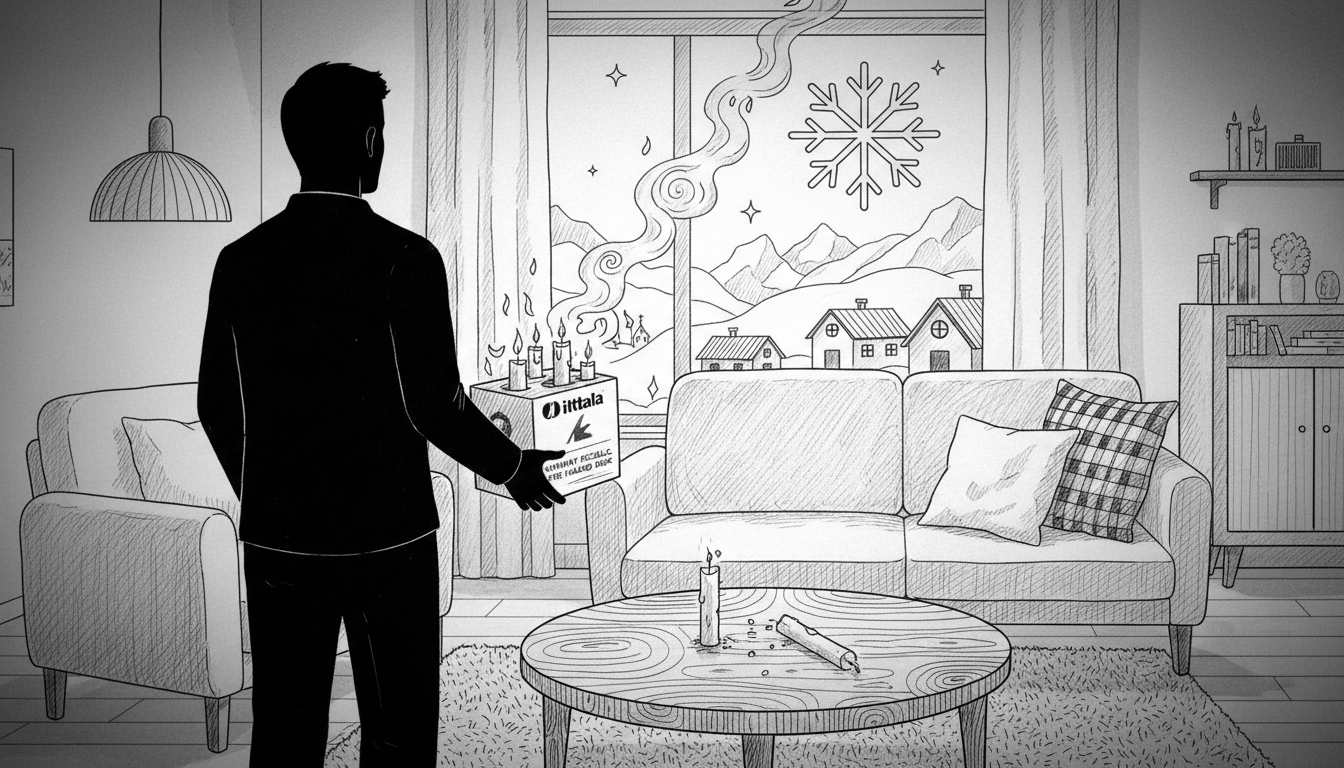
Norway's product safety authorities have issued a recall for Iittala Aalto and Iittala Kanto pillar candles, warning they pose a serious fire hazard. The recall, announced on the official portal farligeprodukter.no, applies to candles sold after October 17th. The defect can cause the wick to accumulate, leading to unusually high flames, significant smoke development, dripping wax, and a direct risk of fire.
Consumers are urged to stop using the candles immediately and contact their point of purchase for a full refund. This action highlights the critical, behind-the-scenes work of Norway's product safety framework, which aims to prevent household dangers before they result in injury or property damage.
A Silent Threat in Nordic Homes
The recalled Iittala candles are not obscure items. Iittala is a prestigious Finnish design brand, and its products are widely sold across the Nordic region in department stores, design shops, and homeware boutiques. The Aalto and Kanto lines, with their clean, geometric shapes, are emblematic of Scandinavian minimalist design. Their presence in a home suggests a conscious aesthetic choice, making this recall particularly jarring for design-conscious consumers who associate the brand with quality and safety.
"The wick can accumulate, which leads to unusually high flames, smoke development, dripping wax, and thus a fire hazard," the official recall notice states plainly. This simple malfunction transforms a common object of ambiance into a potential source of disaster. The recall specifically targets items sold after a certain date, indicating a possible change in materials, manufacturing process, or supplier that introduced the flaw.
The Machinery of Consumer Protection
This recall operates through Norway's coordinated product safety system. The website farligeprodukter.no is the central hub, managed by the Norwegian Product Safety Authorities to inform both the public and market operators. It feeds into the EU's Rapid Alert System for Dangerous Non-Food Products (RAPEX), ensuring the information spreads across European borders.
Oversight in Norway involves several agencies. While the Norwegian Directorate for Civil Protection (Direktoratet for samfunnssikkerhet og beredskap, DSB) has a broad mandate for societal safety, specific product safety enforcement often falls to the Norwegian Maritime Authority for marine equipment or the Norwegian Food Safety Authority for goods, with general consumer safety monitored by the Norwegian Consumer Authority. This interconnected system relies on manufacturers to report defects and authorities to act swiftly.
"A recall like this is a preventive measure," explains a product safety expert familiar with the Nordic system, who spoke on background. "Its success depends entirely on public awareness and compliance. The goal is to get the hazardous product out of homes before a statistical probability becomes someone's personal tragedy. The refund is not just a goodwill gesture; it's a critical incentive to ensure participation."
The Unseen Calculus of Product Safety
Every product recall represents a complex calculation. For a brand like Iittala, owned by the global Fiskars Group, the reputational damage must be weighed against the legal and moral imperative to protect consumers. A swift, transparent recall, while costly, is often less damaging than the fallout from a fire linked to a known, unaddressed defect. The Nordic market, with its high trust in institutions and brands, places a premium on this transparency.
From a regulatory perspective, the focus is on the hazard's severity and probability. A candle that produces a dangerously high flame is a high-severity risk, as it can quickly ignite nearby materials like curtains, tablecloths, or wooden surfaces. The probability increases with prolonged or unattended use—common scenarios for decorative candles. This combination triggers urgent action.
Norway's approach is inherently risk-averse, reflecting its broader societal safety culture. The state has a duty, codified in law, to protect citizens from foreseeable harm, whether from major industrial accidents or from seemingly mundane household goods. This incident is a minor but clear example of that philosophy in action.
Beyond the Recall Notice
The practical steps for consumers are clear: stop burning the candles, remove them from the home, and seek a refund. However, the implications run deeper. This recall should serve as a broader reminder about candle safety, a perennial concern, especially during Norway's dark autumn and winter months when candle use peaks.
Safety experts consistently advise never leaving burning candles unattended, keeping them away from drafts and flammable materials, and placing them on stable, non-flammable surfaces. This recall underscores that even products from reputable brands require vigilant use. It also demonstrates the importance of registering products with manufacturers when possible, as this allows for direct contact in the event of a recall.
For retailers, the recall imposes a duty to effectively notify customers, a challenge when many sales are cash transactions or lack detailed contact information. This often makes public announcements in media and on platforms like farligeprodukter.no the primary notification channel.
A Test of Systemic Trust
The ultimate effectiveness of this recall will not be measured in press releases but in the return rate of the candles. It tests the public's trust in official warnings and their willingness to undertake the minor hassle of returning an item for a problem they may not have yet experienced. High compliance would indicate strong public confidence in the product safety system.
Conversely, a low return rate would signal a communication breakdown or public apathy, leaving a known hazard in circulation. Authorities likely monitor sales data to estimate how many defective units are in the market, setting a benchmark for success.
This event is also a data point for regulators. It may prompt increased scrutiny of candle standards or testing procedures for similar decorative items. Each recall feeds into a body of knowledge that shapes future regulations and safety standards, creating a feedback loop designed to make consumer goods safer.
The Nordic Model of Prevention
While dramatic police operations or political scandals dominate headlines, the quiet work of product safety is a cornerstone of the Nordic welfare model. It is a form of preventive governance, using regulation and information to mitigate risk before it materializes. The recall of the Iittala candles is a small but perfect example: a state mechanism activating to correct a market failure and protect citizens in their private spheres.
It reflects a societal consensus that safety is not merely a personal responsibility but a collective one, shared by manufacturers, retailers, and the state. The seamless right to a refund, mandated by the recall, reinforces the principle that consumers should not bear the cost—financial or physical—of a defective product.
As the dark season approaches in Norway, with homes increasingly illuminated by the warm glow of candles, this recall offers a stark reminder. The line between cozy ambiance and danger can be as thin as a poorly constructed wick. The system worked this time to issue a warning. The rest depends on the choices made in countless living rooms across the country.