
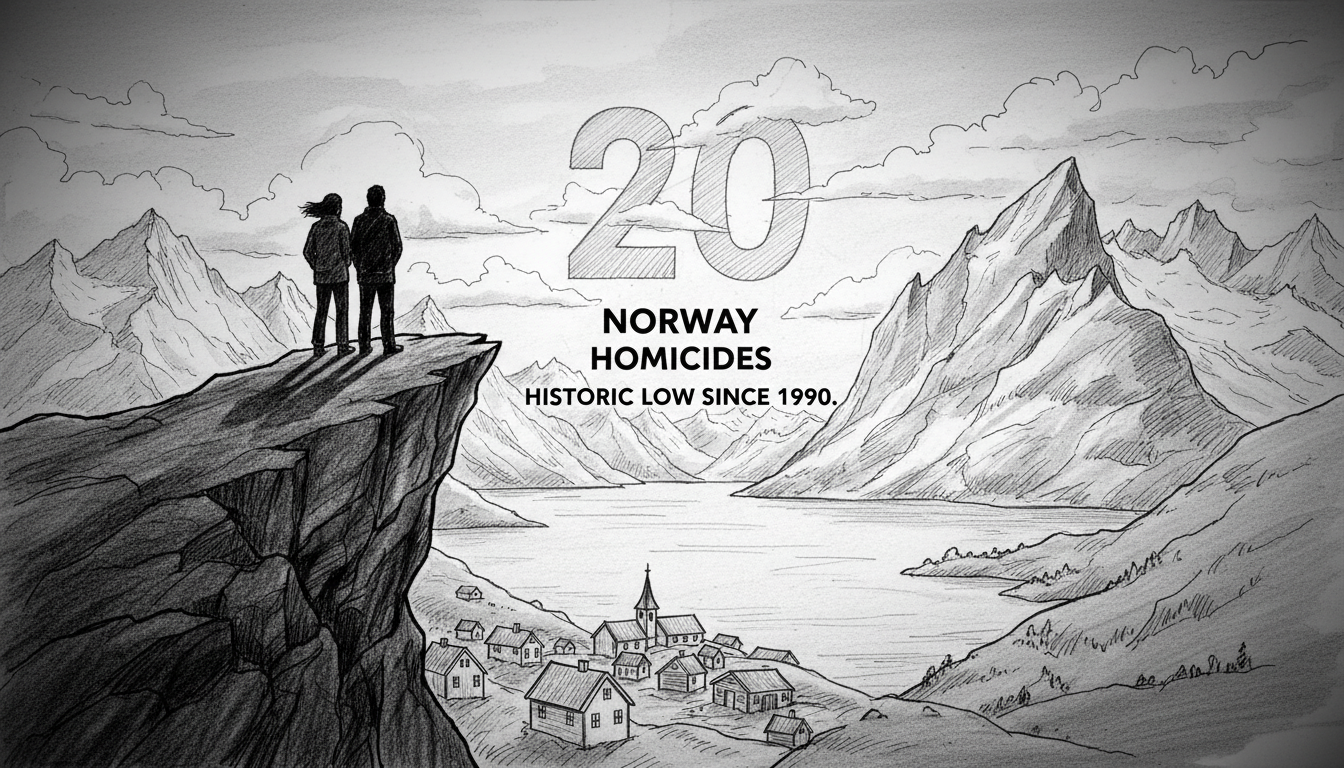
Norway has recorded its lowest homicide count in over three decades, with just 20 deaths this year. This figure marks the fewest murders since the National Criminal Investigation Service, Kripos, began its current statistical tracking in 1990. The data confirms a long-term, if gradual, downward trend in one of Europe’s safest nations.
“When we adjust for the population size, we see there has been a slight but consistent decline in the occurrence of homicide in Norway since 1990,” said Solveig Karin Bø Vatnar, a researcher at Oslo University Hospital. Her team's study, which uses the same homicide definition as Kripos and analyzes data back to 1990, provides the academic backbone for this official milestone. The numbers reflect a society where lethal violence remains exceptionally rare.
A Statistical Milestone in a Safe Society
Reaching only 20 homicides in a population exceeding 5.4 million underscores Norway’s position as a global leader in public safety. For context, many major international cities record more homicides in a single month. This year's figure is not a sudden anomaly but the lowest point on a descending curve. Experts point to a multi-faceted web of social, economic, and judicial factors that collectively discourage violent crime. The country’s robust welfare state, high levels of trust in public institutions, and comprehensive focus on rehabilitation over pure punishment are frequently cited as foundational elements.
The Norwegian model prioritizes early intervention and social support. Strong public services in healthcare, education, and family support create a safety net that can prevent the desperation and social fragmentation often linked to criminality. “It is difficult to pinpoint a single cause,” said a criminologist at the University of Oslo, who requested anonymity as their full study is forthcoming. “But the consistency of the decline suggests it is systemic. We are looking at the product of a relatively equitable society with effective policing and a justice system aimed at reducing recidivism.”
Regional Patterns and Criminal Context
While the national figure is low, homicide in Norway is not evenly distributed geographically or contextually. Historically, a significant proportion of cases occur in major urban areas like Oslo, Bergen, and Trondheim. However, even these cities report rates far below comparable European capitals. The nature of the crimes also follows predictable patterns, with a majority occurring between individuals known to each other, often in domestic or acquaintance settings. Random acts of lethal violence against strangers are extremely uncommon.
Organized crime-related killings, while garnering significant media attention when they occur, represent a small fraction of the total. Police efforts to combat gang activity, particularly focused on drug trafficking networks, continue. The low homicide rate suggests these conflicts are largely contained within criminal milieus and rarely spill over to affect the general public. Police methodology has also evolved, with greater emphasis on forensic technology and intelligence-led policing, potentially helping to resolve conflicts before they turn deadly.
International Comparison and the ‘Nordic Exceptionalism’
This new data reinforces the concept of ‘Nordic exceptionalism’ in crime statistics. When placed on a European scale, Norway’s homicide rate per 100,000 inhabitants is among the very lowest, consistently alongside its Nordic neighbors Sweden, Denmark, Finland, and Iceland. This regional bloc outperforms much of the continent, where average rates can be two to three times higher. The contrast is even starker when compared to global figures, particularly with nations experiencing high levels of economic inequality and social instability.
The Nordic model, with its high tax burden funding extensive social programs, appears correlated with low levels of violent crime. While debates continue about the cost and structure of this model, its outcomes in public safety are clear. Norway’s investment in its citizens’ well-being, from childhood through adulthood, creates a societal buffer against the forces that typically drive homicide rates upward elsewhere.
Future Challenges and Sustaining Safety
The record-low number presents its own challenges for authorities and researchers. With such small annual figures, statistical volatility increases; a single tragic event can significantly impact the year-on-year percentage change. Maintaining the downward trend requires continuous adaptation. Police and social services now focus on emerging threats, including cyber-facilitated crime and the potential for increased violence linked to mental health crises, which remains a factor in many cases.
Furthermore, as Norwegian society becomes more diverse, ensuring that safety and social trust are universal experiences for all residents is an ongoing priority. Integration policies and equitable service access are seen not just as social goals, but as crime prevention strategies. The goal for Norwegian policymakers is not merely to react to crime, but to sustain the conditions that make it so rare. As Researcher Vatnar’s analysis shows, the decades-long trend is positive. The task for the nation is to understand why, and to protect those hard-won conditions.
Does a record-low homicide rate signify the ultimate success of a society's design? Norway’s experience suggests that safety is not an accident, but the product of deliberate, long-term investment in people. The real story behind the number 20 is not about a single year's tally, but about the steady, decades-long cultivation of a society where life is profoundly protected. The question for the rest of the world is what lessons can be drawn from this Nordic experiment in peace.