
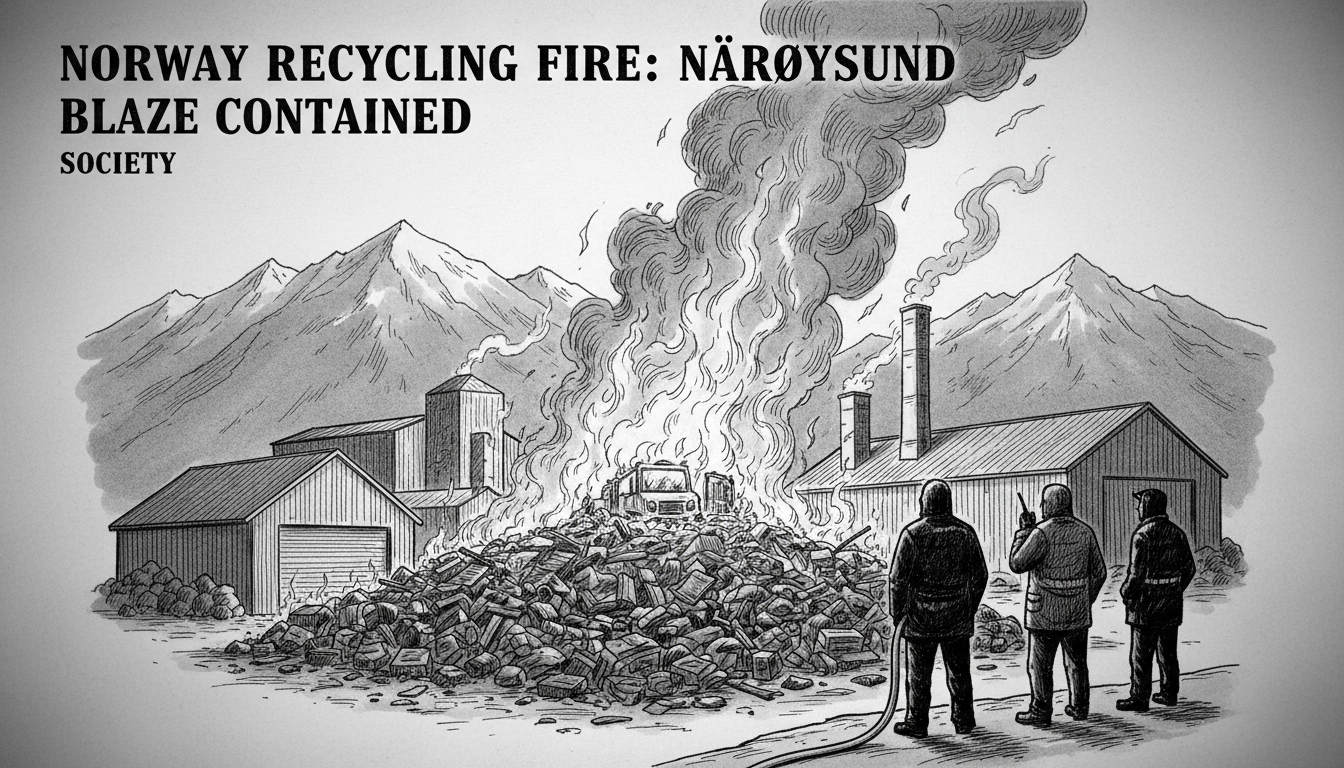
Norway's Trøndelag county faced a significant environmental incident Tuesday night as a major fire erupted at a municipal recycling station in Nærøysund. The Trøndelag police district reported the blaze at 23:43, with emergency services rushing to the scene to prevent a potential ecological disaster in the sensitive coastal municipality.
Flames lit up the night sky over the Nærøysund facility, a key waste management hub for the community formed from the 2020 merger of Vikna and Nærøy. Fire brigades engaged in a protracted battle to control the fire, which threatened to release toxic pollutants into the air and surrounding landscape. Authorities confirmed there was no immediate danger of the fire spreading to adjacent areas, a critical containment success given the station's location.
Emergency Response and Initial Assessment
Local fire departments mobilized multiple units to tackle the intense blaze. The primary objective was to prevent the fire from reaching any hazardous materials that might be stored on-site, such as batteries, electronic waste, or chemical containers common at recycling facilities. A police spokesperson confirmed the firefighting operation was underway but provided no immediate estimate for when it would be fully extinguished.
"Fire brigades have begun extinguishing the blaze," the police statement read, emphasizing that the situation was being managed. The absence of reported injuries or evacuations offered some relief, but the long-term environmental impact remained a pressing concern for local officials and residents. The Nærøysund station handles a wide variety of household and industrial recyclables, making the composition of the fire complex and potentially dangerous.
Environmental Risks and Expert Analysis
Fires at waste management facilities present unique challenges and hazards. When plastics, treated woods, and electronic components burn, they can emit a cocktail of toxic fumes, including dioxins and heavy metals. Dr. Henrik Larsen, an environmental chemist at the Norwegian Institute for Air Research, explained the specific risks associated with such incidents.
"A fire at a recycling station is not like a forest fire," Larsen said. "You have an uncontrolled mix of materials combusting. The immediate priority is preventing exposure to nearby populations and containing runoff water, which can become contaminated and seep into the soil or local waterways." He noted that while authorities reported no spread, the smoke plume itself carries particulate matter that can affect air quality over a considerable distance.
In Norway, municipal recycling stations are operated by the local government or by contracted private companies. They are subject to strict regulations from the Norwegian Environment Agency regarding fire prevention, waste storage, and emergency preparedness. This incident will likely trigger a review of those protocols in Nærøysund and similar municipalities across Trøndelag.
The Broader Context for Norwegian Waste Management
This fire highlights the inherent risks in modern waste processing. Norway boasts one of the world's most advanced recycling systems, with ambitious circular economy goals. However, the infrastructure that enables this—sorting stations, compaction sites, and storage yards—concentrates combustible materials. A single ignition source, whether from a lithium-ion battery, chemical reaction, or electrical fault, can lead to a large-scale fire.
Similar incidents have occurred elsewhere in Scandinavia. In recent years, major fires have damaged recycling plants in Sweden and Denmark, causing millions in damages and prolonged operational shutdowns. These events have pushed insurance costs higher for the sector and intensified the focus on preventive measures, such as improved site layout, better separation of hazardous waste, and enhanced fire detection systems.
For Nærøysund, a municipality defined by its archipelago and coastal beauty, protecting the natural environment is paramount. The region's economy is closely tied to fishing and tourism, both of which depend on clean air and water. A significant pollution event from this fire could have lasting repercussions beyond the immediate damage to the facility.
Community Impact and Next Steps
While the physical danger appears contained, the operational disruption will be felt by Nærøysund's residents. The recycling station is a necessary utility for household waste disposal and recycling. Its temporary closure will force citizens to use alternative, potentially more distant facilities, or suspend recycling until the site is cleared and deemed safe.
Local municipal leaders will face questions about the cause of the fire and the adequacy of existing safety measures. An investigation led by the police and fire authorities will seek to determine the origin. Potential causes range from accidental ignition to equipment failure or even deliberate arson.
"The coming days will be about cooling the site, ensuring no re-ignition, and beginning the environmental assessment," said a source within the Trøndelag Fire and Rescue Service. "Only then can we start to understand the full scope of the damage and the path to reconstruction."
A Look at Prevention and Policy
This event serves as a stark reminder of the vulnerabilities in essential public infrastructure. As Norway continues to promote sustainability and recycling, the safety and resilience of the facilities that enable these policies must keep pace. Investment in fire-resistant construction materials, advanced suppression systems, and stricter on-site management of high-risk items like batteries may become more urgent priorities for municipalities nationwide.
The Nærøysund fire, while now under control, burns a question into the agenda of local and national policymakers: How can we protect the facilities that protect our environment? The answer will require not just better technology, but sustained vigilance and investment in the often-overlooked corners of our civic infrastructure. The true cost of this fire will be tallied not just in kroner spent on rebuilding, but in the renewed scrutiny applied to every station where Norway's green ambitions are put into daily practice.