
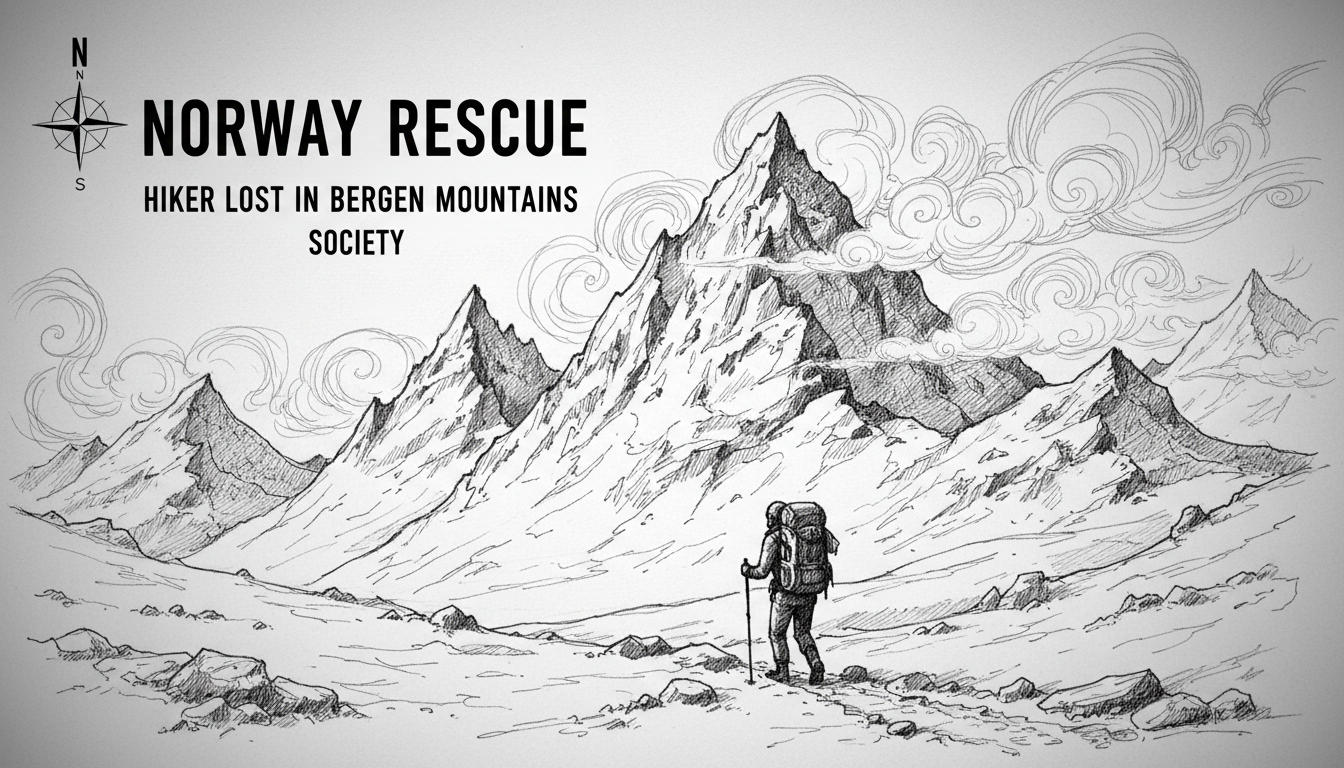
Norwegian rescue services launched a major operation Tuesday night after a hiker was reported lost in the treacherous terrain between Ulriken and Fløyen mountains in Bergen. Police and the Joint Rescue Coordination Centre (Hovudredningssentralen) mobilized volunteer teams from the Red Cross, Norsk Folkehjelp, and Norske Redningshunder, along with police dog patrols, as darkness and deteriorating weather closed in on the city.
"Crews are now being transported up via the Ulriken cable car," police reported at 8:27 PM. Johan Mannsåker of the Joint Rescue Coordination Centre expressed cautious optimism. "We have a position on the man further into the mountain, so if he stays put we should find him fairly easily," he said. "We are not aware that the man is injured, but the weather is poor with precipitation up there, so he is probably cold."
The operation highlights the ever-present risks in Norway's outdoor culture, even within sight of a major urban center. Bergen, nestled between seven mountains, offers immediate wilderness access that can turn dangerous with sudden weather shifts and fading light.
The Race Against Darkness and Weather
Rescue personnel faced a dual challenge: locating the hiker before complete darkness enveloped the steep, rocky landscape and before exposure to the wet, cold conditions could lead to hypothermia. The area between Ulriken, Bergen's highest peak at 643 meters, and the popular Fløyen mountain is a network of trails, some well-marked and others more rugged. While the mountains are a defining feature of city life, their microclimates are notoriously unpredictable.
Mannsåker's statement about having a position suggests the hiker may have been able to use a mobile phone to provide coordinates, a critical advantage for search teams. The decision to transport crews via the Ulriksbanen cable car was a strategic move to save precious time and energy, allowing rescuers to begin their ground search from a high elevation on Ulriken.
"This is a classic Bergen scenario," said Lars Fjelde, a former mountain guide and safety instructor based in the city. "People see the city lights below and think they cannot get into serious trouble. But the terrain is complex, and weather can change from a clear evening to dense fog and driving rain in minutes. Once you lose the trail markers, disorientation sets in quickly."
A Community Mobilizes for Rescue
The composition of the response team underscores Norway's integrated search and rescue model. While the Joint Rescue Coordination Centre provides central command, the operational backbone consists of highly trained volunteers from nationwide humanitarian organizations. The Red Cross and Norsk Folkehjelp maintain dedicated mountain rescue groups, while Norske Redningshunder specializes in deploying search dog teams.
This volunteer network, coordinated by professional authorities, is considered essential for covering Norway's vast and varied geography. It represents a societal contract where outdoor enthusiasts contribute to the safety system they may one day need. The police dog patrol added another specialized layer, capable of tracking scent over difficult ground where human searchers might miss clues.
"The efficiency of the response is built on decades of experience," explained Anette Hjelle, a researcher in emergency preparedness at the University of Stavanger. "Bergen has specific protocols for mountain rescues because they are, unfortunately, a regular occurrence. The integration of transport infrastructure—like using the funicular—shows adaptive thinking. The goal is always to get resources to the search area as fast as possible to improve outcomes."
The Allure and Peril of Bergen's Backyard Wilderness
Fløyen and Ulriken are among Norway's most-visited natural attractions. The Fløibanen funicular carries over a million passengers annually to Fløyen's summit, where a network of gentle paths leads to stunning views over the city and fjords. Ulriken, accessible by cable car or a steeper hike, offers more dramatic vistas. The trail connecting the two mountains, known as Vidden, is a popular full-day hike traversing high mountain plateau.
This very accessibility can breed complacency. Tourists and residents alike often embark on hikes without adequate preparation, assuming that proximity to the city ensures safety. They may wear insufficient clothing, carry no navigation tools beyond a phone, and underestimate the time required to complete a route.
"Many rescues involve people who started a hike too late in the day," Fjelde noted. "They get caught by nightfall. Between Ulriken and Fløyen, there are sections with steep drops and rocky outcrops. In the dark or fog, moving becomes hazardous. The best advice is always to turn back well before you think you need to, and always pack a headlamp and an extra layer, even for a short afternoon walk."
The Broader Context of Norwegian Friluftsliv
This rescue operation sits at the intersection of Norway's deep-seated "friluftsliv" (open-air life) tradition and modern risk management. The right to roam freely in nature is a cherished principle, but it comes with an emphasis on personal responsibility. Public agencies continuously campaign for preparedness, advocating the use of the "123" rule: inform someone of your route, adapt the trip to your ability and conditions, and be prepared for bad weather and delays.
Despite these efforts, the rescue services remain busy. The Joint Rescue Coordination Centre handles thousands of incidents annually, a significant portion related to mountain and outdoor activities. The model is effective but costly, funded by the state to support the volunteer organizations. Some debates arise about whether to charge reckless hikers for rescue costs, but the prevailing ethic maintains that fear of a bill should never deter someone from calling for help in a genuine emergency.
Analysis: Success Factors and Inherent Risks
The successful resolution of this incident—implicit in the rescuers' confident statements—likely hinged on several factors. The hiker's ability to communicate his position was paramount. The swift activation of the volunteer network allowed a large search party to assemble rapidly. Utilizing the Ulriken cable car provided a significant logistical advantage not available in more remote regions.
However, the incident serves as a critical reminder. Norway's dramatic landscape is an integral part of its cities, not separate from them. This creates a unique urban dynamic where wilderness risks are embedded in daily life. Climate change may be altering these risks further, with more unpredictable weather patterns and extended seasons that tempt people into the mountains during unstable conditions.
"We will never stop these incidents completely," Hjelle concluded. "The call of the mountain is too strong, and that is a good thing. The aim is to build a culture where preparation is automatic, and where the rescue system, as we saw tonight, can respond with maximum speed and competence when things go wrong. That system, blending professional coordination with voluntary passion, is something Norway does exceptionally well."
As the Bergen rescue teams worked through the wet night, their mission reflected a national commitment: to protect the friluftsliv that defines the Norwegian identity, while acknowledging the formidable power of the nature that surrounds it. The city's lights twinkled safely below, a stark contrast to the challenging darkness on the mountain, where a community's resources were deployed to bring one of its own back to safety.