
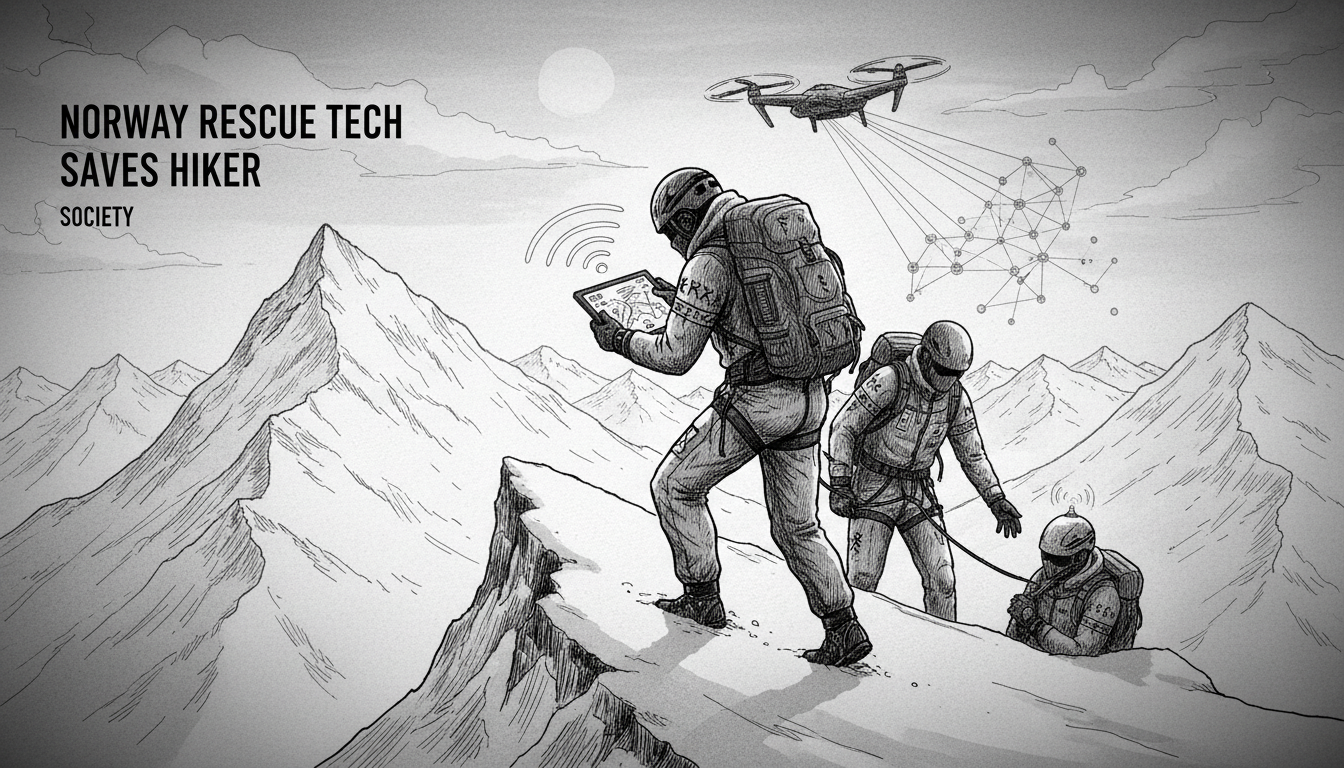
Norway mountain rescue teams deployed a coordinated tech response to locate a lost hiker wearing a suit jacket on Bergen's Ulriken. A 23-year-old Polish man was found near a cairn in dense fog just as hypothermia set in. The operation highlights Norway's focus on integrating digital tools with expert volunteer networks for mountain safety.
A Call in the Dusk
The alert reached the Red Cross Hjelpekorps in Hordaland just after 7 PM. A young man was lost on Ulriken, the tallest of the seven peaks encircling Bergen. Darkness had fallen. The weather was foul, with a mix of rain, hail, and snow. The information was sparse, but critical: he was underdressed and disoriented. Operational leader Matias Høgden, 23, mobilized immediately. His civilian role is operational leader for the Laksevåg Red Cross. He also serves in the Norwegian Armed Forces.
"The information we got was minimal," Høgden said. "We knew he had been out in the bad weather for a long time. We had to reach him fast." A full-scale rescue mission was activated. It involved two police dog patrol officers and three Red Cross volunteers. The team used the Ulriken cable car to ascend quickly. The tram was opened specially for the emergency operation.
The Search in Zero Visibility
From the cable car's upper station, the team continued on foot. They estimated the lost hiker was nearly three kilometers away. The conditions deteriorated rapidly. Dense fog cut visibility to under 50 meters. Winds gusted between 10 and 15 meters per second. "It was classic Bergen weather," Høgden explained. "Rain, hail, and snow all at once. The footing varied between wet and icy. It was miserable." The severe weather forced two volunteers to turn back. Høgden and the two police officers pressed on.
Norwegian mountain rescues often rely on this hybrid model. Professional police and military resources combine with trained local volunteers. These volunteers possess irreplaceable knowledge of the terrain. Digital mapping and communication systems guide them, but local instinct often completes the search. The teams use GPS and specialized radio systems to maintain contact with command centers. These centers coordinate all available assets in real-time.
A Critical Discovery
The team reached the man's location around 9:30 PM. Minutes earlier, they heard shouts echoing in the fog. They found him sitting against a cairn in an exposed area. He was shivering lightly. "He was dressed a bit more formally than we imagined," Høgden noted. "He wore a suit jacket and was very poorly dressed for the conditions." The team's arrival was timely. Hypothermia was progressing. Høgden explained the signs. The body shivers to generate heat in the early stages. When shivering stops, the situation becomes grave and life-threatening.
Seeing the man still shivering was a cautiously good sign. The rescuers acted quickly. They covered him with insulated blankets. They replaced his wet socks with dry ones. Getting him moving was essential to generate core warmth. The team helped him to his feet to begin the descent. The immediate danger was mitigated, but the mission was not over. They needed to get him to a sheltered location.
The Tech Behind the Team
This rescue underscores a broader Norwegian commitment to safety technology. While not featuring drones or novel gadgets, this operation was powered by integrated systems. The coordination between police dispatch, the cable car operator, and the Red Cross demonstrates a streamlined approach. Many Norwegian safety organizations use a shared digital platform for incident management. This allows for real-time resource tracking and communication.
Innovation in this field often focuses on improving coordination and data sharing. For instance, several Norwegian tech startups are developing apps for hikers. These apps allow users to share their planned routes with emergency contacts. Some can send automatic alerts if a hiker deviates significantly from their plan or fails to check in. The Norwegian Trekking Association (DNT) promotes the use of its official app for this purpose. It features updated maps and emergency information.
The Human Element in a Digital System
Experts stress that technology is only one component. The human expertise of volunteers like Høgden remains vital. "The technology gets us there, but the judgment on the ground saves lives," said a veteran mountain rescue coordinator in Western Norway. He asked not to be named as he was not part of this specific operation. "Knowing how to read the weather on a specific slope, understanding how fog moves around Ulriken—that's local knowledge."
Training for Red Cross volunteer rescue personnel is extensive. It includes navigation in zero visibility, first aid for hypothermia, and technical rope skills. This training complements the digital tools at their disposal. The model is effective. The Norwegian Red Cross Hjelpekorps participates in thousands of operations annually. They range from mountain rescues to urban searches for people with dementia.
A Wake-Up Call for Preparedness
The rescued man was led to the Turisthytta cabin to warm up fully. He was then escorted down the mountain to safety. No serious medical treatment was required. The incident serves as a stark reminder. Bergen's mountains are accessible from the city center. This can create a false sense of security. Weather changes with brutal speed and severity. Proper preparation is non-negotiable.
The Norwegian principle of 'Friluftsliv' (open-air life) emphasizes connection with nature. It also carries a responsibility for self-reliance. Authorities recommend checking forecasts from the Norwegian Meteorological Institute. They advise wearing multiple layers of wool and windproof clothing. Hikers should always carry a map, compass, headlamp, and extra food. Telling someone your planned route and expected return time is the simplest safety tech of all.
The Future of Mountain Safety
Looking ahead, Norwegian developers continue exploring new safety solutions. Research projects at institutions like the Norwegian University of Science and Technology (NTNU) are testing wearable sensors. These could monitor a hiker's vital signs and location, transmitting data via low-power networks. The challenge is balancing safety with the ethos of self-reliant wilderness exploration. Another focus is improving public education through digital channels.
The Ulriken rescue was a success. It demonstrated the strength of Norway's existing system. It blended trained volunteers, professional responders, and coordinated logistics. For the young man in the suit jacket, it was a fortunate lesson in the power of Norwegian mountain preparedness. For the rescue community, it was another validation of a model where human courage is supported by reliable, well-practiced systems. As hiking grows in popularity, refining this integration of people and technology remains Norway's ongoing mission for mountain safety.