
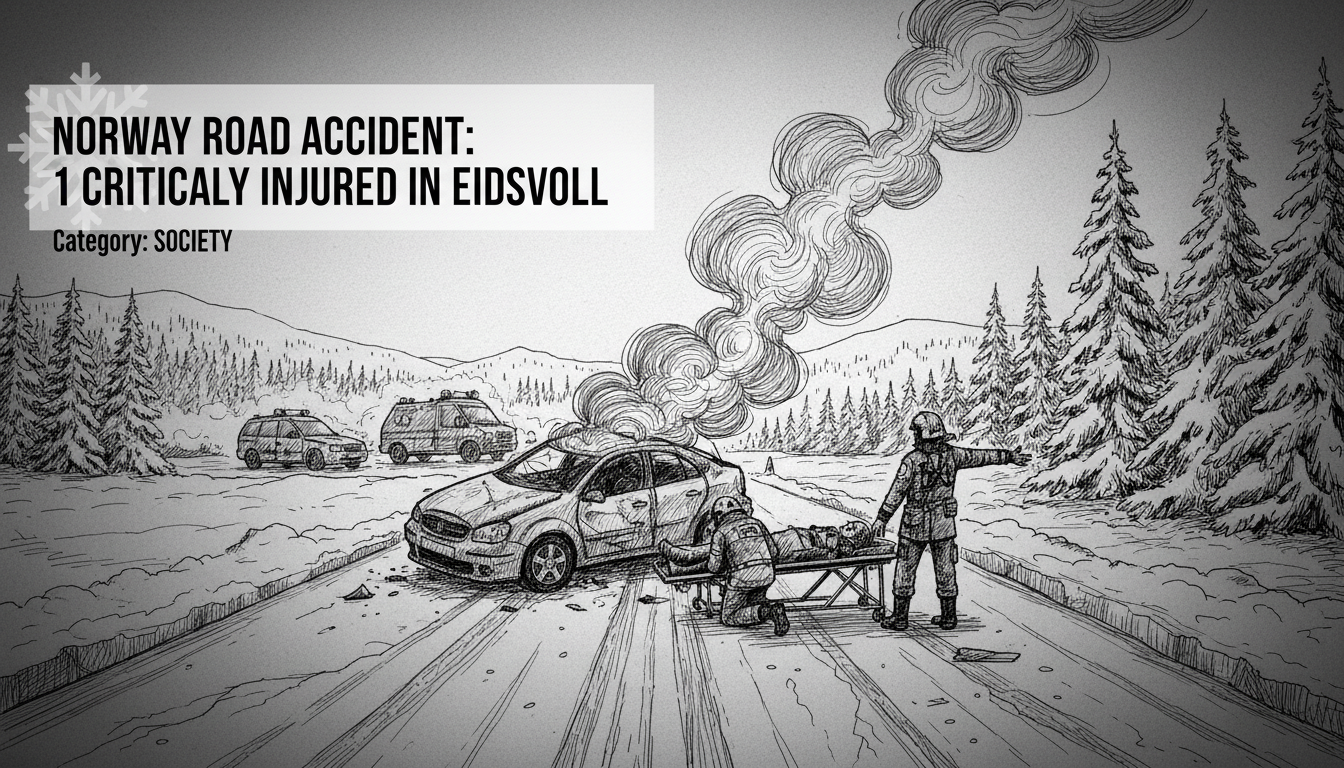
Norway road accident investigators are working to determine the cause of a serious head-on collision in Eidsvoll that left one man critically injured. The crash occurred between two cars on a major route north of Oslo, sending one driver to hospital with life-threatening injuries. Police report the driver of the second vehicle is in relatively good condition given the circumstances.
"It is unclear what is the background for the accident, but likely one car came over into the oncoming lane," police operations manager Ørjan Hustad said in a statement. Both drivers were conscious at the scene following the collision. Emergency services responded quickly to the incident in the Akershus county municipality, a heavily trafficked area connecting the capital to northern regions.
A Community on a Busy Corridor
Eidsvoll sits approximately 60 kilometers north of Oslo along the E6 highway, Norway's main arterial road running from the Swedish border in the south to Kirkenes near the Russian frontier. This location makes its local roads conduits for both regional commuters and long-distance freight. The specific site of the collision has not been disclosed, but such incidents on these routes often trigger widespread disruption and profound local concern.
Road traffic accidents remain a persistent challenge for Norwegian authorities, despite the country's generally excellent safety record. In 2022, 117 people died in road traffic fatalities across Norway. Each serious collision initiates a standard protocol involving police, accident investigators, and often the Norwegian Public Roads Administration. Their work will scrutinize vehicle condition, road surface markings, signage, and potential environmental factors.
The Human Cost Behind the Statistics
While the police statement confirmed one man was "critically injured," the term carries significant weight in Norwegian emergency medicine. It typically indicates injuries that are life-threatening and require immediate, extensive medical intervention. The patient was transported to a hospital, likely a major trauma center capable of handling such cases. The condition of the other driver, described as "good under the circumstances," suggests they avoided the most severe impacts but may still have sustained injuries.
These two individuals now join an annual national statistic that officials work tirelessly to reduce. The human impact of such crashes extends far beyond the immediate victims, affecting families, first responders, and witnesses. For local residents in Eidsvoll and surrounding areas, news of a serious collision on familiar roads serves as a stark reminder of the risks inherent in daily travel.
Norway's Road Safety Landscape
Norway consistently ranks as one of the safest countries in the world for road travel, a achievement built on decades of sustained policy effort. The government's "Vision Zero" policy, adopted in the late 1990s, aims to eliminate all fatal and serious injuries on Norwegian roads. This philosophy treats every death as a system failure, leading to investments in safer road infrastructure, lower speed limits in urban areas, and stringent enforcement of traffic laws.
Major contributing factors to accidents in Norway remain speeding, drunk driving, and distracted driving—particularly mobile phone use. The police investigation in Eidsvoll will explore whether any of these factors, or others like fatigue or a medical emergency, played a role. Technical inspections of the vehicles involved will check for mechanical failures like brake or tire defects.
The Investigation Process Unfolds
Following the initial emergency response, the scene is secured for technical investigation. Traffic police and specialist forensic officers will map skid marks, vehicle resting positions, and debris fields. They will measure sight lines and assess road conditions, including any ice, water, or gravel that may have contributed to a loss of control. Data from the vehicles' event data recorders, similar to "black boxes," may be retrieved if available.
"Accident investigators build a timeline from the physical evidence," explains a veteran traffic safety analyst familiar with Norwegian procedures. "They look for the point of no return—the moment where the sequence of events became unavoidable. The goal is not to assign blame for its own sake, but to understand the failure in the system so it can be prevented next time." This evidence informs both any potential legal proceedings and future safety engineering on that stretch of road.
Infrastructure and Behavioral Challenges
Norway's geography presents unique road safety challenges. Long, dark winters with icy conditions demand extra vigilance from drivers and robust winter maintenance from authorities. Roads like those around Eidsvoll see high traffic volumes mixing private cars, heavy goods vehicles, and increasingly, electric vehicles whose quiet operation has raised new safety questions for pedestrians and cyclists.
Public awareness campaigns run by the Norwegian Public Roads Administration (Statens vegvesen) and organizations like Trygg Trafikk continuously emphasize core safety messages: obey speed limits, never drive impaired, stay focused, and wear seatbelts. The high safety standards of modern cars, including autonomous emergency braking (AEB) and lane-keeping assist, are also seen as crucial tools. Investigators will note whether such systems were present and activated in the Eidsvoll collision.
A Local Impact with National Resonance
For the municipality of Eidsvoll, an area steeped in national history as the site of Norway's 1814 constitution signing, a serious accident disrupts the community's sense of security. Local officials often face calls for traffic calming measures, improved lighting, or road redesigns in the aftermath of a crash. The national focus on "Vision Zero" means that data from this collision will be fed into broader analyses to identify trends and prioritize safety investments across the country.
The incident serves as a somber checkpoint on Norway's journey toward eliminating road deaths. While the annual number of fatalities has fallen dramatically from the highs of the 1970s, each individual tragedy underscores that the work is not complete. The goal of zero remains aspirational, driving continuous improvement in vehicle technology, road design, and driver education.
The Path Forward from the Scene
As the injured man fights for his life in hospital, the official processes continue. The police will complete their report. If a traffic violation like reckless driving is suspected, the matter may proceed to the prosecution authority. The road administration may schedule a safety audit of the collision site. Insurance companies will begin their assessments.
For the public, the story is a brief headline, a reminder to drive carefully on the way home. For those involved, it is a life-altering event. Norway's systematic approach to road safety seeks to bridge that gap—transforming personal tragedy into collective learning. The true test of the system lies not just in responding to the crash in Eidsvoll, but in implementing the lessons it provides to prevent the next one. Can a society that has engineered remarkable road safety now tackle the complex human factors that remain the final frontier?