
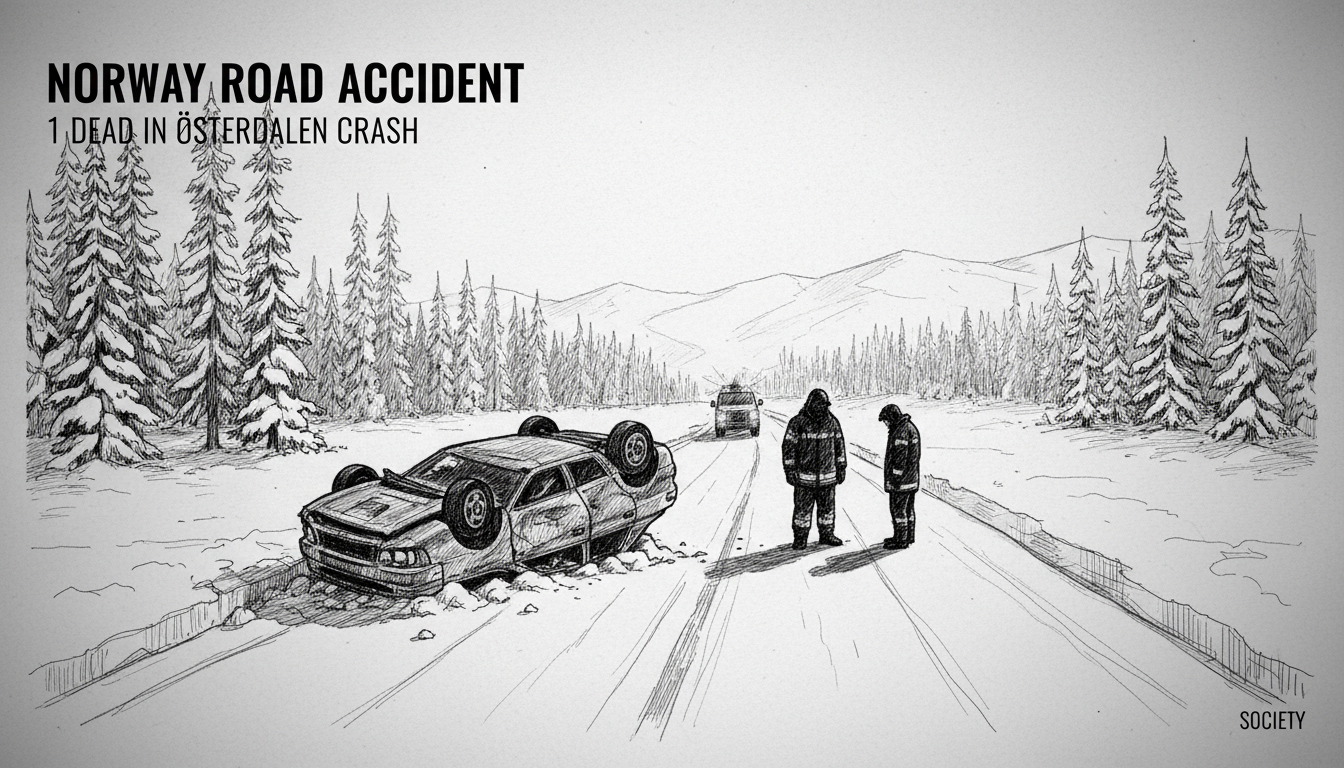
Norway road accident investigators are working at the scene of a serious single-vehicle crash in Åmot municipality. The fatal collision occurred in the Østerdalen valley region of Innlandet county, prompting an extended closure of a key local road. Police operations leader Bård Einar Hoft confirmed the incident involved one car. Emergency services responded to the remote location, but the driver was pronounced dead at the scene. This tragedy adds to a concerning pattern of serious accidents on rural Norwegian roads, particularly in the eastern inland regions during winter months.
A Remote Valley and a Closed Road
The accident happened on a road in Åmot, a municipality with a population of just over 4,300 people spread across a vast, forested area. Åmot sits in the traditional district of Østerdalen, a long, sparsely populated valley running north-south through Eastern Norway. The region is characterized by dense coniferous forests, logging industries, and long distances between communities. Road closures here have an immediate and significant impact, as alternative routes are often lengthy detours on smaller, less-maintained tracks. Police have not specified the exact duration of the closure, stating only that the road will be shut for "an extended period on the site" while investigation and cleanup operations continue. This is standard procedure for fatal accidents, where forensic teams meticulously document the scene to understand the sequence of events.
The Persistent Challenge of Rural Road Safety
This latest fatality must be viewed within the broader context of Norwegian road safety statistics. Preliminary figures from the Norwegian Public Roads Administration (Statens vegvesen) show there were 117 fatal road accidents in Norway in 2023. While Norway maintains one of the world's lowest rates of traffic deaths per capita, serious accidents in counties like Innlandet remain a stubborn challenge. Innlandet, Norway's largest county by area, consistently records a higher proportion of serious accidents compared to more urbanized regions. Experts attribute this to a combination of factors: higher speeds on long, straight stretches of road, variable and often severe winter weather conditions, and the increased risk associated with wildlife crossings in forested areas. The human cost in these regions is disproportionately high.
Winter Demands Constant Vigilance
Although the specific cause of the Åmot crash remains under investigation, the timing points to the perennial dangers of the Nordic winter. Late winter and early spring present some of the most treacherous driving conditions in inland Norway. Fluctuating temperatures create black ice, while snow melt can leave patches of slick asphalt. Traffic safety experts continuously stress the non-negotiable necessity of proper winter tires, which are a legal requirement in Norway for the season. More than just having them fitted, drivers must adjust their speed significantly to match the conditions, a rule many find difficult to heed on familiar, seemingly open roads. "The greatest risk on these rural roads is a false sense of security," says a veteran driving instructor from the region. "You can drive for kilometers without seeing another car, the road looks clear, and speed creeps up. Then you hit an unexpected patch of ice in the shade of the pine trees, or a moose steps out, and recovery is impossible."
The Investigation Process Unfolds
Police at the scene will follow a meticulous protocol. The single-vehicle nature of the crash narrows the focus but does not simplify the task. Investigators will examine the vehicle's mechanical condition, including brake and tire wear. They will analyze the road surface for ice, snow, or other contributing factors. The driver's actions in the moments before the crash will be scrutinized, though with profound respect for the deceased. In rural accidents, there are often few witnesses, making physical evidence on the road and vehicle paramount. The investigation aims not to assign blame, but to understand the causative factors. This data feeds into national safety programs, informing decisions about road design, signage, and public awareness campaigns. The findings from Åmot will become a small but important data point in Norway's ongoing effort to achieve its "Vision Zero" goal of no road fatalities or serious injuries.
A Community Feels the Loss
Beyond the statistics and investigations, the impact of a fatal road accident in a small community like Åmot is deeply personal. In tight-knit rural districts, everyone is connected. The victim is likely a neighbor, a co-worker at the local mill, a member of the volunteer fire brigade, or a parent from the school. The shock reverberates through the community, a stark reminder of the fragility of life in an environment where people often feel most secure. Local community leaders and the church will mobilize to provide support to the grieving family and friends. This communal aspect of tragedy is a defining feature of life in Norway's remote valleys, where people rely on each other out of necessity and shared experience.
Norway's Road Safety Paradox
Norway presents a paradox in road safety. It is a global leader, with strict laws on alcohol, speeding, and vehicle safety. Its infrastructure is generally excellent. Yet, a significant portion of the remaining fatalities occur on these rural roads, away from the multi-lane highways and urban centers. The challenge is one of geography and human behavior. Engineering solutions like guardrails and better lighting are costly over vast distances. Ultimately, the final layer of safety rests with the individual driver's judgment. Campaigns by the Public Roads Administration try to combat complacency, using stark advertisements and local news stories about accidents like the one in Åmot to drive the message home. The question remains whether education and enforcement can ever fully counteract the isolated, monotonous, and sometimes over-confident driving that rural roads can induce.
Looking Ahead: Technology and Terrain
The future of road safety in regions like Østerdalen may lie in technology. Advanced driver assistance systems (ADAS) like automatic emergency braking and electronic stability control are becoming more common and could prevent some single-vehicle departures from the road. However, the adoption of new vehicle technology in rural populations can be slower than in cities. Furthermore, the very landscape that defines the region—its forests, hills, and remote valleys—can interfere with cellular and GPS signals, potentially limiting the effectiveness of some connected safety systems. The solution will likely be a continued, unglamorous grind: maintaining road surfaces, clearing snow efficiently, enforcing traffic laws, and repeating the basic safety message until it becomes an unbreakable habit for every driver who turns onto a quiet, forest-lined road.
The quiet valley of Østerdalen will absorb this loss, as it has others before. The road will reopen, the tire marks will fade, and the memorial flowers by the roadside will eventually wither. But for the investigators compiling their report, the safety officials studying the trends, and the community mourning a neighbor, the work continues. It is the work of understanding a moment of catastrophic failure, with the hope of preventing the next one. In Norway's relentless pursuit of safer roads, every tragedy, no matter how remote the location, is a call to look harder, think deeper, and drive more carefully.