
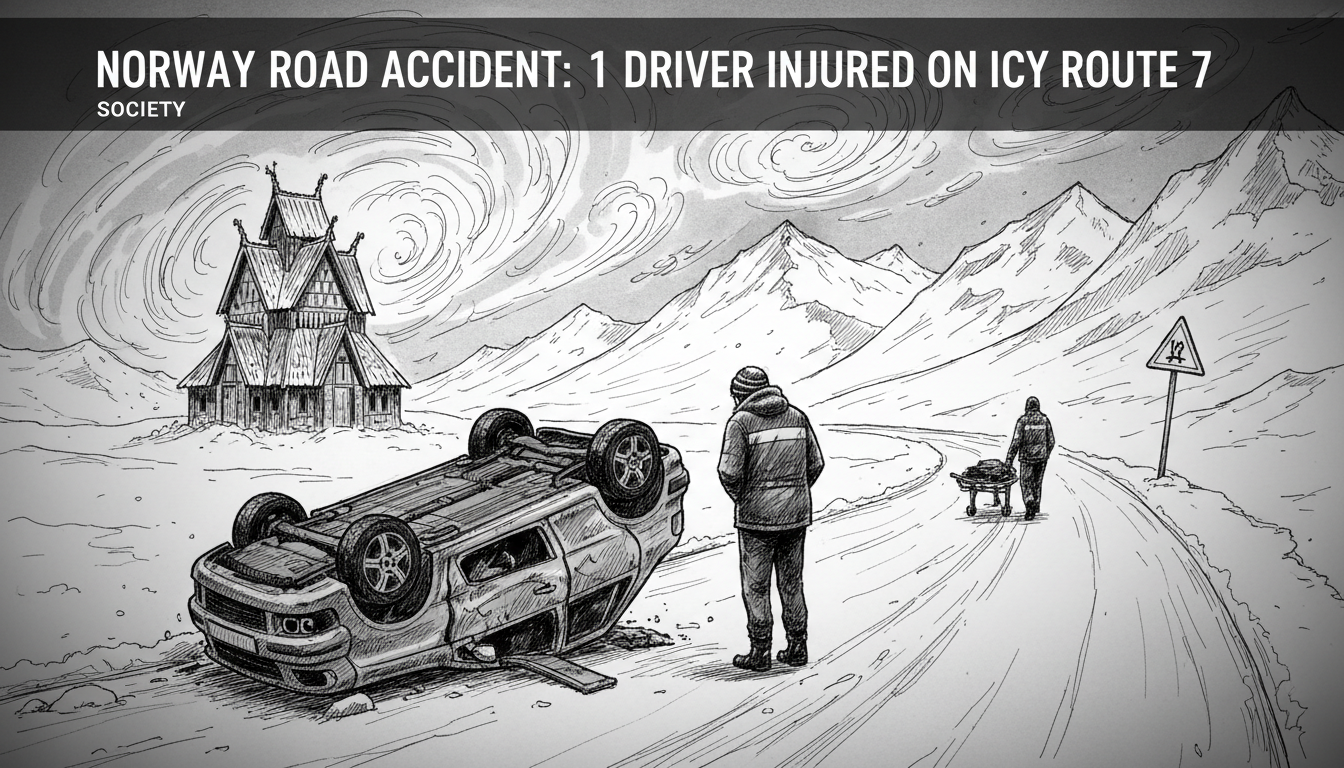
Norway's treacherous Route 7 mountain road sent another driver to the hospital Sunday night after a single-vehicle crash in the Nautaflottunnelen near Eidfjord. A man in his 40s was transported by ambulance to Voss Hospital following a skid on an icy road surface. The vehicle ended up in a snowbank around 9:45 PM. The driver, who was alone, reported pain in his neck and head.
This incident highlights the persistent dangers of one of Norway's most vital and challenging transport corridors. Route 7, or Rv7, is the primary road link between Oslo and Bergen, crossing the vast and exposed Hardangervidda mountain plateau. The accident occurred in the Eidfjord municipality, an area of dramatic fjord landscapes where weather conditions can shift rapidly from the valley floor to the tunnel portals.
A Critical Corridor's Inherent Risks
Route 7 is not just a scenic tourist route. It is a critical economic artery for western Norway, carrying freight, commuters, and travelers between the country's two largest cities. The stretch over Hardangervidda is notorious for extreme and changeable weather, even in late spring. Sudden snow squalls, black ice, and strong winds are common hazards. The Nautaflottunnelen, where Sunday's crash occurred, is one of several tunnels on this section designed to protect traffic from avalanches and rockfalls, but which can create microclimates and varying road surface conditions.
"Drivers must understand that a tunnel entrance can be a transition zone," said a road safety advisor with the Norwegian Public Roads Administration, speaking on general principles. "The road surface inside a tunnel can be dry while the approach is wet or icy. Conversely, melting snow can be tracked into a tunnel, creating slippery patches. Adjusting speed to the actual conditions, not just the posted limit, is non-negotiable on these mountain passes."
The 80 km/h zone where the accident happened is a standard speed limit for that type of road. However, experts consistently stress that the legal limit is for ideal conditions. On Sunday night, with reported slippery conditions, a appropriate speed would have been significantly lower.
The Human Factor in Harsh Geography
The injured driver's experience—being alone, facing sudden loss of control, and the subsequent wait for emergency services—is a scenario feared by many who traverse Norway's remote highways. While cellular coverage is generally good, stretches in deep valleys or tunnels can be dead zones. The response from local emergency services, culminating in the ambulance transport to Voss Hospital, demonstrates the vital network of first responders that supports these rural communities.
Voss Hospital serves as a key medical center for the region, handling a significant number of traffic-related injuries from the surrounding mountains and fjords. The nature of the driver's complaints—neck and head pain—typically triggers a thorough trauma assessment to rule out spinal or serious head injuries, a standard precaution following vehicle collisions.
This accident follows a familiar seasonal pattern. While the worst winter weather often subsides by May, high-altitude roads like Route 7 across Hardangervidda can remain hazardous well into June. Early mornings and late evenings are particularly risky periods when temperatures drop and any moisture refreezes.
Infrastructure and the Safety Balance
Norway invests heavily in road safety engineering. The very existence of the Nautaflottunnelen is a testament to this, built to mitigate the even greater risks of avalanche paths. The national road authorities deploy advanced weather monitoring stations and webcams along critical routes like Rv7. Real-time data on road surface temperature, wind, and precipitation is publicly available via apps and websites.
Yet, technology and engineering can only do so much. The final layer of safety rests with the driver. Decisions about tire choice—whether using winter tires past the legal season deadline for high-mountain travel—and driving behavior are paramount. Norwegian law requires winter tires or suitable alternatives until conditions no longer demand them, a judgment call often left to the driver in the spring shoulder season.
For commercial traffic, including the heavy goods vehicles that are the lifeblood of coastal industries, these mountain crossings are a daily calculation of risk versus delivery schedules. The closure of Route 7, which does happen during severe storms, causes major logistical disruptions and economic costs, adding pressure to keep the road open whenever possible.
A Broader View on Arctic Mobility
This single-vehicle accident, while minor in scale, opens a window into the broader challenges of mobility in a northern nation. Norway's geography demands an extensive and expensive road network that must contend with alpine, coastal, and Arctic conditions. The country's approach combines robust infrastructure investment with a strong cultural emphasis on individual responsibility and preparedness.
Driving in Norway is not merely a means of transport; it is a skill adapted to the environment. The driver's education system includes specific training for skid control and winter driving, but for visitors and even some residents, the conditions on a pass like Hardangervidda can be unexpectedly severe.
Local authorities in Vestland county continuously analyze accident data to identify black spots and plan improvements. Each incident contributes to a database that informs future road design, signage placement, and safety campaigns. The focus is increasingly on proactive measures—better information dissemination, more dynamic speed limit signs linked to weather stations, and public awareness campaigns—to prevent accidents before they occur.
The Road Ahead
The driver involved in the Eidfjord crash faces a recovery period. His vehicle likely sustained significant damage. The immediate aftermath—the emergency response, the hospital visit, the vehicle recovery—represents the direct cost. The indirect costs include personal trauma, potential lost work time, and the strain on public services.
As Norway moves toward warmer months, the risk on high mountain roads will shift from ice to other hazards like tourist traffic, cyclists, and melting snow runoff. However, the lesson from this Sunday night in late spring remains clear: Norwegian mountain weather respects no calendar. The conditions that created a slippery surface in the Nautaflottunnelen are a year-round possibility at altitude.
The enduring challenge for transport authorities is how to further harden a critical infrastructure link against the immutable forces of nature. For every driver, the task is simpler but equally critical: to approach each journey across the roof of Norway with respect, preparation, and the wisdom to know that the safe speed is often far below the number on the sign.