
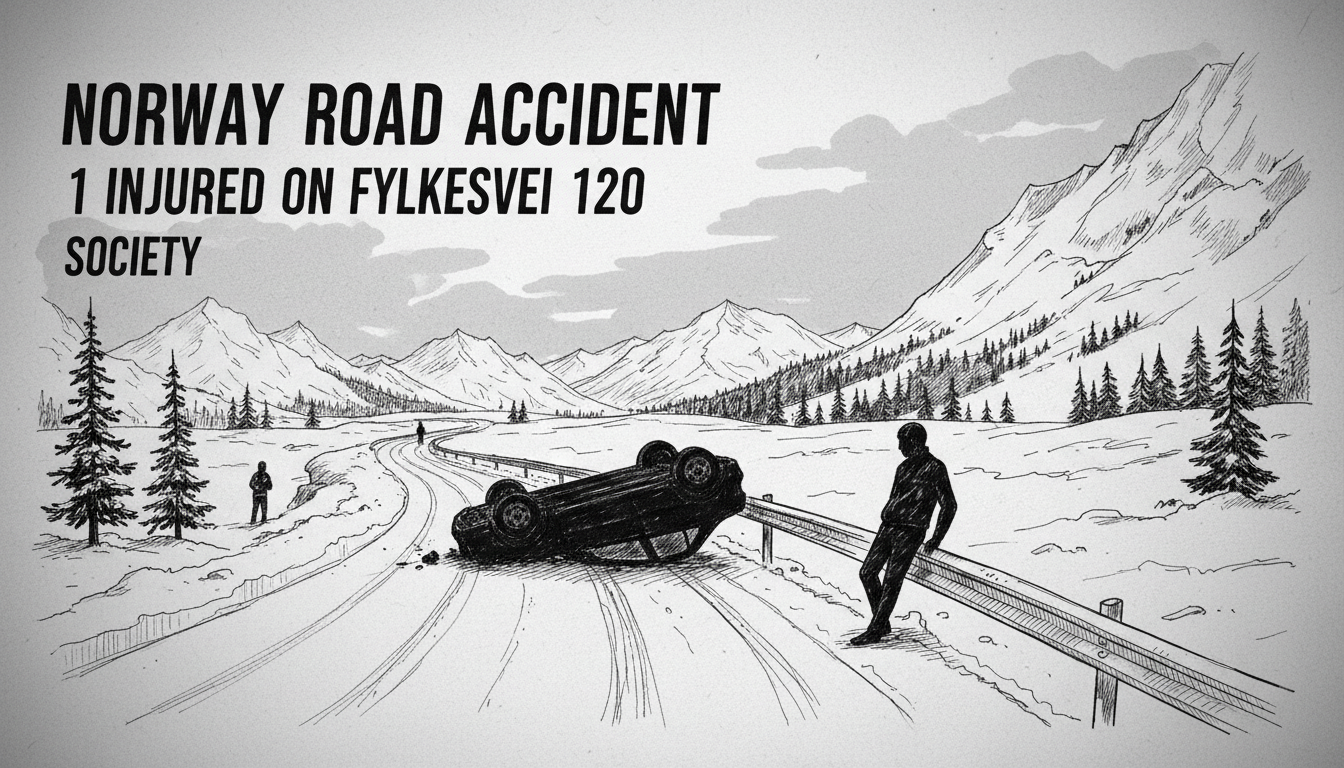
Norway road accident response was activated on a slippery stretch of Fylkesvei 120 in Indre Østfold Tuesday afternoon. A collision involving two vehicles sent one woman to a medical center for examination, while the male driver of the other car emerged physically unharmed. The incident forced the temporary closure of the county road in both directions for approximately one hour, disrupting local traffic as police secured the scene and emergency services provided aid.
A Routine Response to a Common Hazard
The crash occurred during a period of reported spotty ice on roads in the region. Police confirmed the road was reopened by 5:36 PM local time. While details on the precise cause remain under investigation, the conditions point to a familiar winter threat across Norway: black ice forming on roadways, catching drivers off guard. This single-vehicle accident involving two people represents the type of incident that occurs daily across the country, yet each one carries the potential for more severe outcomes. The woman's transport to a legevakt, or emergency medical clinic, indicates a precautionary check for potential injuries, a standard procedure following any significant impact.
Local authorities have not released the identities of those involved, in line with Norwegian privacy practices. The focus now shifts to the police report, which will formally determine contributing factors such as speed, vehicle condition, and driver attention. Initial information suggests no criminal suspicion, framing the event as a traffic accident influenced by environmental conditions.
The Persistent Challenge of Winter Roads
Fylkesvei 120 serves as a vital connector through the municipalities of Indre Østfold, a region within Viken county. Like many secondary roads in Norway, it sees a mix of local commuters, commercial transport, and private vehicles. Its temporary closure highlights how a single accident can impact mobility in rural and semi-rural areas where alternative routes are often limited or non-existent. Road safety experts consistently stress that Norway's dramatic geography and climate demand heightened driver awareness for much of the year.
"The transition periods between seasons are particularly risky," explains a traffic safety researcher from the Institute of Transport Economics in Oslo, who spoke on background. "We see wet roads that freeze overnight, or melting during the day that re-freezes by evening. Drivers who have adjusted to clear autumn roads can be surprised by a sudden patch of ice on a shaded curve or bridge." This accident on Fylkesvei 120 serves as a stark, localized reminder of that national reality. The call from authorities for witnesses to submit information, photos, or video underscores the standard investigative process to piece together the final moments before the collision.
Norway's Broader Road Safety Landscape
While this incident resulted in a minor injury, it occurs against a backdrop of ongoing efforts to reduce serious traffic harm across Norway. The country has some of the world's most ambitious road safety targets, part of a "Vision Zero" policy that aims to eliminate all traffic fatalities and serious injuries. National statistics provide context: in 2022, there were 117 road fatalities in Norway. This number, while low compared to many nations, is scrutinized intensely by transport authorities. Each death represents a policy failure within the Vision Zero framework.
Viken county, as the most populous county in Norway, typically records a significant portion of the nation's total traffic accidents. The number fluctuates yearly, influenced heavily by winter severity, traffic volume changes, and enforcement campaigns. The Indre Østfold accident is a data point in that larger set. It is not an outlier but an example of the common risks that aggregate into national statistics. The successful reduction of fatalities over decades is attributed to a multi-pronged approach: stricter enforcement of drunk driving laws, widespread use of winter tires (studded tires are legal and common), continuous road improvements, and public education campaigns.
The Human and Systemic Response
Beyond the statistics and policies, every accident triggers a human and institutional response. For the individuals involved, the event ranges from a frightening inconvenience to a life-altering trauma. The unharmed male driver must deal with vehicle damage, insurance claims, and the psychological shock of the collision. The woman undergoing medical assessment faces uncertainty about her health and recovery. Their experiences, though private, are replicated in various forms across Norway daily.
The system responds with trained precision. Police officers secure the scene to prevent further accidents and begin evidence collection. Emergency medical technicians assess injuries and provide stabilization. Road maintenance crews may be dispatched to apply sand or salt to the specific stretch of road if ice is confirmed as a factor. This coordinated response is a well-rehearsed operation, a necessity in a country where long distances, sparse population, and challenging weather can complicate rescue and recovery efforts.
Local municipalities and the Norwegian Public Roads Administration (Statens vegvesen) constantly analyze accident data to identify high-risk stretches of road. A cluster of incidents on a specific curve or intersection can lead to engineering interventions—improved signage, better lighting, or even road realignment. It is possible the stretch of Fylkesvei 120 where this accident occurred has been or will be examined in this light. Public funding for road safety is a perennial topic in the Storting, Norway's parliament, with debates often centering on the cost-effectiveness of safety measures versus new road construction.
A Preventable Event in a Harsh Environment
The ultimate question following any accident is one of preventability. Could this collision on Fylkesvei 120 have been avoided? Experts argue that while absolute prevention is impossible, significant risk reduction is achievable. The responsibility is shared. Authorities must provide well-maintained roads and clear, timely warnings about conditions. Vehicle owners must equip their cars with proper seasonal tires and ensure they are in good working order. Drivers bear the responsibility of adjusting their speed and following distance to match the road conditions, not the posted speed limit.
Technology also plays an increasing role. Modern vehicles with electronic stability control and collision warning systems can help drivers maintain control. Weather apps and road condition websites operated by the Public Roads Administration offer real-time data. Yet, technology is only an aid. The final decision-making rests with the person behind the wheel. This incident, like countless others, will likely conclude with a finding that highlights the interplay of environmental factors and human reaction.
As Norway moves deeper into the winter season, this accident stands as a microcosm of the national driving experience. It is a story of minor consequence but major symbolic weight. It underscores that despite Norway's advanced infrastructure and safety culture, the fundamental challenge of navigating ice and snow on two-lane roads remains. The road is now open, the investigation will close, but the need for vigilance does not end. For residents of Indre Østfold and drivers across Viken county, the message is clear: the conditions that led to Tuesday's accident are still out there, waiting on the next shaded curve, the next cold bridge, the next journey home.