
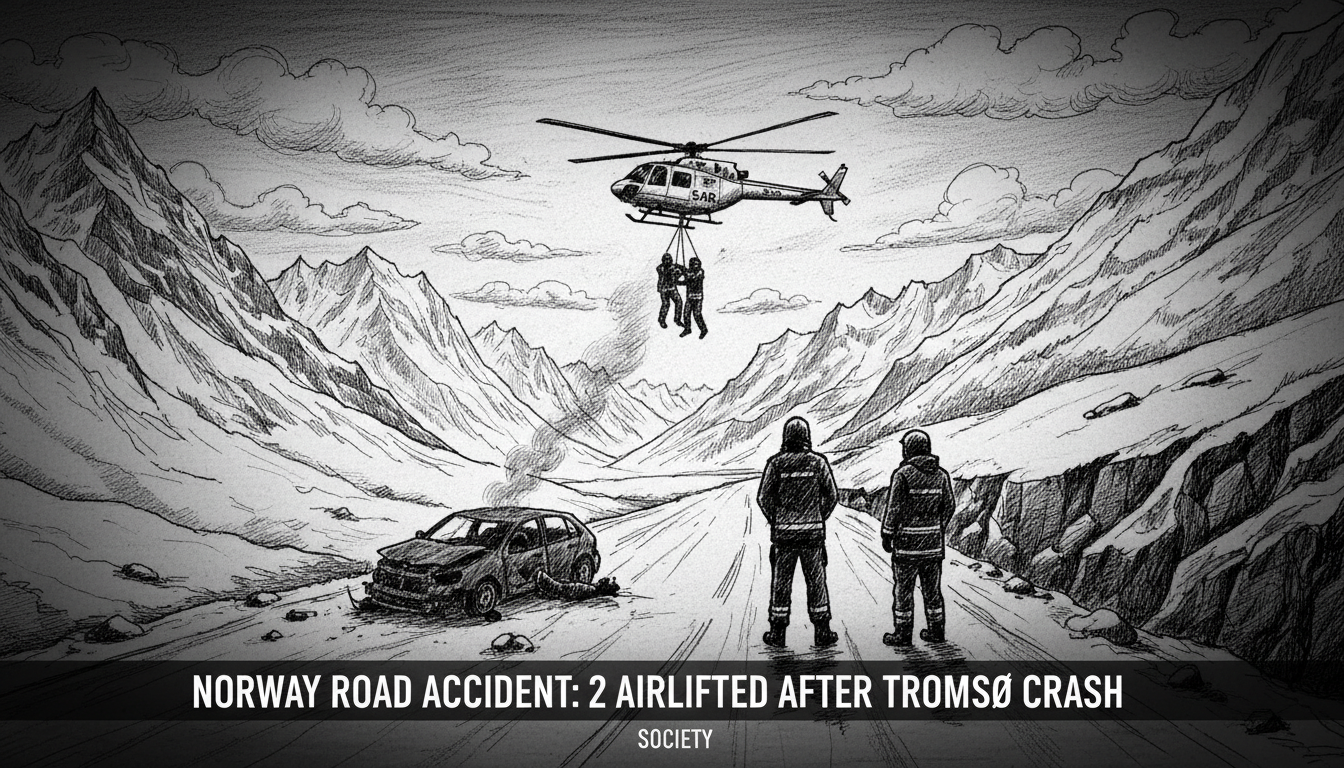
Norway's Fylkesvei 91 remains closed after a serious head-on collision at Breivikeidet in Tromsø sent two people to hospital by air ambulance. The crash involved two private cars and caused significant material damage, according to police operations leader Rune Nilsen. Emergency services responded to the scene on the rural road, which connects communities on the island of Kvaløya, highlighting the persistent challenges of road safety in Norway's northern regions.
A Remote Road and a Critical Response
The accident occurred on a stretch of road known for its scenic but demanding conditions. Fylkesvei 91 is a vital artery for local residents, winding along fjords and through sparse settlements. Its closure disrupts daily life and commerce, forcing detours and isolating areas. The decision to deploy an air ambulance, or Luftambulanse, underscores the severity of the injuries and the logistical realities of providing emergency care in the Arctic. In regions like Troms, with low population density and vast distances between advanced medical centers, air ambulances are a critical component of the national health service. The aircraft, often a helicopter equipped for medical emergencies, can transport patients from remote accident sites to the University Hospital of North Norway (UNN) in Tromsø within minutes, a journey that could take hours by road.
Police have not released details on the cause of the collision. Standard procedure involves a technical examination of the vehicles and the road scene. Investigators will look at factors like road surface conditions, visibility, vehicle speed, and potential driver error. "There was partly major material damage to both vehicles," Nilsen stated in the police log, confirming the force of the impact. The use of the air ambulance indicates the patients required specialized, urgent care that local clinics could not provide.
The Broader Context of Norwegian Road Safety
This incident is a stark reminder of the ongoing struggle to reduce serious accidents across Norway. While the country has one of the world's lowest rates of road fatalities per capita, each accident prompts reflection on safety measures. Preliminary figures from the Norwegian Public Roads Administration (Statens vegvesen) recorded 117 road deaths in 2022. Northern Norway often faces a distinct set of challenges compared to the more populated south. Long, dark winters, rapidly changing weather, icy roads, and the presence of wildlife like moose and reindeer contribute to hazardous driving conditions.
Experts consistently point to a combination of factors for improving safety. "The mantra of the right tires for the season, adapted speed, and increased following distance cannot be repeated enough," says traffic safety researcher Kari Foss. "On rural roads like Fylkesvei 91, drivers must be prepared for sudden changes—a patch of black ice, a snow squall, or an animal on the road. Complacency is a major risk." National campaigns emphasize these points, especially during the seasonal transitions in autumn and spring when conditions are most unpredictable.
Infrastructure and the Human Factor
Norway invests heavily in road safety infrastructure, including fencing to prevent wildlife collisions, improved lighting, and road widening projects. However, upgrading every kilometer of rural road is economically and geographically impractical. This places a significant responsibility on individual drivers. The condition of the vehicle, particularly brakes and lights, is paramount. So too is the driver's attentiveness and willingness to reduce speed well below the posted limit when conditions deteriorate.
Accidents on roads like Fylkesvei 91 also test Norway's emergency response networks. Police, fire, and ambulance services in rural districts cover enormous areas with limited personnel. The seamless coordination required to dispatch an air ambulance, secure an accident scene, and manage traffic diversions is a complex operation. It relies on precise communication between local police districts, the Joint Rescue Coordination Centre (Hovedredningssentralen), and hospital trauma teams.
The Aftermath and Looking Ahead
For the communities along the closed road, the accident means inconvenience and a sobering reminder of vulnerability. Local bus routes are altered, deliveries are delayed, and the simple act of visiting a neighbor becomes a lengthy detour. The psychological impact of a serious crash in a small community is profound, often resonating long after the road reopens.
The investigation into the Breivikeidet crash will take time. Police will interview witnesses, analyze vehicle data recorders if available, and reconstruct the event. Their findings will contribute to the national database used to shape future safety policy. Each serious accident provides data points that inform decisions on where to install new passing lanes, add guardrails, or increase speed enforcement.
Norway's long-term vision, as outlined in the National Transport Plan, is a road network with zero fatalities or serious injuries. Achieving this "Vision Zero" on winding coastal and mountain roads is an immense challenge. It requires continuous improvement in vehicle safety technology, road design, and, crucially, driver behavior. The air ambulance that flew from the scene at Breivikeidet is both a symbol of advanced emergency care and a testament to the distances and dangers that remain ingrained in Norwegian travel.
As the investigation continues and the injured receive treatment, the incident serves as a seasonal warning. The transition into deeper autumn brings shorter days and more frequent frosts to Troms. Every driver navigating these majestic but demanding landscapes must reconcile the freedom of the open road with its inherent risks. The closure of Fylkesvei 91 is temporary, but the questions about safety, responsibility, and preparedness on Norway's rural highways are enduring.