
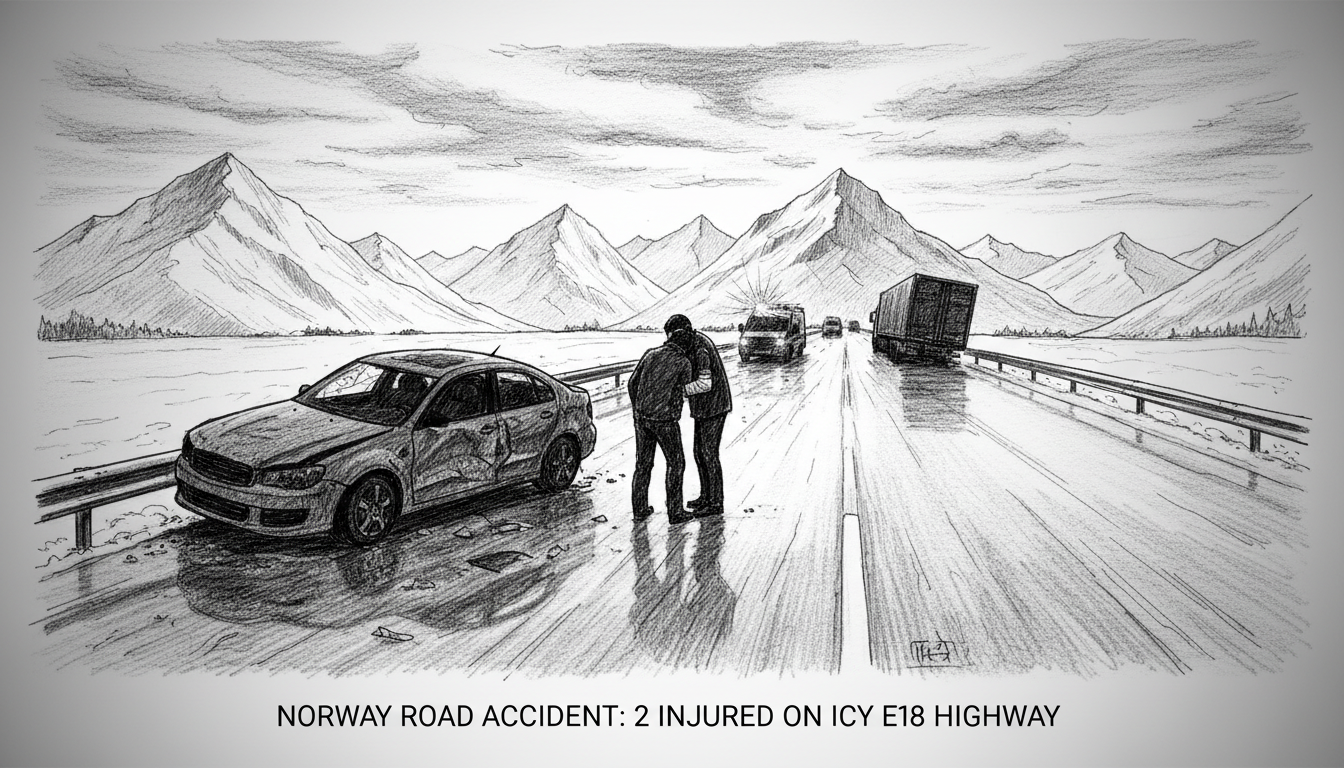
Norway's treacherous winter driving conditions sent two people to an emergency clinic Saturday evening after a car slid into a crash barrier on the E18 highway. The accident occurred near Åby in Kragerø just before 6 p.m., with police confirming the road was "very slippery" at the time. The two occupants of the vehicle were transported for medical assessment, highlighting the persistent seasonal danger on Norwegian roads.
Operational commander Ottar Steinstø of the South-East Police District provided the update, noting a tow truck had been dispatched to clear the scene. Traffic continued to flow slowly past the accident site on the vital E18 corridor, a major artery for freight and passengers along Norway's southern coast. This single-vehicle incident, while not fatal, serves as a stark annual reminder of the challenges posed by Scandinavia's winter climate.
A Recurring Seasonal Hazard
Winter road accidents represent a significant public safety challenge in Norway. The country recorded 117 road fatalities in 2022, with slippery conditions contributing to a substantial portion of winter incidents. While Norwegian drivers are generally experienced with snow and ice, rapid weather changes and localized black ice patches, often called "glattis," can catch even the cautious motorist off guard. The Kragerø area, with its coastal climate where temperatures hover around freezing, is particularly prone to such hazardous conditions.
Road safety experts consistently stress the critical need to adjust speed and following distance to match road conditions. "The posted speed limit is for ideal conditions," explains a veteran driving instructor from the Norwegian Public Roads Administration. "When frost or ice is reported, drivers must reduce their speed significantly, sometimes by half, to maintain control. The first accident of an icy spell is often the one that alerts others to the danger."
The Vital E18 Corridor
The E18 highway where this accident occurred is one of Norway's most important transport routes. It runs from Kristiansand in the south, through major cities like Arendal, Kragerø, and Porsgrunn, before continuing into Sweden. This makes it crucial for both regional commuters and international freight transport. Any disruption, even a minor one like Saturday's crash, can cause ripple effects along the coast. The highway's engineering includes safety features like the crash barrier, or "autovern," which likely prevented a more serious outcome by containing the vehicle.
Municipalities and the national road authority deploy extensive resources to keep the E18 and other major roads clear. This includes regular salting and plowing operations. However, as this incident demonstrates, these measures cannot instantly counteract all ice formation, especially during active snowfall or freezing rain. Police investigations into such accidents typically examine factors including vehicle speed, tire condition (Norway has strict winter tire laws), and whether road maintenance crews had recently treated the specific stretch.
Emergency Response and Winter Preparedness
The response to the Kragerø accident followed a standard protocol for non-life-threatening incidents. The injured were taken to a local emergency clinic (legevakt) for assessment rather than a full hospital, indicating the injuries were likely minor. This tiered response helps manage resources within Norway's healthcare system. The police secured the scene and managed traffic flow until the vehicle could be removed, a process handled by a private towing contractor under a public service agreement.
For Norwegian motorists, winter preparedness is a legal and practical necessity. Regulations require the use of winter tires with a minimum tread depth from November to Easter, depending on region. Many drivers opt for studded tires for superior ice grip, though their use is sometimes restricted in urban areas due to road wear. Carrying emergency equipment—a reflective vest, warning triangle, and a shovel—is also recommended. The goal is to ensure that when accidents do happen, their severity is minimized, and motorists can stay safe while awaiting help.
The Human Factor in Winter Driving
Beyond vehicle equipment and road maintenance, the human element remains the most variable factor in winter safety. Fatigue, distraction, or misjudgment of conditions can have immediate consequences on icy pavement. The accident near Åby occurred in the early evening, a time when fading light can make it harder to spot icy sheens on the asphalt. It also follows a weekend, when drivers may be less focused on commuting and more relaxed, potentially leading to lapses in concentration.
Driving schools in Norway incorporate extensive winter driving training, but for foreign visitors or new residents, the conditions can be daunting. Rental car companies are required to equip vehicles with appropriate tires, but the responsibility for cautious driving ultimately rests with the individual behind the wheel. The Norwegian Public Roads Administration runs annual winter awareness campaigns, emphasizing the mantra: "Is it slippery? Then drive accordingly!"
A Look at Broader Safety Trends
Norway's overall road safety record is among the best in the world, a result of continuous investment in infrastructure, strict laws, and a strong safety culture. The country's ambitious "Vision Zero" policy aims to eliminate all traffic fatalities and serious injuries. While winter accidents pose a persistent challenge, long-term trends show a decline in serious incidents due to better vehicle safety technology like electronic stability control, which helps prevent skids.
However, statistics show that a disproportionate number of accidents still occur on rural highways like the E18, outside major urban centers. These roads may see less frequent salting and have higher speed limits. They also have longer response times for emergency services compared to cities. Each winter incident provides data that traffic planners use to identify problematic curves, gradients, or sections prone to icing, leading to targeted improvements in signage, barrier placement, or drainage.
The Road Ahead After a Close Call
The two individuals involved in the Kragerø crash will hopefully make full recoveries. Their experience, while undoubtedly frightening, is a shared one for many Norwegians who have felt their vehicle lose traction on an unexpected patch of ice. It serves as a communal reminder as the winter season continues. For local authorities, it may prompt a review of the salting schedule for that particular stretch of the E18 near Åby.
As the tow truck cleared the damaged vehicle and traffic returned to normal speed, the underlying message remained. Norway's stunning winter landscape comes with inherent risks for transportation. The nation's approach—combining engineering, regulation, education, and personal responsibility—aims to manage those risks. Yet, as Saturday's crash confirms, absolute safety on every kilometer of road during a Nordic winter remains an elusive goal. The season demands constant vigilance from everyone, from the road worker spreading salt to the driver gently testing the brakes on a cold morning.