
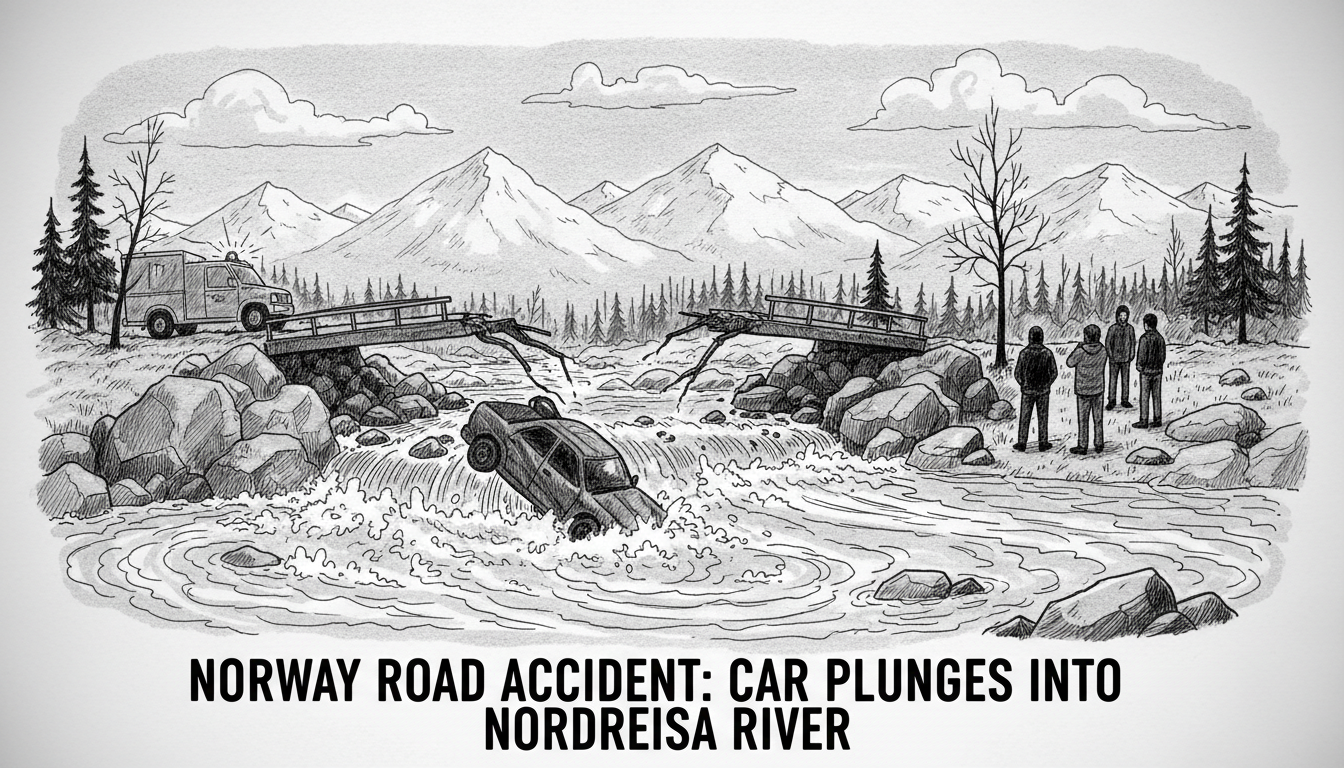
Norway road accident response was tested in Nordreisa municipality on Tuesday when a car left the roadway and landed in a river. Police confirmed the driver managed to exit the vehicle and climb back to the road, reporting no personal injuries. The incident occurred in Nord-Troms, a region where dramatic landscapes and challenging driving conditions frequently intersect.
A Narrow Escape in Northern Wilderness
Emergency services were dispatched to the scene following reports of the vehicle leaving the road. The driver's ability to self-extricate from the submerged car and reach safety without injury marks a fortunate outcome in an area where such incidents can quickly turn tragic. The specific location along the road and the cause of the accident remain under investigation by local police. Nordreisa, with a population of just 4,800, is a community where most residents are familiar with the risks posed by the region's infrastructure and climate.
This accident highlights the ever-present dangers on rural Norwegian roads, even without the complicating factor of winter weather. The vehicle's recovery from the river will present logistical challenges typical for the region. Local tow operators and possibly specialized equipment will be required to retrieve the car from the waterway, a process that can take hours and involve closing sections of the road.
The E6: A Vital Artery with Inherent Risks
The E6 highway, a major European route running from Sweden's Trelleborg to Norway's Kirkenes near the Russian border, passes directly through Nordreisa. It serves as the primary transport link for the entire region, carrying everything from tourist coaches and private cars to heavy freight trucks. In remote areas like Nord-Troms, the E6 is often a two-lane road that winds through valleys, hugs mountainsides, and crosses numerous rivers and fjords.
"Road accidents in rural Norway present a distinct set of challenges," explained a traffic safety researcher familiar with northern conditions. "Factors like variable weather, animal crossings, long distances between settlements, and driver fatigue on monotonous stretches all contribute to risk. The infrastructure, while generally good, must contend with extreme geography and harsh winters that cause wear." The absence of serious injuries in this case does not diminish the need for continuous analysis of road safety in these communities, where emergency response times are inherently longer than in urban centers.
Geography as Both Attraction and Hazard
Nordreisa is renowned for its stunning natural beauty, centered on the Reisadalen valley and the Reisa National Park. The park is a destination for hiking, fishing, and river expeditions, drawing visitors seeking wilderness experiences. This very landscape, carved by glaciers and rivers, dictates the path and character of the road network. Roads follow river valleys and coastlines, meaning drivers are often navigating curves with significant drops or bodies of water immediately adjacent to the pavement.
Local officials consistently balance promoting tourism and outdoor activities with messaging about preparedness. Drivers unfamiliar with these roads may not anticipate sharp turns, changing surfaces, or the potential for wildlife like moose or reindeer to appear suddenly. While this specific accident did not occur in the peak winter season, conditions can change rapidly in the Arctic, with ice, snow, and poor visibility being common threats for much of the year.
The Human Factor in Remote Response
The successful outcome—a driver escaping unharmed—underscores the importance of individual preparedness. In remote areas, the initial response often falls on the involved individuals or passing motorists before professional help can arrive. Norwegian driver's education strongly emphasizes scenarios like vehicle submersion, including the critical window for escape and the use of tools to break windows.
Community resilience is also a factor. In small municipalities, local volunteer emergency services, such as the Red Cross or volunteer fire departments, form the backbone of the initial response. Their training and knowledge of the local terrain are invaluable assets. The police report of no injuries suggests a rapid and effective personal response from the driver, a testament to both luck and potentially, a level of calmness in a crisis situation that residents of these areas often cultivate.
A Broader Look at Road Safety Priorities
This incident, while minor in terms of human cost, feeds into ongoing national conversations about road safety investment. The Norwegian Public Roads Administration (Statens vegvesen) continuously works on projects to improve road standards, install barriers, and add lighting on high-risk stretches. However, the vast geography and high costs of major infrastructure projects in the north mean improvements are implemented gradually.
Political debates often center on the allocation of resources between the densely populated south and the vast, sparsely populated north. Northern representatives argue that reliable, safe road connections are not just a convenience but a necessity for economic viability, population retention, and emergency access. Every accident, even without serious injury, provides data points that inform these debates about where to install new guardrails, improve signage, or consider road realignment.
The Unpredictable Arctic Environment
Even outside of winter, Arctic roads demand respect. Summer brings its own challenges: melting permafrost can affect road stability, midnight sun can cause driver fatigue or glare, and sudden weather shifts can lead to heavy rain and reduced visibility. The road network in Troms is a lifeline that is constantly maintained against the forces of nature. This accident serves as a mid-year reminder of the risks that become magnified during the long, dark winter months when ice, snowstorms, and polar nights dominate.
Tourists are particularly encouraged to plan their journeys carefully, allowing ample time, checking weather and road reports (via sites like vegvesen.no), and ensuring their vehicle is suitable for the conditions. The message from local authorities is consistent: the beauty of the Norwegian north is best enjoyed with a strong dose of caution and preparation.
A Community's Perspective on Risk
For the 4,800 residents of Nordreisa, news of a car in the river is a sobering but not uncommon event. Their daily lives are shaped by an understanding of the environment's power. They drive these roads to work, to school, and to access services that may be dozens of kilometers away. This intimate knowledge likely contributes to generally safe driving practices, but it does not eliminate risk entirely. Mechanical failure, a moment of inattention, or an unexpected obstacle can have serious consequences anywhere, but in the Arctic, the margins for error are often smaller.
The lack of injury in this case will be met with relief. It will be discussed at coffee tables and in local forums, perhaps reinforcing the importance of safe driving habits. The physical reminder—the recovered vehicle—will be seen at a local repair shop or salvage yard, a silent testament to a close call.
This single-vehicle accident in Nordreisa is a microcosm of the broader relationship between Norwegians and their demanding landscape. It illustrates a successful personal safety outcome, yet it implicitly calls for continued vigilance, investment, and respect for the powerful natural forces that define travel in the world's northernmost reaches. As traffic resumes its normal flow along the E6, the question remains: how do societies sustainably build and maintain safe passage through some of the planet's most breathtaking but formidable terrain?